The Yen Is a Safe Haven Again, and Intervention Had Nothing to Do With It
We believe the market is misreading why the yen is rising. The currency is heading for its best week since early September. It has done so in a week when technology stocks, French bonds, and gold all fell. In July the same move needed a record intervention and it lasted just three weeks. This time however no one bought a single yen; the rally came from the market itself.

Executive Summary
For most of this year the yen was a funding currency: investors borrowed it cheaply to buy higher-yielding assets abroad. That trade pays about three percent a year and loses a year of income on a three percent move in the exchange rate. This week supplied that move. Meanwhile Japanese inflation has climbed back above two percent for the first time in nine months. Most economists now expect the Bank of Japan to raise rates in December. The yen is no longer cheap to borrow, and it is no longer safe to be short.
Our case therefore places dollar-yen at 150–155 and euro-yen at 168–174 through the end of the year, with the Bank of Japan raising rates to 1.50% in December. The main counterargument is domestic. Japanese households are still buying foreign shares at a record pace. Our central conclusion is that the yen is strengthening despite the rate gap with the United States not because of it. The market is pricing the move as a one week scare when the drivers behind it are structural.
Key Numbers
| Dollar-yen, 23 October | Record Jul–Aug intervention | Japan core inflation, September | US–Japan ten-year yield gap |
|---|---|---|---|
| 156.8 | ¥15.4trn | 2.1% | 220bp |
Pound Sterling Live interbank close, 23 October 2026. Japan Ministry of Finance, 28 August 2026. Japan Statistics Bureau national CPI, 23 October 2026. Trading Economics and Japan Bond Trading, 23 October 2026.
What the Intervention Did and Did Not Do
The Scale and Timing of the July Operation
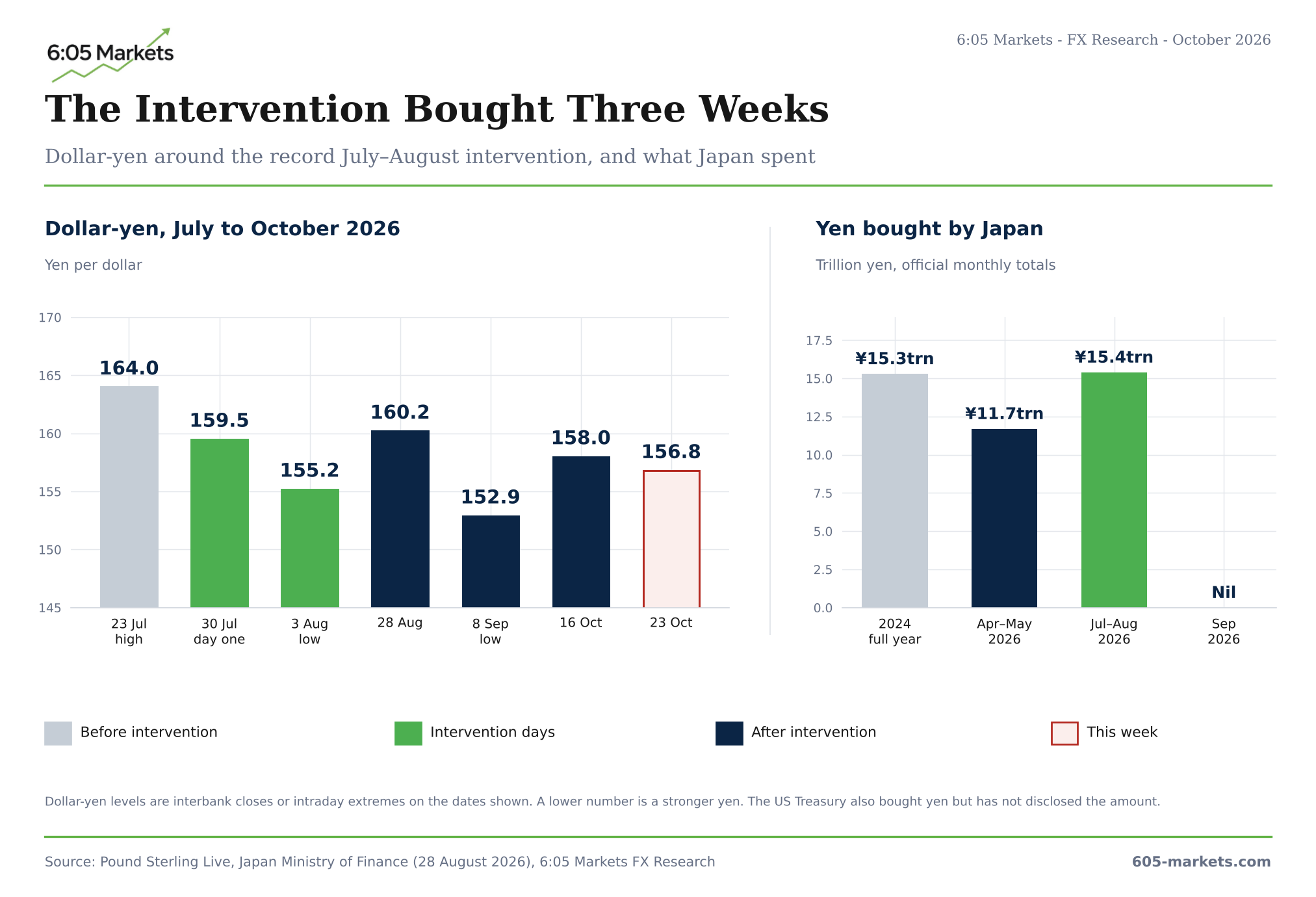
On July 30th the yen was trading at close to 164 per dollar, the weakest it had been in 4 decades. That evening Japan's Ministry of Finance began buying yen, and for the first time since 2011, the United States Treasury bought alongside it. The yen jumped more than three percent in a single session. By August 3rd it had reached 155, its strongest since May.
The gain did not last long, however. By August 10th the yen was back above 159. By the end of August, it had given back everything, trading above 160 again. The Ministry later disclosed that it had spent ¥15.4trn over the month. This was a record for a single month and more than it spent in the whole of 2024. The United States never disclosed its share. A photograph of the Treasury Secretary's notes suggested a figure of five to ten billion dollars.
A record sum, and a joint operation with Washington and a three-week result. The intervention proved what the market already suspected. Buying yen cannot hold back a currency when the interest rate gap is wide and investors are being paid to lean against it. If that gap drove the yen, then the Ministry was fighting the market. This month the Ministry has done nothing, and the yen has rallied anyway.
Lessons from July
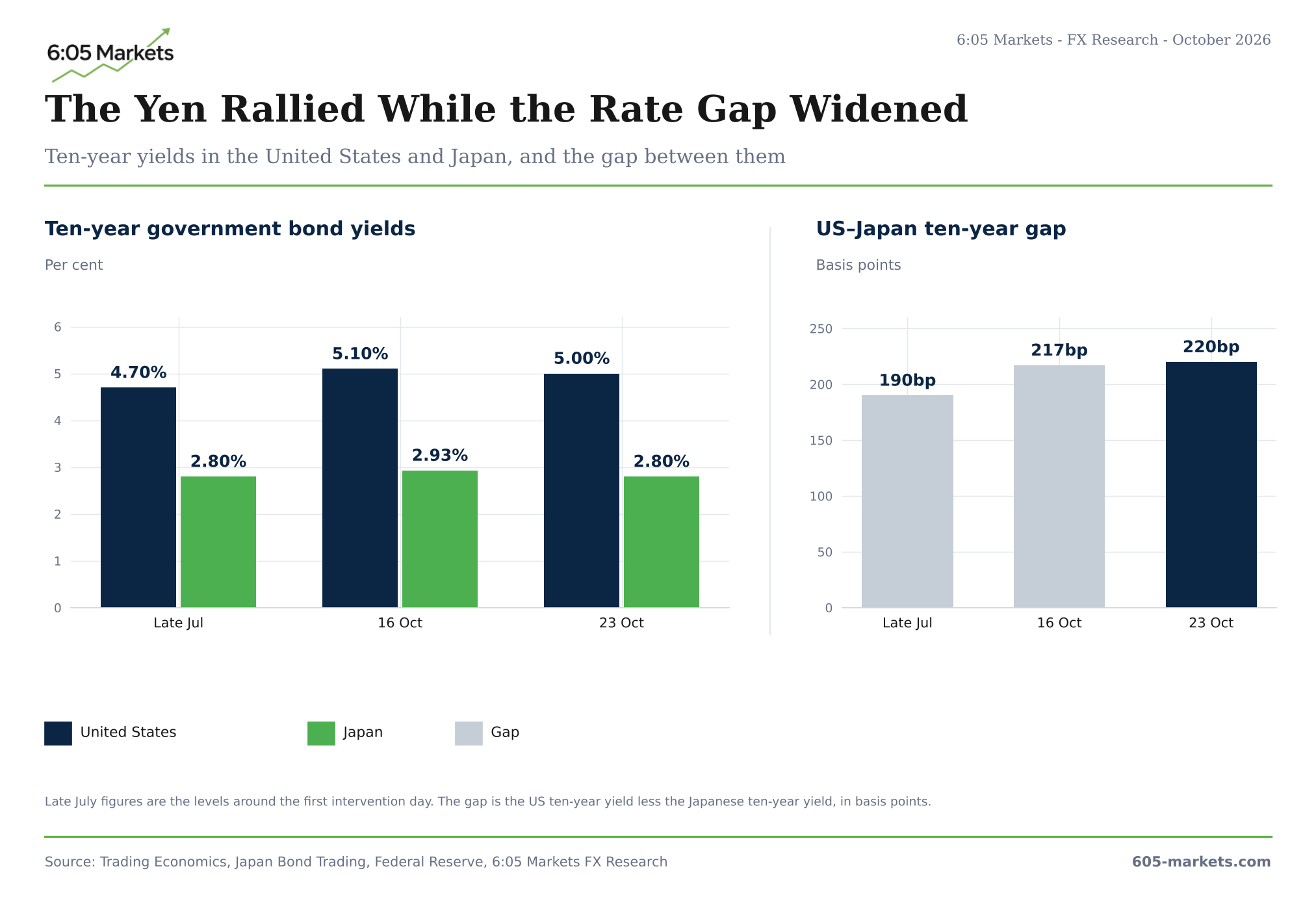
We believe the July episode holds two important lessons. First the rate gap was never the whole story. American ten-year yields are around 5% today against 2.8% in Japan, a gap of roughly 220 basis points. That’s wider than it was on the day of the intervention, when the gap was closer to 190. Based off the summer, the yen should be weaker now than in July. Instead it is more than four per cent stronger.
Second, the market needed a reason to stop shorting the yen, and intervention was not it. The Bank of Japan raised rates in September to 1.25%, the highest in three decades. Its governor has said repeatedly since that underlying inflation is near the target and that rates will keep rising. September inflation data confirmed it. Core prices rose 2.1% on the year the first reading at or above the target since December. The measure that strips out energy as well as fresh food rose faster still.
The Ministry's own figures show the change. Between late August and late September, it bought no yen at all, and the currency still rallied from above 160 to below 153 on expectations of the September hike. The lesson is not that intervention is useless. It is that intervention only works when the fundamentals are already turning. And this autumn, they are.
The scarcity premium has moved to the other side. Speculators who were close to a record short in late July have since cut those positions sharply. Japanese investors have sold foreign bonds for five straight weeks. This is the longest run since 2022 and have been net sellers of more than ¥5trn this year. Each sale brings money home and each one is a yen purchase the Ministry did not have to make.
The Cost of Being Short Yen
Intervene, Hike or Wait for the Market
A stronger yen makes every route Tokyo might take look different. The authorities can intervene again, and the finance minister said on 15 October that they stand ready to do so. They can let the Bank of Japan do the work with a December hike. Or they can wait, because this week the market did the job for them. The three routes should be treated as competing alternatives rather than additive policies. Only one of them costs money, and it is the one that has already been shown not to last.
| Options | What's changed? | What has to be priced in? |
|---|---|---|
| Intervene again | A record ¥15.4trn in July and August bought three weeks | Another drawdown of reserves, a possible second United States contribution, and the same result if the rate gap stays wide. |
| Let the Bank of Japan hike | Core inflation back above 2% and rates already at a 30-year high | A December move to 1.50%, a smaller rate gap over time, and pressure on Japanese government bonds. |
| Wait for the market | Risk aversion is doing in a week what the Ministry could not do in a month | Dependence on an equity selloff that may reverse, and a yen that strengthens for reasons Tokyo does not control. |
Why the Carry Trade Still Matters at the Margin
The size of the rate gap should not be confused with the attractiveness of the trade. Borrowing yen to hold dollars earns the difference between two year rates in the two countries, roughly 2.8% a year at current levels. That income is thin insurance. A move of three percent in the exchange rate which the yen has delivered twice since July wipes out a full year of it. The question for anyone shorting the yen is therefore not whether the carry is positive but whether the exchange rate will sit still long enough to collect it.
| Dollar-yen at year-end | Spot move from 156.8 | One year of carry at 2.8% | Net return for a dollar-long carry position |
|---|---|---|---|
| 160 | +2.0% | +2.8% | +4.8% |
| 155 | −1.1% | +2.8% | +1.7% |
| 150 – Base case | −4.3% | +2.8% | −1.5% |
| 145 – Severe case | −7.5% | +2.8% | −4.7% |
A carry position can survive a stronger yen if the move is slow, but it cannot survive a fast one. Waiting for a better exit is not free either. Every week of volatility raises the cost of hedging. A position that was comfortable at 160 becomes a forced seller at 150. For an investor funded in yen the September rally and this week's move were both reminders that the exit can arrive in a single session.
Lower Yields and a Weaker Dollar
The cost of the shift has been visible for a week especially in the dollar. The yen rose nearly a full per cent on 22 October alone. This was its largest daily gain in a month. The Swiss franc gained less than half as much. The euro fell. Against the yen the euro dropped to its lowest level of the year down about one percent on the week. The French bond rout added a second reason to sell it. For a European investor holding Japanese shares unhedged the currency gain this week roughly offset the fall.
The move is even more visible in bonds. American ten-year yields fell by 17 basis points on 22 October, the largest single-day drop in more than a year. As money left technology stocks for Treasuries. Japanese ten year yields fell more than ten basis points the following day to their lowest level since early August. Both markets are now pricing less and tightening more than they were a couple weeks ago. The Federal Reserve is still expected to hold next week and raise rates in December, but that December move is no longer fully priced.
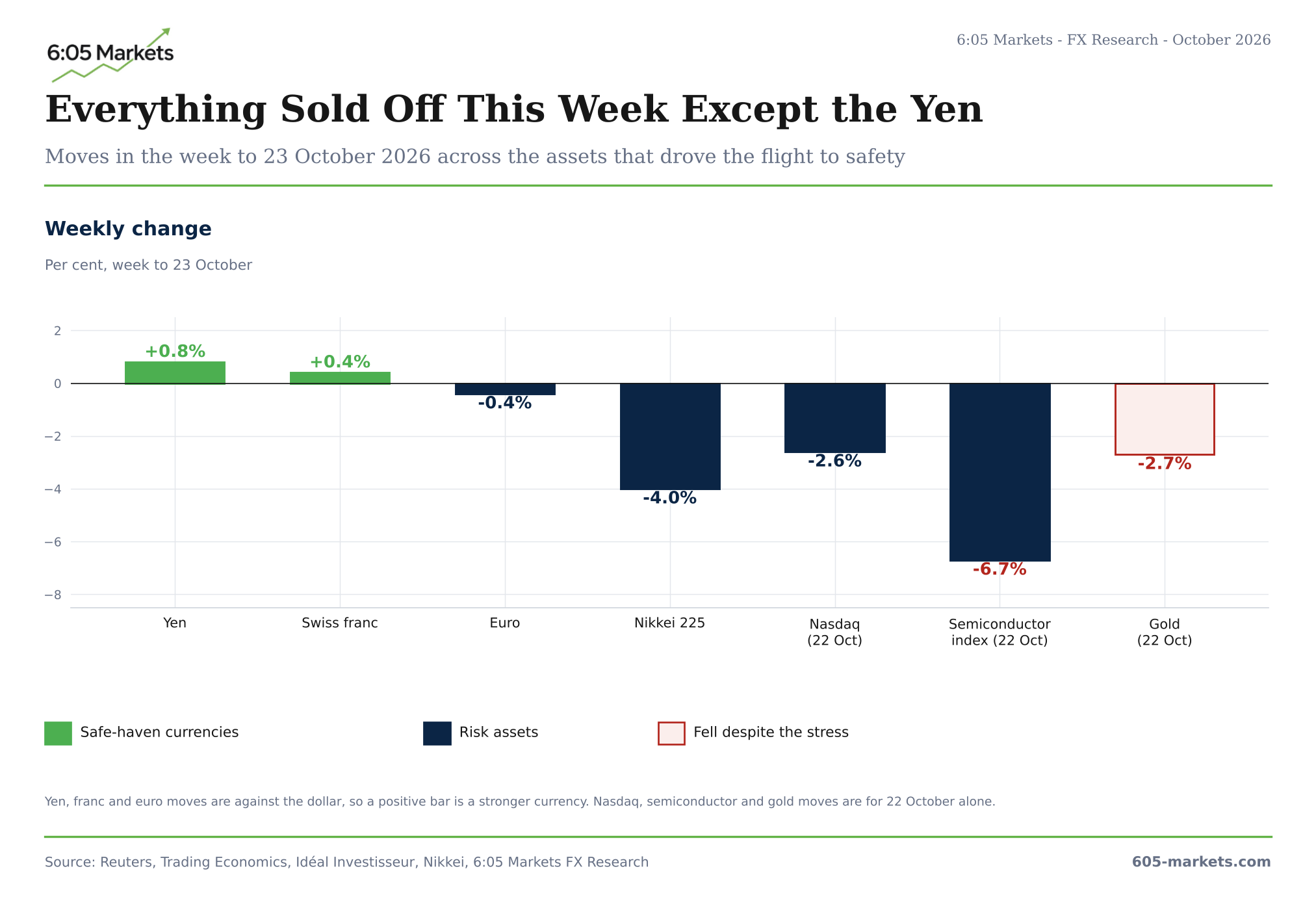
The main issue is the source of why people are running to safety. The reasons differ across markets. In equities, the trigger was a set of results from Meta on 22 October that showed the first cash outflow in a decade as spending on artificial intelligence outran revenue. The Nasdaq fell 2.6% and the semiconductor index nearly 7%. Tokyo followed, with losing 2.65% in a day and three chip-related names accounting for most of the drop. In bonds, French ten-year yields crossed 5% and the spread over Germany reached its widest since 2011. Energy attacks on Saudi infrastructure pushed Brent above $113. Gold, which should have risen on all three fell instead. The yen was the only asset that behaved like a haven across every channel.
Applying this to the exchange rates the consequence is that the yen's correlation has flipped. For most of the year it weakened when American stocks fell, because falling stocks meant Japanese investors needed more dollars to keep buying them. This week it strengthened when stocks fell. That is the pattern of 2008 and 2020, not 2024 and 2025. This is a sensitivity look not a forecast of the equity market. If the technology selloff reverses, the yen will give some of this back. But the direction of the response has changed that is the more reasonable fact.
Methodology Note on Flows and Positioning
A separate yet relevant point is where the yen selling has been coming from. Japanese households have bought foreign shares through tax-free investment accounts at a record pace. Close to ¥4trn in the three months to September. Retail traders held a short yen position worth more than ¥3trn as recently as September. Neither flow stops because the Bank of Japan raises rates by a quarter point. Our scenario assume that domestic outflows continue to cap the yen's gains. That a move below 150 requires foreign investors to reduce their short positions faster than Japanese savers add to theirs.
USD/JPY will average between 150 and 155 from 26 October to 31 December 2026.
Series USD/JPY Entry 156.80 Range between 150.00 and 155.00 Across 26 Oct - 31 Dec 2026 Written 23 Oct 2026
Resolves against Yahoo Finance ticker JPY=X on the average of its readings from 26 Oct - 31 Dec 2026. Not investment advice.
Our Position, Pricing and Risks
Our View Versus Market Pricing
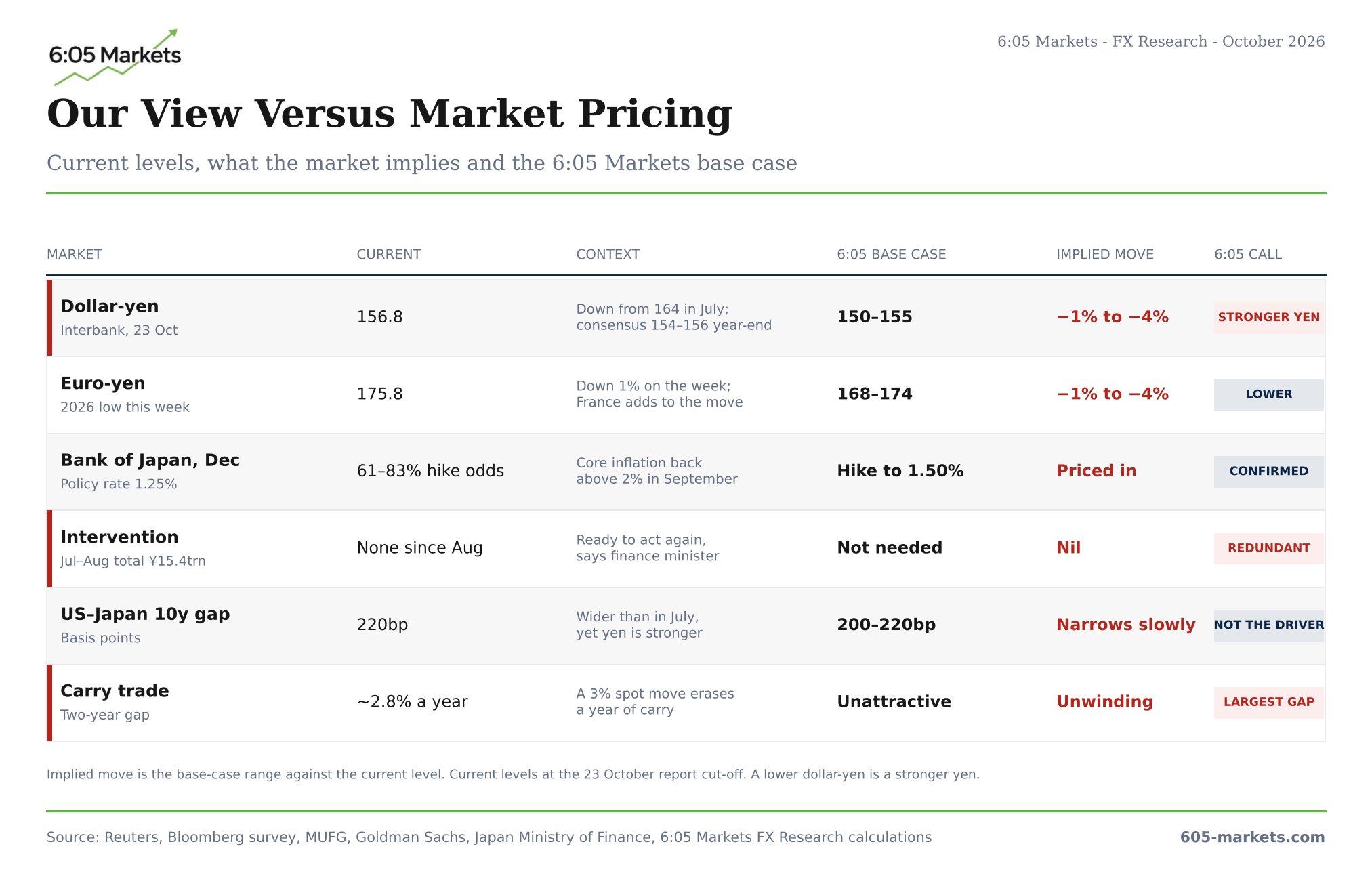
Our central view is that the largest mispricing is not in the level of dollar-yen but in what the market thinks is driving it. Forecasters have already moved. MUFG sees 155 by year-end and 153 by the spring. Goldman Sachs cut its twelve-month view to 150 in September and now describes a long yen position as a hedge against recession. The people think that it sits at 154 to 156 for December. The market, in other words, expects the yen to drift stronger because the Bank of Japan is hiking.
The yen was at 157 at the report cut-off, versus 164 at the July low. Our working assumption is that the Bank of Japan raises rates in December as expected, and that the move adds little on its own because it is already priced. What is not priced is that the yen now rises when risk falls. If the technology selloff has further to run, or if France deteriorates into a wider European problem, the yen will outperform every forecast on the street, and it will do so with no help from Tokyo.
The current analysis shows that the drivers of yen weakness have already reversed. Our disagreement with current pricing is not that the market has failed to turn bullish. It is that the market has turned bullish for the wrong reason, and so will be surprised by the speed of the move if the reason we identify takes over. We expect the yen to carry a safe-haven premium through the fourth quarter keeping dollar-yen below the consensus and euro-yen below 175. The effect should be strongest against the euro, where France adds a second source of weakness, and weakest against the franc.
The Marginal Seller Sets the Yen
This matters because the marginal flow sets the price. A quarter-point hike does not mechanically move the yen by any set amount. But if foreign speculators are closing short positions at the same time as Japanese banks are selling foreign bonds. If every bad day in technology stocks produces a new wave of both, the next seller of dollars for yen may be a forced one. We therefore view the Bank of Japan as confirming a move that risk aversion has already started, rather than creating it.
Dollar-Yen and Euro-Yen Carry the Clearest Downside
At the report cut-off, dollar-yen was 156.8. Our base case places it at 150–155 through the end of the year if the December hike arrives and risk markets stay fragile. A sustained move below 150 is plausible, but it is not our forecast from Japan alone. It requires the equity selloff to become a growth scare that pulls American yields down faster than Japanese ones.
Our strongest conviction is in euro-yen. The pair made a new low for the year this week and has two reasons to fall further. The yen has the haven bid described above, and the euro has the French budget described in our note of 9 October. We see 168–174 as a reasonable range through December. At 170, the pair would be roughly three per cent below today and about nine per cent below its April high.
Scenarios and Expected Outcomes
Recovery
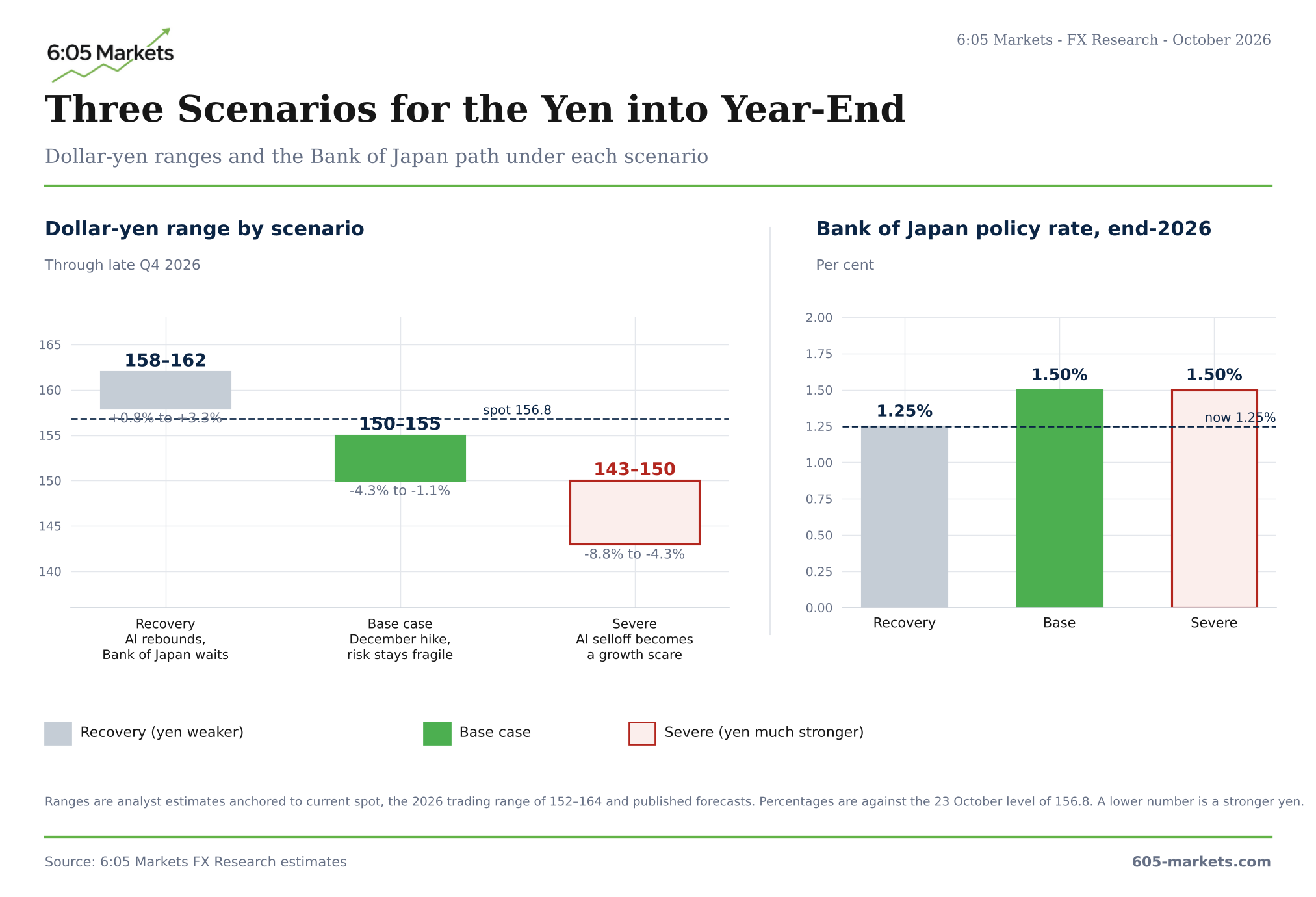
The case for a weaker yen requires technology stocks to recover, French politics to calm and the Bank of Japan to delay its hike into next year. Under those conditions, the carry trade reopens and Japanese savers keep sending money abroad unopposed. Dollar-yen could move back towards 158–162, roughly where it spent most of October. This would not require the inflation data to reverse. It would only require the market to decide that a quarter-point hike is already in the price and that there is nothing to be afraid of.
Base Case
Our base case is that the Bank of Japan holds next week, signals that inflation has reached its target and raises rates in December. Risk markets stay fragile without breaking. Speculators keep covering yen shorts, Japanese investors keep selling foreign bonds, and the Ministry of Finance stays out of the market.
Under this scenario, we expect dollar-yen at 150–155 and euro-yen at 168–174. That implies a stronger yen of between one and four per cent against the dollar from today. The move would come from the change in the yen's role rather than from the rate decision itself.
Severe Constraint
The case for a much stronger yen is the technology selloff becoming a growth scare. American yields would fall sharply, the Federal Reserve would drop its December hike, and the dollar would lose its own claim to haven status. Dollar-yen would move towards 143–150, back inside the range of early this year. The Bank of Japan would still hike in December, but might then pause. Under this scenario, we expect dollar-yen at 143–150 and euro-yen at 160–168, or a stronger yen of four to nine per cent from today.
For the franc, the effect should be smaller and less direct. We estimate the yen gains one to two per cent against the Swiss currency in a severe scenario, mainly because the franc is already expensive and the Swiss National Bank is quicker to lean against it.
What Would Change Our View?
Bullish yen case weakens materially if
- The Nasdaq recovers its 22 October loss within two weeks and the semiconductor index makes a new high.
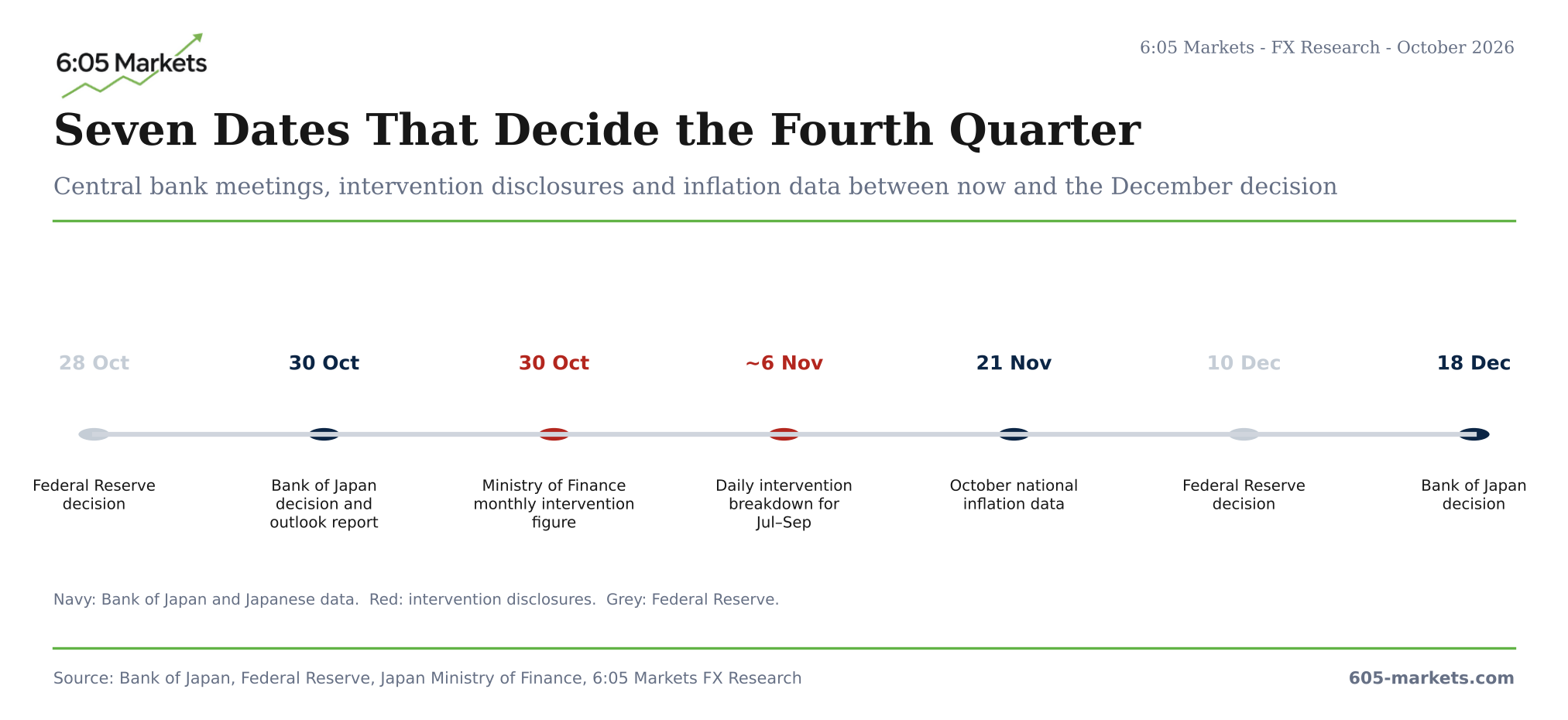
- The Bank of Japan signals on 30 October that it will wait until next year, or December hike odds fall below half.
- October national inflation, due 21 November, falls back below 2%.
- Dollar-yen closes above 160 on a weekly basis.
- Japanese investors return to buying foreign bonds in the weekly data.
- The Ministry of Finance intervenes to weaken the yen, which would mean the move has gone further and faster than anyone in Tokyo wants.
Our thesis position strengthens if
- The yen rises on a day when American stocks fall, for a third week running.
- Euro-yen closes below 172, taking out this week's low.
- The Bank of Japan raises its inflation forecasts on 30 October and the governor says underlying inflation has reached 2%.
- Speculative positioning in the futures market moves to a net long yen for the first time since the summer.
- The Federal Reserve's December hike drops out of market pricing.
- Dollar-yen trades below 152 while the rate gap is still above 200 basis points. That would provide much cleaner evidence that risk aversion, rather than interest rates, is driving the currency.
What Could Break the Base Case?
The largest risk is the equity market. The yen does not need a crash to strengthen, but it does need risk aversion to persist. One strong week for technology stocks would reopen the carry trade and send the yen back towards 160.
The second primary risk is domestic. Japanese households are buying foreign shares at a record pace through tax-free accounts, and the government has promised to cut the tax on food from eight per cent to one per cent without issuing new bonds to pay for it. If the market decides that promise is not credible, Japanese government bonds sell off, and a bond selloff in Japan has historically weakened the yen rather than strengthened it.
Third, the Bank of Japan can solve part of the problem by moving too fast. A hike in October rather than December, or a signal of a half-point move, would push the yen through our base range in days. It would also raise the chance of a pause afterwards, which would cap the move.
Finally, the dollar itself can dominate the yen effect. If the Federal Reserve hikes in December after all and American yields rise again, the rate gap widens and the yen weakens regardless of risk sentiment. Conversely, a sharp fall in the dollar for reasons unrelated to Japan would push dollar-yen through 150 while making it impossible to attribute the move to the yen.
Our position is therefore specific. The yen has stopped being a funding currency and started being a haven again. We expect the strongest effect to appear first against the euro and in the yen's response to bad days in equities. A move below 150 against the dollar requires a growth scare as well.