The U.S. Airline Industry and the Credit Card Competition Act of 2026
With renewed support from President Trump, the U.S. could soon see major changes to the credit card industry. Changes that could cost airlines $31B.
Relevance
Last week, President Trump renewed his support for the Credit Card Competition Act of 2026 (CCCA), a bipartisan bill to increase competition among credit card processing networks. [1] The bill would require card issuers with more than $100 billion in assets to enable at least two unaffiliated networks to process transactions, one of which must be a network other than Visa or Mastercard. [2] Its sponsors aim to create competition over transaction routing that lowers the fees merchants pay; savings they argue would be passed on to consumers through lower prices on everyday goods. An analysis of the 2023 version of the bill commissioned by JPMorgan Chase concluded that interchange fees could decline by 50%. [3]
While researchers have focused on the bill's macro-economic effects, little has been noted on how it could affect the airline industry, even as airlines become more reliant than ever on revenue from credit card partnerships. [4] This report outlines the Credit Card Competition Act of 2026 and models how reduced loyalty revenue could affect U.S. airlines' operating margins and valuations.
History
The CCCA responds to ever rising card processing fees, commonly known as merchant fees. These fees, typically 2–3% of the transaction price, are paid by service providers, who often pass them on to consumers through higher prices. U.S. merchants paid $198 billion in processing fees in 2025, up roughly 220% from $62 billion in 2009. [5] Much of this growth has been fueled by the wide adoption of premium rewards cards, which carry higher fees that fund rewards in the form of airline miles and loyalty program status.
Airlines use these partnerships to attract customers and generate additional revenue. Every major U.S. airline offers a co-branded credit card, and these partnerships can account for up to 12% of a carrier’s revenue. [6] Delta leadership cites that an estimated 1% of the U.S. GDP is processed on Delta-Amex rewards card, resulting in American Express remunerating $8.2B to Delta in 2025. [11]
Airlines earn revenue from co-brand partnerships in two ways: by selling miles to card issuers, who credit them to cardholders, and by licensing the airline's brand. Both revenue streams could fall significantly if the CCCA reduces interchange fees, because card issuers would earn less on each transaction and could no longer afford to pay airlines equal fees for miles or brand rights.
Looking at past precedent for this kind of reduction, in 2011, after Durbin Amendment capped debit card interchange fees for large banks, the average fee fell from 43 cents per transaction in 2009 to 24 cents for covered issuers by the end of 2011, a decline of roughly 45%. [8]
Changes to the credit card industry are therefore likely to have a significant impact on partner airlines. This report estimates potential reductions in merchant fees, models how much of that reduction passes through to airline revenue and calculates the expected impact on operating income and company valuations.
Data & Model
To estimate the CCCA's impact, this report models how a reduction in merchant fees would flow through to the operating income and valuations of seven major U.S. carriers: Delta, United, American, Southwest, Alaska, JetBlue and Allegiant. These are the largest U.S. carriers that disclose loyalty revenue; Frontier does not, and Spirit is excluded due to its bankruptcy. All data is from respective 2025 Form 10-K. [6]
Under U.S. GAAP (ASC 606), airlines recognize revenue from credit card partnerships in two parts: loyalty travel and marketing. Loyalty travel revenue is deferred when miles are sold and recognized only when members redeem their miles for flights. Marketing revenue covers the use of the airline's brand, advertising and access to its members, and is recognized immediately. Because loyalty travel revenue combines miles purchased by banks with miles issued directly by the airline for members of its traditional loyalty program, I separate the card-related portion using the following formulas:
- Card share of miles = (cash from card partners − marketing revenue) ÷ total miles awarded
- Card-related travel revenue = card share of miles × loyalty travel revenue
Below is each airline's operating revenue, its card-related loyalty revenue and its card partnership details ($ millions).
| Airline | Operating Revenue | Card-Related Travel Revenue | Marketing Revenue | Card-Related % of Revenue | Card Issuer | Network Provider |
|---|---|---|---|---|---|---|
| Delta | $63,364 | $4,017 | $3,362 | 11.6% | American Express | American Express |
| United | $59,070 | $2,065 | $3,200 | 8.9% | Chase | Visa |
| American Airlines | $54,633 | $2,442 | $3,511 | 10.9% | Citi | Mastercard |
| Southwest | $28,063 | $1,972 | n/d | 7.0% | Chase | Visa |
| Alaska | $14,239 | $863 | $855 | 12.1% | Bank of America | Visa |
| JetBlue | $9,062 | $405 | $521 | 10.2% | Barclays | Mastercard |
| Allegiant | $2,607 | n/d | $79 | 3.0% | Bank of America | Visa |
Note: n/d = not disclosed. Where cash from card partners is not disclosed (United, Southwest, Alaska and JetBlue), estimated card share of 60% is used. Southwest does not disclose marketing revenue, and Allegiant does not disclose travel redemption.
Since card issuers earn revenue from sources beyond merchant fees, namely annual fees and balance interest, a cut to merchant fees would be unlikely to pass directly to airlines. Therefore, using past precedent I estimate the ability for banks to absorb the loss versus passing through directly to airline.
In 2003, Australia implemented similar credit card reform which saw reward revenue at the four largest banks fall from 0.81% to 0.54% despite annual fees rising. This implies that roughly 60% of the fee reduction resulted in lost reward revenue. [9] In America, after the 2011 Durbin Amendment, debit card rewards programs largely disappeared. [10] Because co-brand contracts are competitively bid for it is likely issuers have thin margins. Therefore, I use 50%, 75% and 100% pass-through for its low, mid and high scenarios. The effective cut to loyalty revenue is modeled as:
Effective cut to airline card revenue = merchant fee rate × merchant fee cut × pass-through ÷ airline revenue per dollar of card spend
Using Delta's partnership with American Express it is possible to estimate how much an airline earns per dollar of card spend: American Express paid Delta $8.2 billion on roughly $238 billion of card spend, or 3.44¢ per dollar. [7] Applying this ratio to all carriers, with a standardized merchant fee of 3%, produces the following outcomes.
| Scenario | Merchant Fee Cut | Pass-through to Airlines | Effective Cut to Loyalty Revenue |
|---|---|---|---|
| Base | 0.0% | 0.0% | 0.0% |
| Low | 10% | 50% | 4.4% |
| Mid | 25% | 75% | 16.4% |
| High | 50% | 100% | 43.6% |
Using the mid scenario, the 16.4% cut is applied to each airline's card-related loyalty revenue. Since these partnerships have almost no additional costs for the airline, I consider the lost revenue as lost operating income. Implied value is calculated by an 8x EV/EBIT multiple, a mid-range value for U.S. airlines.
| Airline | Lost Operating Income | Lost % Operating Income | Pro Forma Operating Margin | Change (pts) | Implied Value Lost | Value Lost per Share |
|---|---|---|---|---|---|---|
| Delta | $1,210 | 21% | 7.4% | -1.77 | $9,681 | $14.82 |
| United | $863 | 18% | 6.6% | -1.37 | $6,908 | $21.36 |
| American Airlines | $976 | 67% | 0.9% | -1.77 | $7,810 | $11.83 |
| Southwest | $323 | 76% | 0.4% | -1.15 | $2,587 | $5.27 |
| Alaska | $282 | 93% | 0.2% | -1.98 | $2,254 | $19.66 |
| JetBlue | $152 | n.m. | -5.8% | -1.77 | $1,215 | $3.29 |
| Allegiant | $13 | 35% | 0.9% | -0.49 | $104 | $5.61 |
*Figures are in $ million except per share values.
Findings
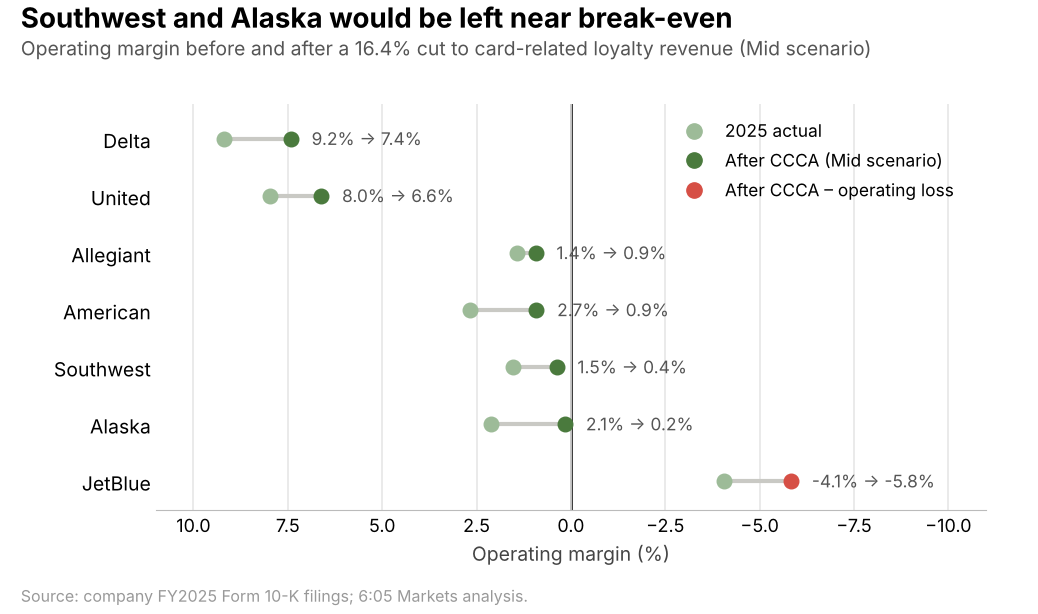
The CCCA is expected to impact airlines differently. Carriers with loyalty programs that make a large component of operating income are, naturally, most exposed. Delta and United each lose about $0.9–1.2 billion in operating income but have strong enough operating margin from other business functions to survive the shift. American on the other hand could see a 67% drop in operating income leaving a 0.9% operating margin.
Most notable, Southwest and Alaska would be left near break-even. Each would lose most of its 2025 operating income (76% and 93%). JetBlue, already unprofitable, would see its operating margin worsening from −4.1% to −5.8%. Allegiant, despite sharing limited data, would still see a 35% reduction in operating income.
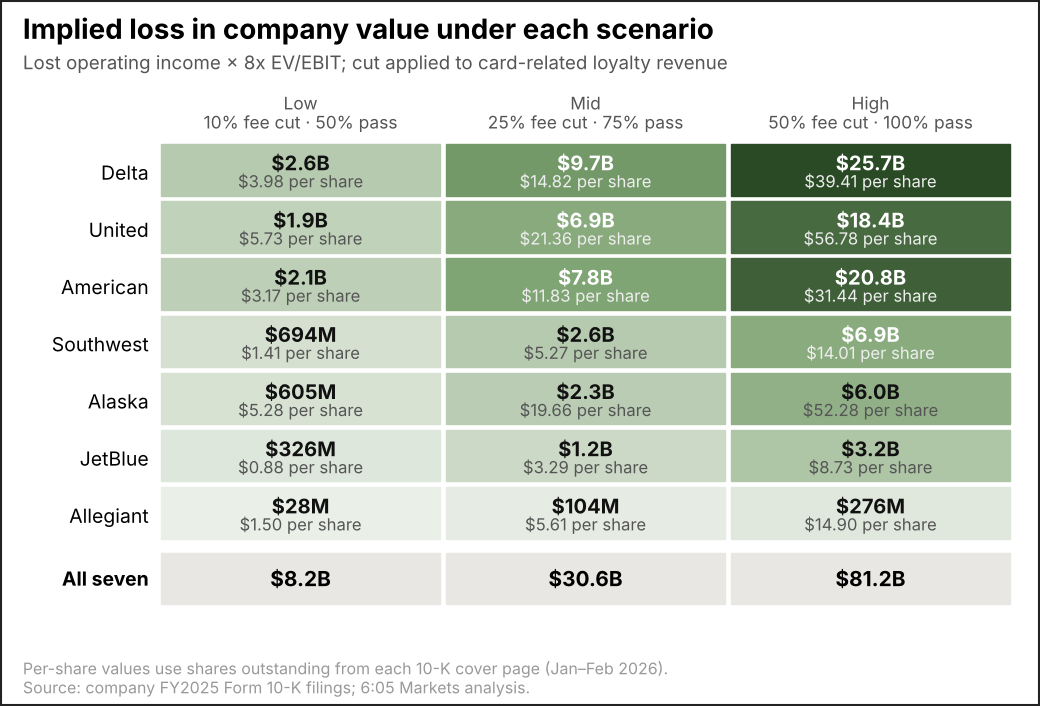
The value lost follows the same pattern. At an 8x multiple, Delta would lose close to $10 billion in value, American about $7.8 billion and United about $6.9 billion. Per share, United ($21.36) and Alaska ($19.66) are hit hardest. Across all seven carriers, the mid scenario removes about $3.8 billion in annual operating income and roughly $31 billion in value.
The bill could also shift competition toward Delta. If Visa and Mastercard co-brand cards become less rewarding while Amex cards are less affected, high-spending cardholders may move to Delta's American Express card. That would partly offset Delta's losses and widen the gap between Delta and its rivals.
Limitations
This model has significant limitations relating to its ability to capture second-order effects.
First, American Express being both a card issuer and network provider, is not covered by the CCCA. American Express would not have to add an additional network and therefore could retain similar merchant fees. It is possible in a post-CCCA landscape, service providers choose not to accept American Express cards at a high rate, resulting in reduced card utilization, however that effect is not modeled.
Second, this model treats lost revenue as lost operating income. It is challenging to model loyalty related costs so it is possible the effect on operating income is an overestimate.
Third, co-branded partnerships are contracts negotiated non-annually. This means losses from the CCCA would reach airlines at different times. It is also challenging to predict how performance obligations could be violated within these contracts and its resulting impact on airlines.
Fourth, data for airline revenue per dollar spent is based of a rough estimate from Delta’s partnership with American Express. Since each airline’s co-branded partnership is unique, this is a significant source of error.
Finally, this model does not consider a change in cardholder spending, which could further reduce loyalty revenue as card issuers purchase fewer miles. This would result in the model underestimating the CCCA’s impact.
Conclusion
The Credit Card Competition Act of 2026 targets banks and card networks, but it could significantly change the underlying economics of the U.S. airline industry. Under the mid scenario, a 25% cut in merchant fees with 75% passed through to airlines would result in a $31B loss across the airline industry.
Delta and United, the most profitable carriers, would stay solidly profitable, with operating margins falling by less than two percentage points. While carriers with thinner margins, American, Southwest, Alaska, JetBlue would see near zero to negative to operating margins.
Data Sources
- [1] The Wall Street Journal, “The Credit-Card Bill That Banks Fear Most Has Gained Trump as an Ally”.
- [2] U.S. Congress, S. 3623, Credit Card Competition Act of 2026 (bill text).
- [3] NERA Economic Consulting (commissioned by JPMorgan Chase), “Analysis of the Potential Impact of the Credit Card Competition Act”.
- [4] Airlines for America, “Protect Our Points”.
- [5] The Nilson Report, “Merchant Processing Fees in the United States 2025”.
- [6] FY2025 Form 10-K filings, SEC EDGAR: Delta, United, American, Southwest, Alaska, JetBlue, Allegiant.
- [7] Delta Air Lines, “Delta Air Lines Announces December Quarter and Full Year 2025 Financial Results,” January 2026.
- [8] Board of Governors of the Federal Reserve System, debit card interchange fee data release, May 1, 2012.
- [9] Reserve Bank of Australia, “The Personal Credit Card Market in Australia: Pricing over the Past Decade,” Bulletin, March 2012.
- [10] Kay, Manuszak and Vojtech, “Bank Profitability and Debit Card Interchange Regulation: Bank Responses to the Durbin Amendment,” Federal Reserve FEDS working paper, 2014.
- [11] Fortune, via Yahoo Finance, “How Delta CEO Ed Bastian built a massive partnership with American Express that now generates over 10% of the airline's revenue,” April 3, 2026.