The Surge of Foreign Investor Influx in Brazilian Bond Market
Last Sunday, October 4th, Brazil’s first round of the presidential election caused the largest repricing of Brazilian assets in years.
Executive Summary
Last Sunday, October 4th, Brazil’s first round of the presidential election caused the largest repricing of Brazilian assets in years. A narrow first round election, resulting in Flávio Bolsonaro’s marginal first-place finish over President Lula, 47.0% to 45.2%, a massive surprise given many pre-election surveys that had consistently placed Lula ahead, sent the Brazilian real (BRL) up about 4% in a day, and pulled the Brazilian interest rate curve (DI) January 2031 future down 174 basis points (bp) (1.74 percentage points), from 13.99% to 12.25%, in the following 5 days. From abroad, foreign investors read the result as a possible shift towards tighter fiscal policy, and for the current market it may be interesting, but that bet rests on a program that has no numerical targets or structured plans, so much of the rally depends on promises rather than policy.
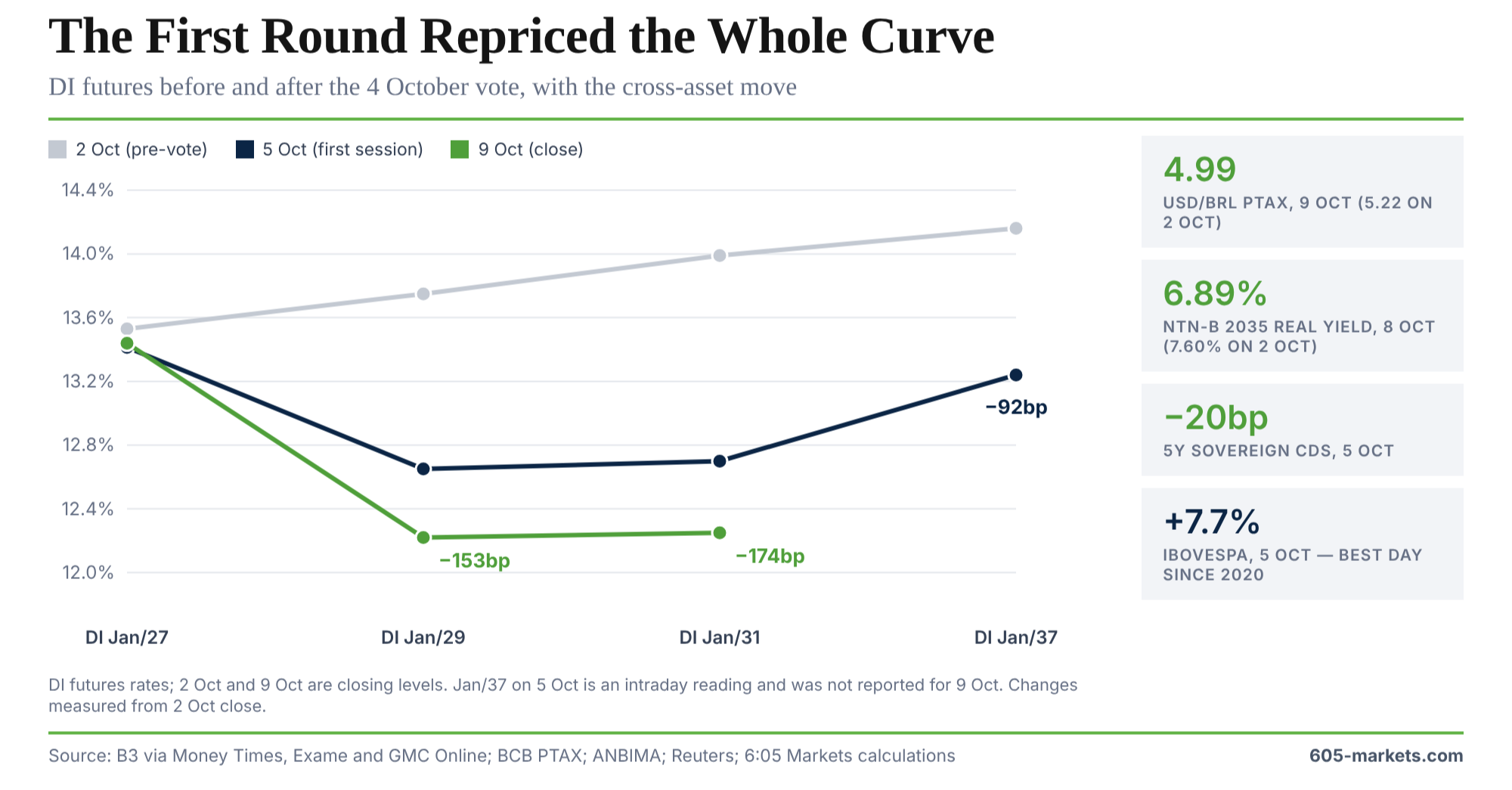
Part of what makes Brazilian bonds interesting today is the prospect of structural change and lower risk premiums in the future, but that is not the part that will last. We believe the durable attraction does not depend on who wins on 25 October, but on a 13.75% policy rate that pays about 8.45% in real terms. What matters is how attractive the opportunity turns out to be depending on the outcome. Our thesis is that interest in Brazil will persist, but not at its current intensity, as today’s post-election excitement in the Brazilian market is unsustainable. Markets are pricing a fiscal turnaround in a country where governments of both camps have bent the fiscal rules in recent years.
Using Polymarket's odds as of October 9th (88.1% Flávio, 11.9% Lula), our expected outcome is DI Jan/31 near 12.5% at year-end, slightly above today's 12.25%, where we expect foreign ownership of domestic debt edging up to about 10.25% if these results were too happen above the last produced number of 9.91%. In other words, we expect the election premium to fade a little while the carry keeps drawing money in, whoever wins.
KEY NUMBERS
-174bp | 8.45% | 88.1% / 11.9% | 9.91% |
DI JAN/31 POST-ELECTION | REAL INTEREST RATE | POLYMARKET: FLÁVIO / LULA | FOREIGN SHARE OF DEBT AS OF AUGUST 2026 |
Beyond the Headline Result
A Deeper Look into the Election
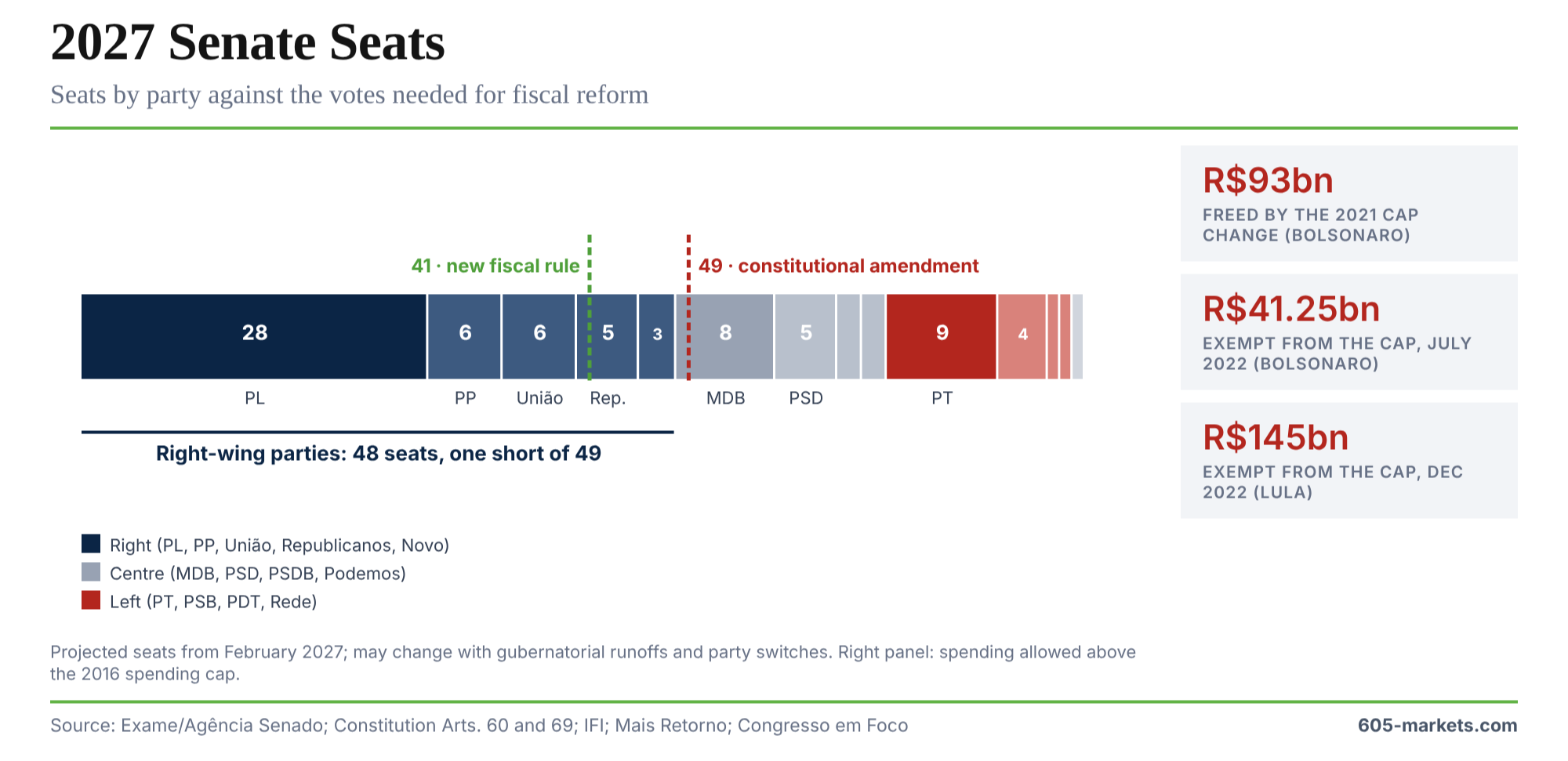
Apart from Senator Flávio Bolsonaro’s surprise first-place finish, the congressional result was a significant victory for his party, Partido Liberal (PL). The PL almost doubled in the Senate, going from what is currently 15 seats in 2026 to 28 starting 2027 (19 new and 9 retained) out of the 81 fixed seats, representing nearly 35% of the house and establishing itself as the major party bloc. At the same time, within the senate center parties' lost seats, such as the centrist PSD, which fell from 15 to 5, while President Lula’s left-leaning party, Partido dos Trabalhadores (PT), held steady at 9 seats, highlighting the continued shift to the right among the Brazilian population.
Being the biggest party bloc within the senate and with a favorable atmosphere ahead of the second and decisive election round, the PL’s gains are a shift that are being read as fiscally positive, though the previous Bolsonaro government’s record suggests caution. In 2021, the PEC dos Precatórios changed the spending-cap formula allowing about R$93bn of room in the 2022 budget above the cap that had been previously agreed on. Rather than reduce spending and focus on new fiscal incentives, former President Jair Bolsonaro’s government used that room to fund the Auxílio Brasil social program at R$400 a month. Following that, in July 2022, three months before that year’s election, Congress then approved a further R$41.25bn in benefits outside the cap, raising the program to R$600. This move was seen by many as an attempt to gain votes since it was an election year, showing his preference to continue his place in power rather than fulfilling the promised cuts. Lula isn’t innocent of this either. When elected in 2022, his team secured R$145bn in spending above the original cap, continuing to increase the national debt, while weak fiscal credibility also led to higher interest rates alongside inflation and high global rates.
What decides these caps and limits what a newly entered government can do is both the house of Congress and the Senate. But now that the PL and its right-wing allies hold 48 of 81 seats, it is more than most of the seats available. That is enough to pass a new fiscal rule, which needs 41 votes, but one short of the 49 needed to change the Constitution.
Foreign Investor Interest and the Risks
The Carry Is the Structural Attraction
The Selic rate at 13.75% towers above an effective Fed funds rate of 3.88%, even after a fifth consecutive 25bp cut on September 16th. Considering Brazil’s 4.58% inflation rate, the policy rate pays a real return of about 8.45%, among the highest of any major economy. NTN-Bs (local treasury notes) offer a premium close to 7% above inflation.
Foreign Capital Flooded to Equity Markets Over Fixed Income
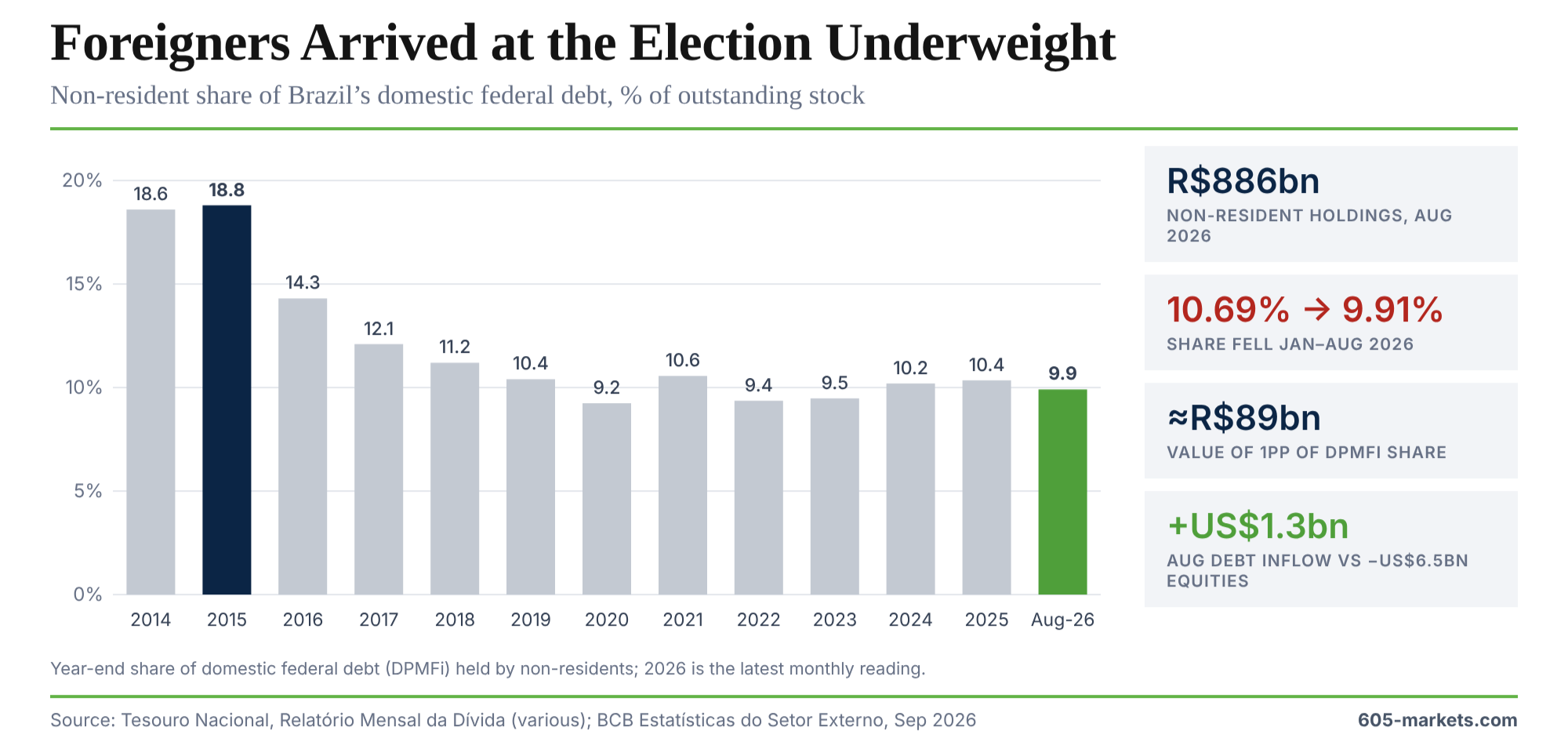
Despite that carry, foreigners entered the election holding little Brazilian duration. Non-residents held R$886bn, or 9.91%, of domestic federal debt in August, down from 10.69% in January and about half the 18.8% they held at the end of 2015. The fastest money went into equities, with net foreign purchases of R$10.06bn on 5 October and R$12.61bn over the first four days of October, more than in all of September. Bond buying by real-money funds tends to follow more slowly.
The Market’s Bet on Spending Cuts
The election added a second, more speculative layer on top of the carry: a bet on fiscal consolidation. Gross general-government debt reached 82.9% of the country’s GDP (R$11.1tn) in August, and nominal interest alone added 6.5 percentage points of GDP to it in the first eight months of 2026. Investors such as J.P. Morgan and Ashmore argue that a government led by the right-wing candidate with a friendly Senate could restrain public spending, letting rates and debt fall together.
A Program Without Numbers
While Flávio proposes cutting at least ten ministries, reducing VAT rates (value-added tax), and investing R$900bn in infrastructure over four years, he hasn’t yet presented primary-surplus targets. September IPCA rose 0.82% against a 0.60% consensus, taking 12-month inflation to 4.58%, above the 4.5% ceiling, which keeps the Copom cutting only 25bp at a time. The Fed raised rates to 3.75–4.00% in September, and the 10-year Treasury yields 5.22%, which makes emerging-market bonds less attractive. And no fiscal law can pass before the new Congress sits on 1 February 2027, so until then investors will get announcements, not legislation.
The constraint runs deeper than the candidates' ideologies. Barclays estimates that stabilizing Brazil’s debt by 2031 would require a fiscal effort of at least 2.5% of GDP, roughly R$350bn, while 92% of primary spending is mandatory. TS Lombard projects that debt keeps rising under either candidate, peaking at 90% of GDP in 2032 under Flávio and 94.7% in 2034 under Lula.
Our Prediction
We see two cases for the 25 October runoff. We take the probability of each directly from Polymarket, which on 9 October priced a Flávio win at 88.1% and a Lula win at 11.9%.
If Flávio wins. Markets get the result they bet on, so there is little left to rally on the day. After that, the election premium should partly fade: the fiscal plan still has no numbers, inflation is above the ceiling and nothing can be legislated before February. Foreigners keep adding to Brazil gradually, mainly for the carry. We expect DI Jan/31 at 12.00–12.60% by year-end, NTN-B 2035 at 6.70–7.10%, USD/BRL at 4.90–5.15 and the foreign share of domestic debt at 10.0–10.6%.
If Lula wins. The election premium comes out quickly and long-dated rates sell off, roughly back to where they were before the first round. But the carry is still there, so foreign holdings dip rather than collapse; they rose during Lula’s current term. We expect DI Jan/31 at 13.50–14.25%, NTN-B 2035 at 7.30–7.70%, USD/BRL at 5.30–5.60 and the foreign share at 9.7–10.1%.
What we expect
Weighting the two cases by their odds, our expected outcome is DI Jan/31 around 12.5%, NTN-B 2035 around 7.0%, USD/BRL around 5.08 and a foreign share of about 10.25% at year-end. Under both cases foreign ownership stays close to or above today’s level, which is the core of our thesis: the carry holds investors whoever wins, while the election premium is the part that moves. That is also why we prefer inflation-linked NTN-Bs, whose yields moved far less than nominal rates, to long nominal duration, which is mostly a bet on one candidate.
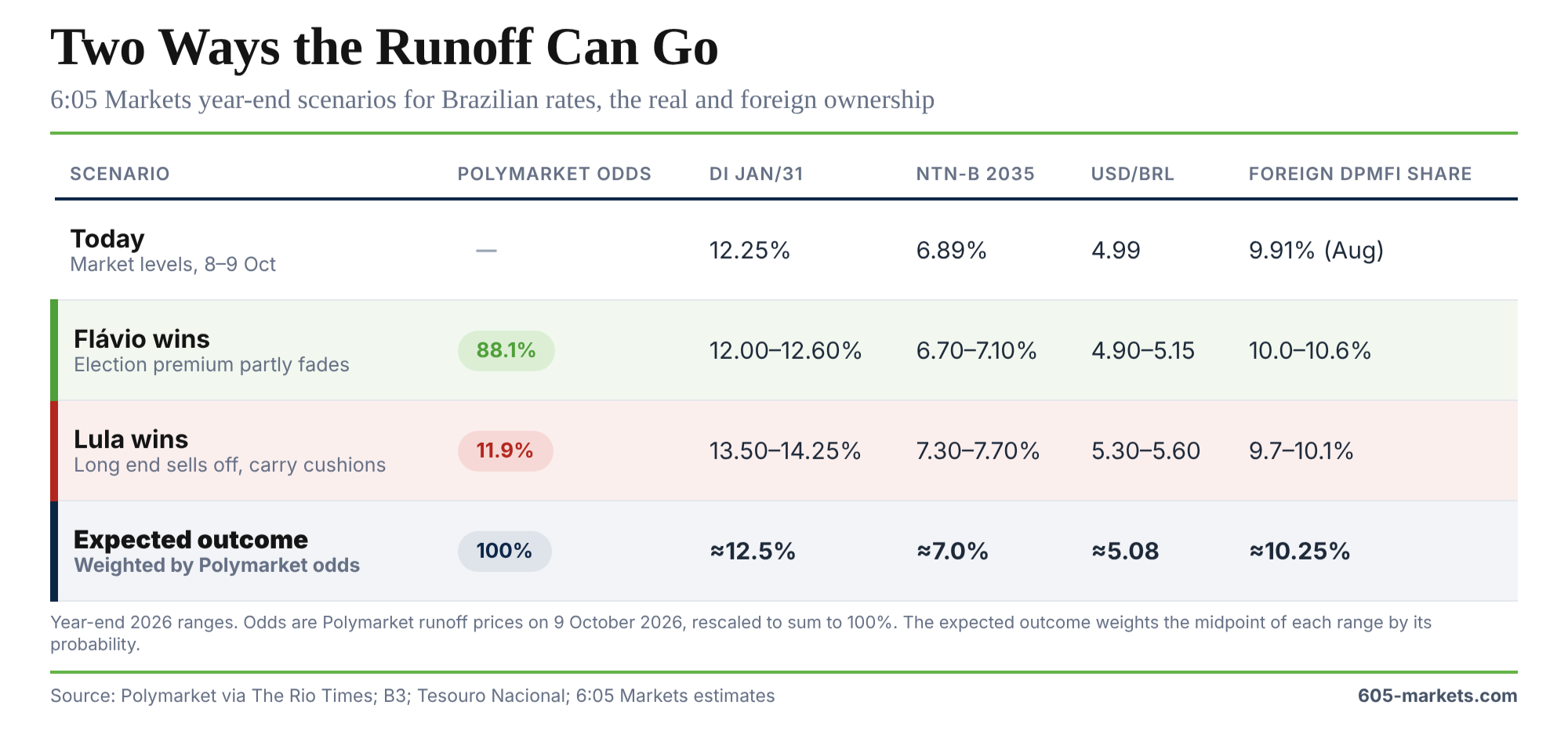
Forecast Method.
Our scenario ranges are 6:05 Markets analyst estimates anchored to current B3 DI futures settlement rates, NTN-B yields, the BCB PTAX exchange rate, the Copom’s current easing pace, Tesouro Nacional data on non-resident holdings and observed market behavior around the 2022 election. Scenario probabilities are taken directly from Polymarket runoff prices on 9 October 2026. They are not outputs from a probability-weighted term-structure model. The ranges represent the levels we believe are consistent with each election outcome rather than point forecasts, and the expected outcome is a simple probability-weighted average of the range midpoints.
What Would Change Our View?
The election premium proves durable if:
The winner publishes a numerical primary-surplus target and names a credible finance minister before year-end.
The carry case weakens if:
The 10-year Treasury moves decisively above 5.5%, or IPCA keeps surprising upwards and the Copom pauses its cuts.
Conclusion
No matter the election result, some optimism does exist for foreign investors in Brazilian bonds. Current Brazil interest rates pay among the highest compared to other major economies given to high policy rates and real rates. These rates will stay high independent of the result on October 25. What did change and what may change in the scenario of Flávio winning is the election premium given a more right-leaning senate and probable President, and later down in the future a potential but not guaranteed positive fiscal scenario.
Our thesis is therefore that the interest in Brazil will persist but not at today's intensity, with slightly higher DI Jan/31 than it is currently and a small edge in foreign ownership of domestic debt. We also continue to believe that even if Flávio wins, it’s still a bet whether he will follow through on his promises or if it will remain solely candidate talk to stimulate the economy and gain voters. For investors, the real question is whether to lock in today’s yields or wait for better entry points if rates rise again, if an unexpected result were to surprise the polls again with a Lula comeback.
USD/BRL will end 2026 between 4.90 and 5.15 reais per US dollar.
Series USD/BRL Entry 5.41 Target at or above 5.08 By 31 Dec 2026 Written 13 Oct 2026
Resolves against Yahoo Finance ticker BRL=X on the last observation on or before 31 Dec 2026. Not investment advice.