The Privatization of Policing
How private surveillance platforms are changing municipal budgets, technology markets, and the economics of police oversight.
Introduction
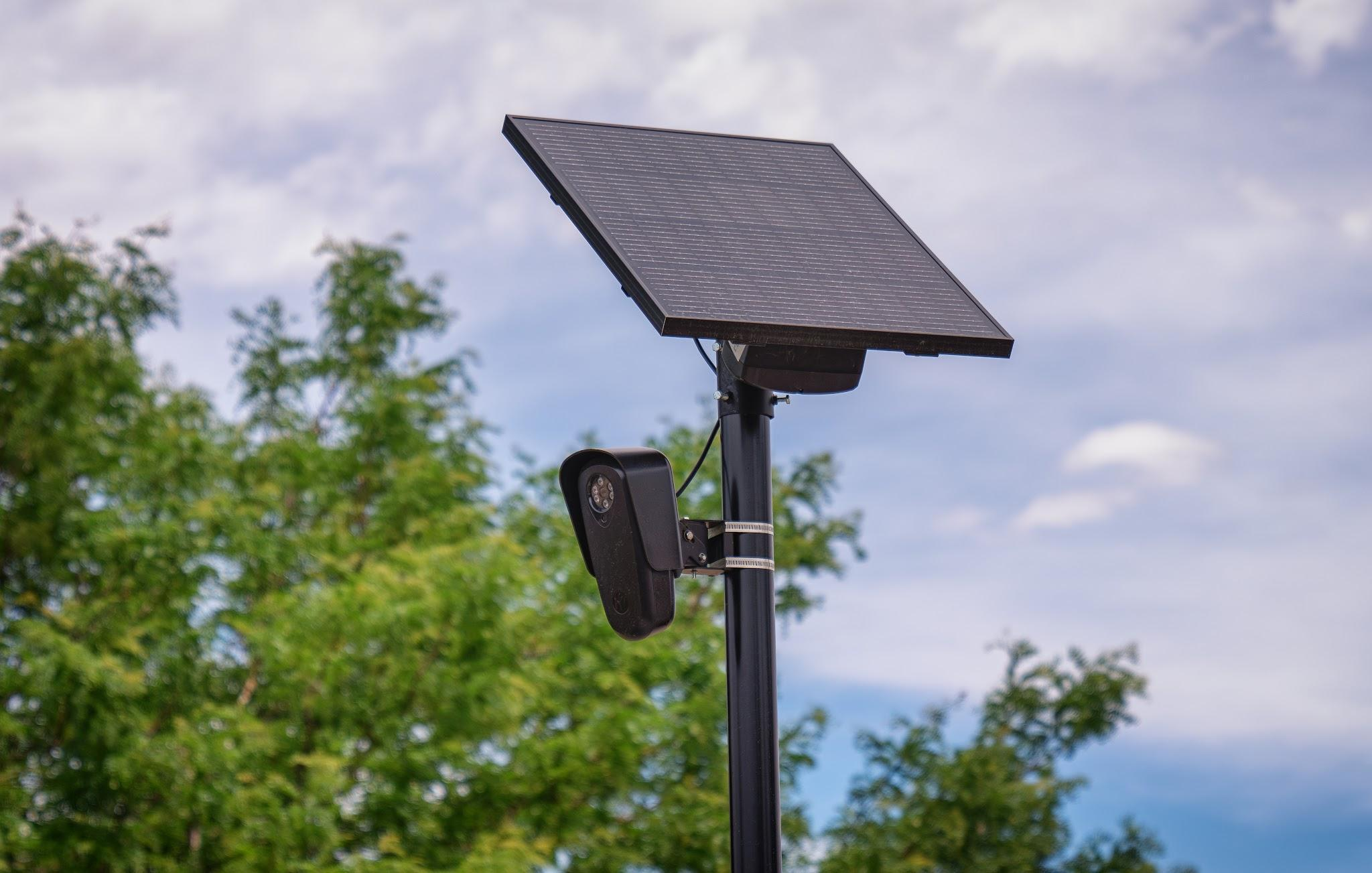
In July, Douglas County, Colorado, approved a nearly $23 million agreement with Axon after its sheriff raised concerns about rival Flock Safety's handling of privacy and security issues. Beginning in January 2027, the county plans to replace its 50 Flock license-plate readers and install 50 additional Axon readers, bringing the planned total to 100. The contract, which also includes drones and other policing technology, will run for ten years (Axios, July 23, 2026). For an industry facing growing scrutiny over surveillance and data privacy, the decision is revealing. Douglas County is abandoning one surveillance company while expanding its surveillance capabilities. The cameras are changing hands, but the surveillance is not going away. As local governments reconsider their relationships with private technology providers, the question is whether the backlash will reduce spending on surveillance or simply redirect it.
Public Budgets, Private Platforms
Flock's rapid expansion has attracted substantial venture capital, but its growth has also brought financial and political pressures. Reuters reported that the company had raised more than $950 million and reached a $7.5 billion private valuation, with more than 4,800 law-enforcement agency customers and nearly 1,000 business customers. Yet on October 9, Reuters also reported plans to cut roughly 270 employees, or 18% of its workforce, as the company faced mounting opposition to its surveillance practices (Reuters, October 9, 2026). The valuation is not annual revenue, which Flock does not publicly disclose in the same way as a listed company (Reuters, October 9, 2026).
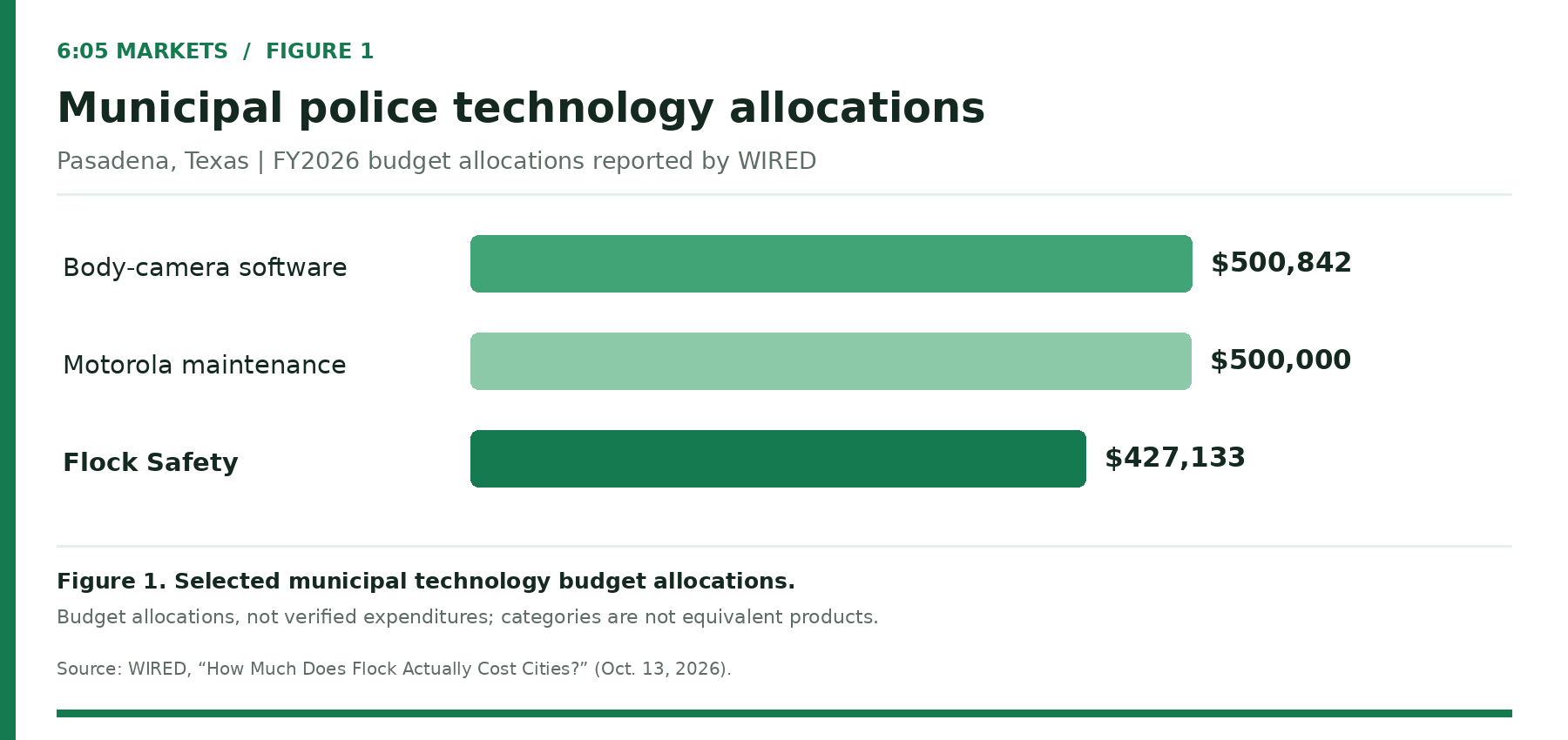
Public records provide a clearer view of how customer spending can develop. Covington, Georgia, paid Flock $40,000 in 2020 and $159,000 in 2025. Through August 2026, it had paid $201,000, including $100,000 for camera maintenance, $100,200 for new software and $800 for a replacement camera. Those amounts reflect changing equipment and services, not a like-for-like increase in price. Flock nonetheless accounted for only a small portion of Covington’s roughly $12.5 million police budget (WIRED, October 13, 2026).
The commercial value of these contracts extends beyond the initial sale. In Alpharetta, Georgia, police officials cited compatibility with their existing Flock system when explaining why competing vendors were unsuitable. The city later signed a five-year agreement that offered lower pricing than a series of one-year contracts (WIRED, October 13, 2026). For municipalities, integration can make a system convenient and less expensive to maintain in the short term, while potentially narrowing future choices. For vendors, that same integration can help protect recurring revenue.
The Economics of a Shared Network
Automated license-plate readers, or ALPRs, capture vehicle plate information for subsequent searches. Their commercial appeal extends beyond each physical camera. The BBC reported that Houston’s METRO transit authority owned 35 Flock cameras yet could access records from roughly 20,000 participating devices, including some as far away as New York. That access depended on sharing permissions; it did not constitute ownership or continuous monitoring of all devices (BBC, September 5, 2026).
The network creates a potential advantage: more participants can make the service more useful to existing customers. But it also creates a policy exposure. If governments restrict searches across jurisdictions, cameras can remain installed while the usefulness of the shared platform declines. Restrictions on data sharing could therefore weaken one of the competitive advantages of a network-centered surveillance platform.
Why Software Changes the Business Case
Axon, which sells Tasers, body cameras, evidence software and other police technology, reported $904.4 million in second-quarter 2026 revenue, compared with $668.5 million a year earlier. Its Software & Services segment produced $397.8 million of revenue at a 71.3% reported gross margin; Connected Devices recorded a 51.9% margin. Axon also reported approximately $1.64 billion in annual recurring revenue. These are company-wide segment results, not ALPR-specific sales or margins (Axon SEC filing, August 5, 2026).
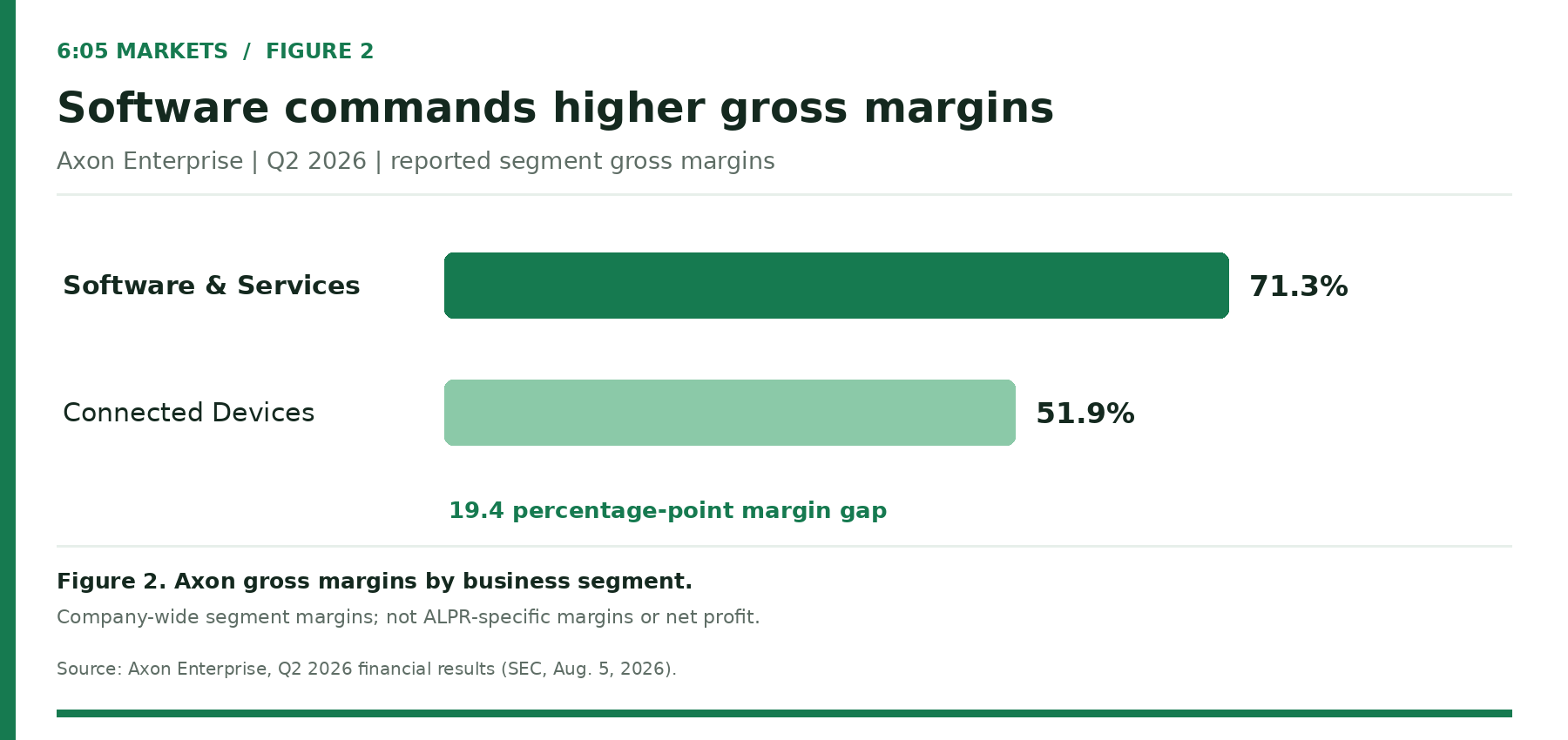
The camera may be the most visible part of the sale, but the software can be the more attractive business. The 19.4-percentage-point margin difference illustrates why software is an important part of Axon's business model. However, the gap should not be mistaken for an ALPR-specific advantage. Axon's Software & Services margin declined from 75.6% a year earlier to 71.3%, partly because of a greater share of professional services and the costs of scaling newer products. Its Connected Devices margin, meanwhile, increased from 48.6% to 51.9% (Axon SEC filing, August 5, 2026). The financial opportunity lies not simply in selling more cameras, but in expanding the software and services associated with an installed customer base.
When Privacy Policy Becomes Procurement Policy
The public-safety argument is substantial: license-plate readers can provide leads involving stolen vehicles, missing persons and suspects. Critics question the retention and sharing of searchable location histories. Rich Lowry has argued for safeguards rather than abandoning ALPRs, while the Cato Institute has warned that legal oversight has not kept pace with networked surveillance (National Review, August 2026; Cato, October 6, 2026).
The policy dispute is already affecting procurement. Fairfield, Connecticut, replaced Flock equipment with 54 Axon readers and adopted a policy governing the replacement system (CT Insider, October 16, 2026). Los Angeles illustrates the limit of the substitution thesis. On October 6, the City Council intervened in a proposed Axon streetlight-mounted ALPR pilot. On October 20, its Public Safety Committee recommended vetoing the pilot; on October 21, the council continued the matter to October 27. As of October 23, no final council veto had been recorded. The disputed pilot is separate from the LAPD’s ten-year, $235 million Axon agreement covering a broader range of police technology. The pilot’s status does not mean the larger agreement was canceled (Los Angeles City Clerk, Council File 26-1394; Los Angeles Times, October 6, 2026).
For vendors, restricting access to surveillance data and prohibiting cameras altogether would have very different financial consequences. Stronger audit trails, retention limits and access controls may increase spending on compliance features. Restrictions on cross-jurisdictional sharing may erode the value of shared networks. Deployment bans or contract cancellations would directly constrain demand. No vendor is immune to all three risks.
The Cost of Changing Suppliers
Surveillance technology is increasingly sold as part of a larger system rather than as a collection of individual cameras. The economic consequence is that a purchasing decision can shape a department's technology choices for years. Software compatibility, access to historical records, maintenance agreements and employee training may all affect the cost of changing suppliers.
The experience of Alpharetta suggests that integration can influence purchasing decisions, while Douglas County demonstrates that switching vendors remains possible. The two cases point to a competitive tension: integrated platforms may help companies retain customers, but privacy concerns and dissatisfaction with a supplier can still outweigh the convenience of staying. The real test comes when contracts expire and police departments must decide whether to renew their existing software and equipment agreements or switch providers.
6:05 Markets Outlook
Over the next 12 to 24 months, recent procurement decisions suggest that municipalities may become more selective about surveillance vendors rather than abandon ALPRs altogether. Douglas County’s planned expansion shows how a department can reject a supplier without reducing coverage; Los Angeles shows how scrutiny can delay a competitor’s deployment. The result may be a fragmented market in which contract wins depend increasingly on data governance, not just equipment performance.
For investors and policymakers, four indicators matter: whether cities renew, replace or cancel contracts; how camera counts change after vendor switches; whether data-sharing restrictions reduce network utility; and what share of police-technology budgets becomes committed to continuing software and service payments. The central question is whether privacy backlash reduces surveillance itself or chiefly changes the private companies paid to provide it.