The Middle Corridor: Growth the Market Hasn't Priced In
In this report we will argue that the Middle Corridor will continue to grow beyond market expectation, and that investment in strategic infrastructure providers in the region such as Georgian Railway will result in overperformance.
Introduction
In May, we analyzed the viability of the emerging global trade route through the Middle Corridor. As outlined, all other major global trade routes are or have been under duress: The Strait of Hormuz remains largely blocked, carrying only 10.9 million bpd (barrels per day) in September as opposed to pre-war averages of about 20 million bpd, the Suez Canal remains dangerous especially at the south entrance, and the Northern Corridor through Russia remains caught up in the Russian-Ukrainian war. The Middle Corridor is becoming a more feasible route day by day. The primary problem, as we reported in May, was the Middle Corridor lacked capacity. However, we highlighted how the Middle Corridor’s land and sea based route could be a great hedge for when alternative major maritime routes are caught up in conflict and become unusable.
Whether it emerges as a permanent Eurasian trade artery or remains a temporary alternative will depend on the corridor’s ability to expand capacity, improve regional coordination, and maintain political stability.
Azerbaijan and the South Caucasus
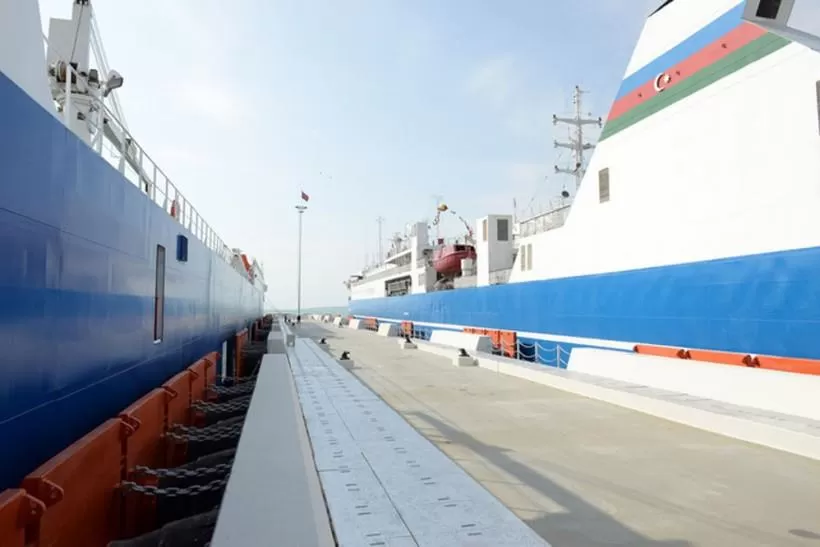
Azerbaijan lies at the center of the Middle Corridor route where every container must be unloaded and prepared to be shipped across the Caspian. In September, Azerbaijan’s second International Investment Forum yielded 23 agreements worth $10.8 billion (the economy minister cited 26 contracts), with BlackRock, GIP and Brookfield attending and an infrastructure dialogue hosted by SOFAZ and BlackRock. Deals span AI, energy and manufacturing. Such international investment from major firms creates a reliable signal of expected future growth in the corridor, growth not necessarily shared by the large majority of investors.
Cargo growth is also evident: Alat Port handled more than 107,000 TEU in 2025. In January–July 2026, throughput reached more than 72,000 TEU, up 20% year over year, while dry-cargo handling increased 82%. Current container capacity has been raised from 100,000 to 150,000 TEU. Azerbaijani planned expansion reaches up to 500,000 TEU and 25 million tonnes, with 260,000 TEU due by 2027.
Aktau, a major Kazakhstani port on the other side of the Caspian from Alat, has commissioned a 140,000-TEU container hub, with expansion to 240,000 TEU planned for 2027–28. Kazakhstan has also ordered six multipurpose container-capable vessels. Combined with dredging projects to counter falling Caspian sea levels, Kazakhstan has continued strengthening its freight fleet while allowing it to operate at fuller loads.
Freight Growth
A 2026 World Bank study found that targeted investment could more than triple corridor trade volumes by 2040 and transit times could be cut in half. For reference, it projects corridor tonnage to rise from 8.8 million tonnes in 2023 to about 32 million tonnes by 2040.
They found that combining infrastructure with customs and operational reforms could quadruple volumes and reduce transit times by two-thirds. Its four recommendations being:
- Create a single digital system for freight and customs documentation.
- Establish an integrated rail-and-Caspian-shipping operator.
- Coordinate performance and bottleneck removal corridor-wide.
- Improve the commercial governance of state-owned rail, port, and shipping companies.
These projections are conditional, which is important to the thesis. The World Bank isn’t forecasting automatic growth under the status quo, rather it’s showing the upside if the corridor can meet and implement said conditionals. Evidence that these conditions are already being implemented would therefore suggest that actual growth can exceed the market's expectations.
The implementation of a single trans-national digital system for customs and tariff unification is already underway. The China Railway Container Transport has entered the Middle Corridor’s joint operating platform alongside the Kazakh, Azerbaijani, and Georgian railways. The platform has introduced centralized monitoring, and the three railways are developing a unified long-term tariff, making freight shipment through the route more viable. In June of this year, its first coordinated train traveled from Hefei to Tbilisi in 12.8 days, demonstrating that the corridor’s separate legs can operate as a single logistics chain.
The other conditions are also beginning to move forward. The platform provides shared digital tracking, the corridor governments are implementing a joint 2022-2027 roadmap to coordinate investment and remove bottlenecks, and new World Bank support for the Kazakh and Georgian railways links financing to operational and governance reforms. A complete customs single window has not yet been achieved, but progress is measurable across all four recommendations.
Many investors have been quick to note that growth through the corridor has appeared to have stalled. From 2024 to 2025, total Trans-Caspian International Transport Route (TITR) freight fell about 8%, from 4.48 million tonnes to 4.12 million tonnes. However, the aggregate figure masks the fact that underlying container traffic continued to grow. Kazakhstan's transport ministry reported about 77,000 TEU on the route in 2025, up from 56,500 TEU in 2024. Investors focused on total tonnage may therefore miss the shift toward higher-value containerized freight and the operating improvements required to carry it. Such a slowdown may then in fact lead to an undervaluation of TITR growth. If World Bank projections hold, and there is not yet evidence to suppose otherwise, we could see a massive public misjudgment of Middle Corridor capacity.
Horadiz-Aghband Railway
The Horadiz-Aghband railway is being built inside Azerbaijan toward the Armenian border, with the wider connection through Armenia to Nakhchivan and Türkiye dependent on implementation of the Trump Route for International Peace and Prosperity (TRIPP) agreement, which Armenia has signed but not yet ratified. The connection would benefit the corridor in three ways: it would increase total freight capacity, create an alternative westbound route that bypasses Georgia, and give Armenia and Azerbaijan an economic reason to preserve political stability. It would not remove the Caspian crossing for Central Asian cargo, but it would reduce dependence on a single westbound rail alignment after cargo reaches Azerbaijan.
Official reporting in 2026 put construction of the Azerbaijani section at 73% complete, while its first stage has carried freight to the Araz Economic Zone since September 2025. The completed network is designed for as much as 15 million tonnes of annual freight. This makes the project more than a political proposal, although the unfinished Armenian segment means it should remain an upside catalyst rather than part of the base case.
Risks
As with any argument, there are two sides to the coin. Growth in the Middle Corridor could be stymied for a multitude of reasons. Chief among them is the state-owned railway. Nearly every core railway is owned and controlled by their respective governments, and each operator can prioritize its own tariffs, and domestic prerogatives. Although this makes financing of the railways a far less burdensome task, it comes with dissonance between government and profit. A decision at a singular railway, in favor of government objectives rather than net trans-route profit, can disrupt the whole route. State ownership therefore reduces financing risk but increases governance and execution risk.
Additionally, there is the issue of the evaporating Caspian Sea. As global warming has progressed and dams have been built along the Volga and the Ural, simultaneously the sea rapidly loses water and has less water flowing in to compensate. If artificial dredging fails to keep up with water loss, ships are forced to carry lighter loads across a shallower sea, limiting freight capacity.
The Horadiz-Aghband connection is also a risk to our position: once complete, it would give some westbound cargo a route that bypasses Georgia.
JSC Georgian Railway's 4% green bond due June 2028 will trade at or above 96.19 on 31 March 2027.
Series Georgian Railway 4% 2028 green bond (price) Entry 96.13 Target at or above 96.19 By 31 Mar 2027 Written 16 Oct 2026
Resolves against the readings entered for XS2340149439 on the last observation on or before 31 Mar 2027. Not investment advice.
Thesis
In the past year, it has become evident that supply chain reliability is the largest factor in determining the stable pricing on commodities. Sole reliance on the Suez, Hormuz or the Northern Corridor can create congestion of global freight if one were to shut down, as they are wont to do. We believe the Middle Corridor, of potential candidates for a new shipping route, will have the most extreme growth in coming years, growth not yet priced in by the market. Once reliability and efficiency of the Middle Corridor is realized by freight carriers, rapid investment will follow to ensure capacity matches demand. The most direct investable expression is Georgian Railway's $500 million 4% green bond due June 2028. Nearly every westbound shipment through Azerbaijan uses Georgian rail to reach the Black Sea or Türkiye. The bond traded at 96.13 on Börse Stuttgart on October 16, 2026, a yield of about 6.6%. We expect it to trade at or above 96.19 on March 31, 2027.
Works Cited
- World Bank – Integration: World-Class Trade Logistics Along the Trans-Caspian Transport Corridor, 2026
- World Bank – Trans-Caspian Transport Corridor Investments Could Spur Growth and Create Millions of Jobs Across Europe and Central Asia, 28 September 2026
- Astana Times – World Bank report on the Trans-Caspian corridor (8.8 Mt in 2023 to 32.1 Mt in 2040), 1 October 2026
- IEA – Oil Market Report, October 2026, 14 October 2026
- EIA – Amid regional conflict, the Strait of Hormuz remains critical oil chokepoint, 16 June 2025
- Ministry of Economy of Azerbaijan – Second Azerbaijan International Investment Forum concludes, 26 September 2026
- Euronews – Azerbaijan agrees multi-billion-dollar deals with investment giants, 27 September 2026
- Report.az – SOFAZ, BlackRock hold Azerbaijan Infrastructure Investment Dialogue, 26 September 2026
- AZCON Holding – Passenger and freight transportation indicators in the transport sector in 2025, 26 January 2026
- Caliber.az – Baku Port handles 4.8 million tonnes of cargo in seven months, 10 August 2026
- APA – Baku Port to expand fertilizer cargo handling capacity, 6 October 2026
- Trend – Baku Port container handling to reach 123,000 TEU by year-end, 6 October 2026
- Prime Minister of Kazakhstan – Prime Ministers of Kazakhstan and Uzbekistan Discuss Prospects for Increasing Transportation Along the Middle Corridor, 23 July 2026
- KTZ Express – KTZ to Develop Its Own Maritime Fleet: Contracts Signed for Construction of Six Vessels, 30 April 2026
- Ministry of Transport of Kazakhstan – Dredging works to be carried out at the port of Aktau, 9 May 2025
- Astana Times – Trans-Caspian Transport Route Cargo Volumes Increase Fivefold in Seven Years, 10 March 2026
- Interfax – TITR container transport in 2024 (56,500 TEU), 14 March 2025
- Interfax – China Railway unit joins Azerbaijan-Georgia-Kazakhstan JV to develop Middle Corridor, 8 August 2025
- Middle Corridor Multimodal – First MCM through train crosses Middle Corridor, Hefei–Tbilisi in 12.8 days, 2026
- Georgia Today – Tokayev: Kazakhstan, Georgia, Azerbaijan develop unified Middle Corridor tariff model, 24 June 2026
- Interfax – Astana, Ankara, Tbilisi, Baku agree to develop Trans-Caspian route, eliminate bottlenecks, 25 November 2022
- World Bank – World Bank Support to Enhance Rail Connectivity and Logistics in Kazakhstan, 19 February 2026
- World Bank – Georgia Boosts Role in Trans-Caspian Transport Corridor with World Bank Group Support, 2 June 2026
- Trend – Azerbaijan Railways reports 73% construction progress on Horadiz–Aghband line, 5 October 2026
- APA – Cargo transportation to Araz Economic Zone Industrial Park launched via Horadiz-Aghband railway, 5 September 2025
- APA – ADY: Annual capacity of Horadiz-Aghband railway planned to be 15 million tons, 5 September 2025
- Ministry of Foreign Affairs of Armenia – Signing of the Framework Agreement concerning the Trump Route for International Peace and Prosperity (TRIPP), 4 June 2026
- Duku et al. – The Shrinking Caspian Sea: Eco-Hydrological Responses to Human and Climate Pressures, Earth's Future, 5 June 2026
- Dechert – Dechert Advises on Georgian Railway's Landmark Green Bond Issuance, 5 July 2021
- Börse Stuttgart – Georgian Railway JSC 4.00% Notes 2021/28 Reg S (XS2340149439), price as of 16 October 2026
- London Stock Exchange – JSC Georgian Railway 4.00% notes due 17 June 2028