The Great Divide: Treasuries vs AI Credit
On October 22, 2026, the U.S. 10-year Treasury yield fell 19 basis points (bps) in a single session, the largest daily drop since the Silicon Valley bank crisis in 2023. This happened after Meta reported third-quarter earnings per share of $3.83 against an expected $6.67 while maintaining a very high expenditure.
Executive Summary
On October 22, 2026, the U.S. 10-year Treasury yield fell 19 basis points (bps) in a single session, the largest daily drop since the Silicon Valley bank crisis in 2023. This happened after Meta reported third-quarter earnings per share of $3.83 against an expected $6.67 while maintaining a very high expenditure. The selloff in artificial intelligence (AI) stocks that followed made many investors instead consider going to government bonds as an alternative, leading to the 10-year closing at 5.00% on Friday. This was the first time in weeks that the yield was not above 5.00%. However, the companies borrowing to fund the AI build-out did not benefit from the same flight to safety.
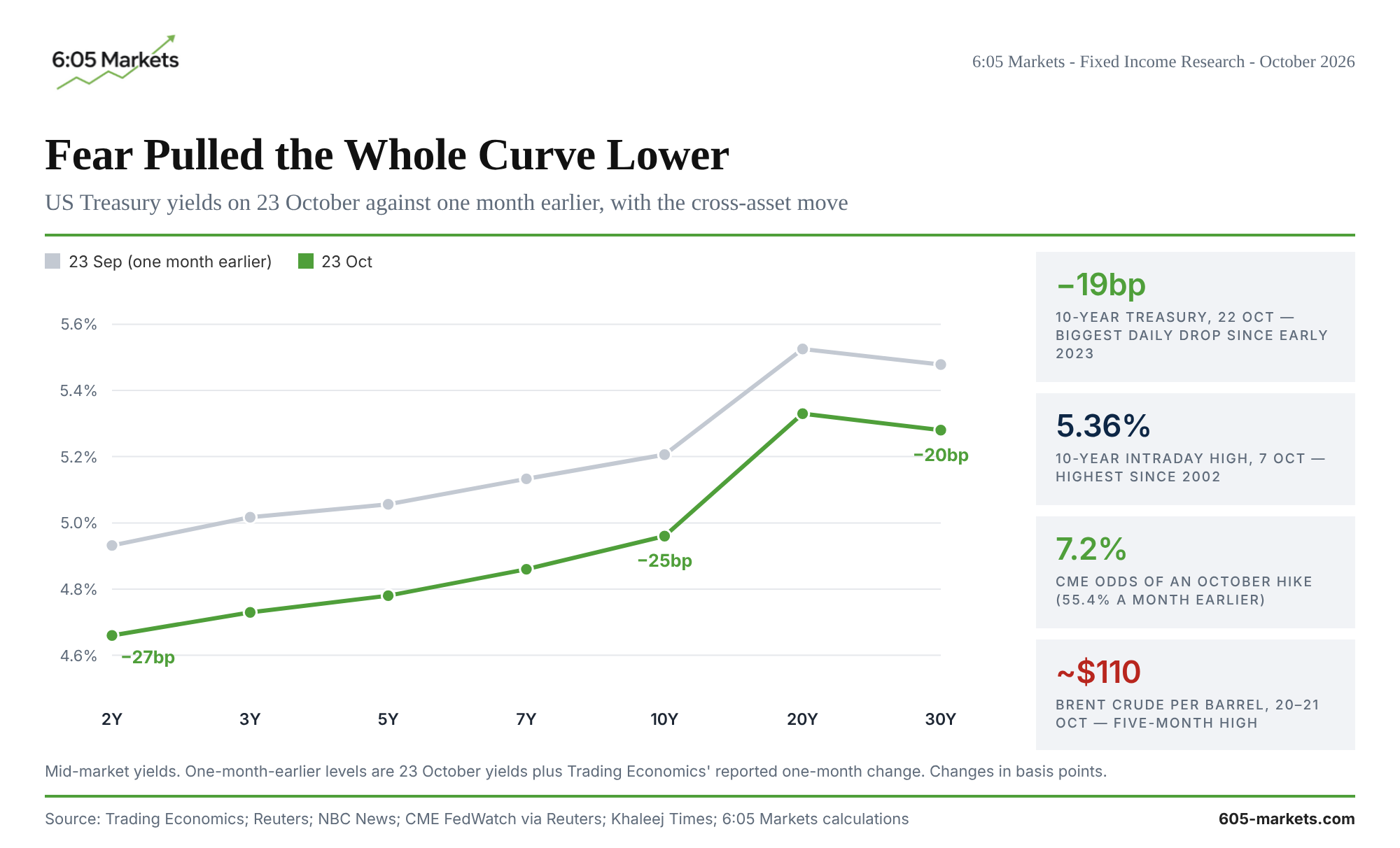
The same fear produced two opposite reactions in the bond market. Treasuries were bought because AI looked risky, and AI borrowers were sold for that reason. Our thesis focuses on this difference between those who bought Treasuries and those who sold as the Treasury rally is driven primarily by fear rather than a change in fundamentals. With the Brent price remaining at a high near $110 a barrel, the Federal Reserve (Fed) raised rates in September to try and control inflation with markets expecting another hike in December.
At the same time, there will be a new supply of debt coming from the Government and AI companies, which would therefore mean higher yield as prices will be lower than current. The repricing in credit, however, is not a temporary panic but the market beginning to demand a premium for the leverage behind the AI build-out, a premium that is likely to stay and remain concentrated in the most indebted borrowers ensuring they have something hedging against it.
To drive our thesis we will be using the CME FedWatch odds as of October 22 (about 78% for a December hike and 22% for no hike), we expect the 10-year Treasury to end the year near 5.08%, which would be slightly above Friday’s 5.00%. At the same time, we also expect corporate spreads to keep widening given the massive amount of debts being in taken by AI companies and others involved in AI investment. With investment-grade going from 0.89% to around 0.98% and high yield from 3.40% to around 3.64%.
Key Numbers
| 10-year Treasury, 22 Oct (one day) | CoreWeave 5Y CDS spread, 20 Oct | US IG corporate spread (OAS), 22 Oct | CME: December hike/no hike |
|---|---|---|---|
| -19bp | ~1,081bp | 0.89% | 78%/22% |
Reuters, Morning Bid, 23 October 2026; CNBC, 20 October 2026; ICE Data Indices via FRED (BAMLC0A0CM), 22 October 2026; CME FedWatch via Reuters and 24/7 Wall St., 22 October 2026.
A Rally Without a Policy Change
Previously, given the current landscape in the USA Treasuries were moving in the opposite direction increasing in yields way above 5.00%. On October 7, the 10-year yield reached 5.36% intraday and the 30-year 5.73%, both their highest levels since 2002, and on the same day the Treasury sold $39 billion of 10-year notes at 5.3%, the highest yield at a 10-year auction since November 2000. The reason for all this was needing to provide high yields to ensure these bonds were competing in investor attractiveness with AI companies that are currently the big talk in the market.
However, following Meta’s earnings and another round of selling in CoreWeave, investors rushed into government bonds on Thursday, and according to Reuters, fed funds futures rallied enough to essentially remove a full rate hike for next year, while a December hike was no longer fully priced in. With the long end rallying the most, the move resembles a flight to safety more than a bet on rate cuts, as investors bought duration to protect themselves rather than in anticipation of a looser Fed. The rally also spread to other markets, with Japan’s 10-year government bond yield falling as much as 10 bps to 2.78% on Friday.
The rally, however, did not last two full days. On Friday, Treasury yields moved back up as rising oil prices weighed on both stocks and bonds, and CNBC noted that the day’s stock slide coincided with a selloff in bonds, the opposite of the usual relationship between the two.
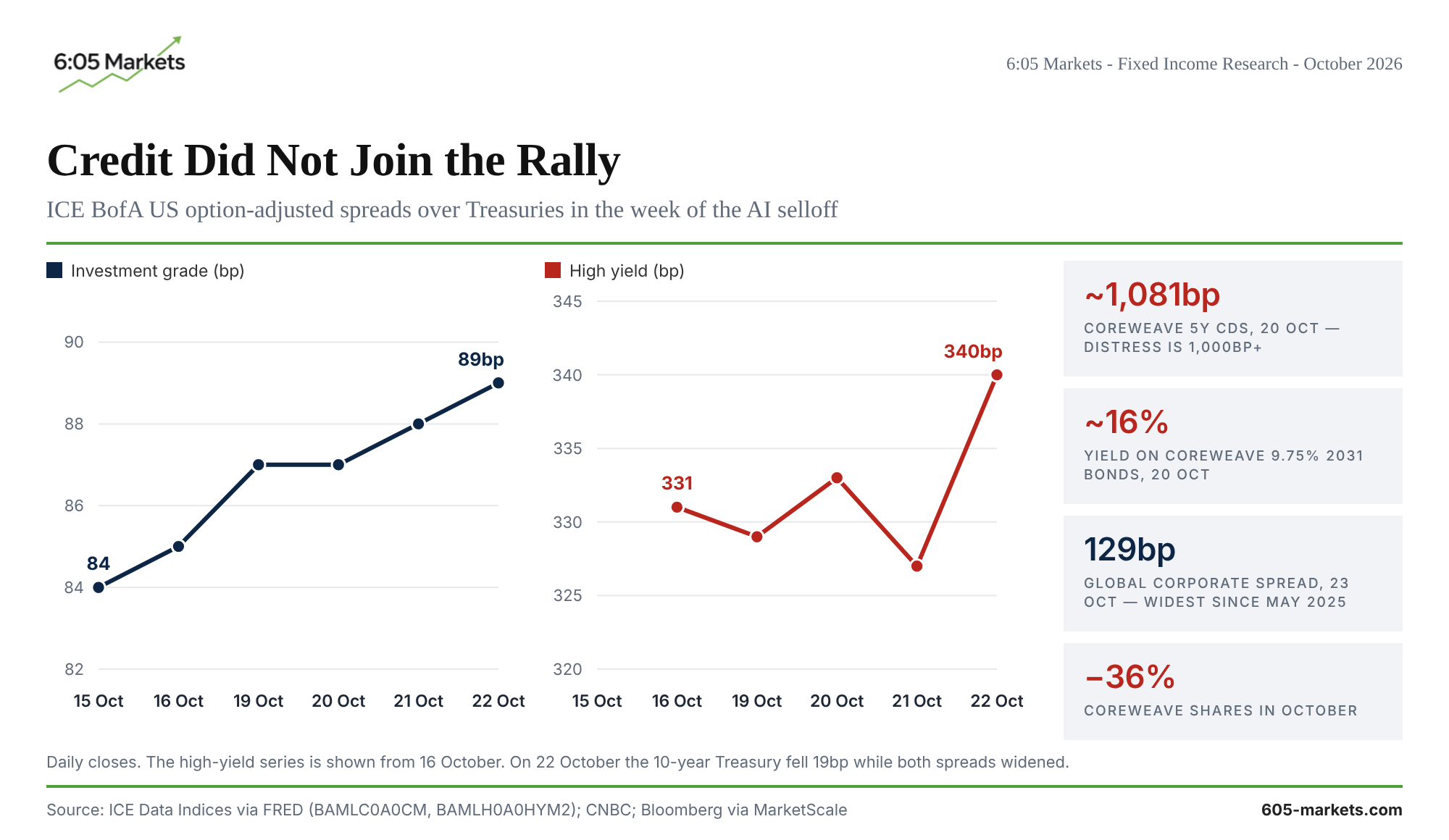
Corporate bonds did not follow. The ICE BofA U.S. investment-grade spread has shown to have widened from 0.84% on October 15 to 0.89% on October 22. The divide becomes clearer when looking at who was selling. On Monday, October 19, AI stocks rebounded, but CNBC reported that CoreWeave and Oracle bond yields remained elevated, under the headline that stock investors were ready to move on while credit investors were not. Equity markets treated the AI scare as a bad week. Lenders, on the other hand, are treating it as a fundamental question about whether this debt can be repaid.
The Cost of Building AI: The Neocloud Problem
The situation we picked to focus on with the AI boom is CoreWeave. With a current investment rating of B+ by S&P, which falls under the junk bond territory, the company carries roughly $51.6 billion in total debt as released in these bonds. The company bonds due in 2031 currently yield about 16% much higher than their beginning value of 9.75% when originally released. Furthermore, the five-year CDS spread briefly topped 1,140 bps on October 15 and hovered near 1,081 bps on October 20, and according to S&P Global Market Intelligence, a spread at or above 1,000 bps is generally a sign of credit distress. The stock has plummeted 36% in October alone.
What follows matters more for the rest of the market. According to Bloomberg, CoreWeave’s co-founder said the company was exploring ways to borrow in the investment-grade market, where insurers hold vast pools of capital, at the same time that junk bond buyers began freezing out tech startups looking for financing. When the riskiest borrowers in a sector lose access to the high-yield market, they are left with paying much more, selling assets or relying on their customers and partners, and this is how stress begins to move up toward larger names. Not every investor agrees. John Lloyd of Janus Henderson, who holds CoreWeave’s 2031 bonds, told CNBC the selloff is an overreaction. This may hold for one company, and a CoreWeave default is not the argument here, but the market has started to treat the cost of financing itself as the main risk.
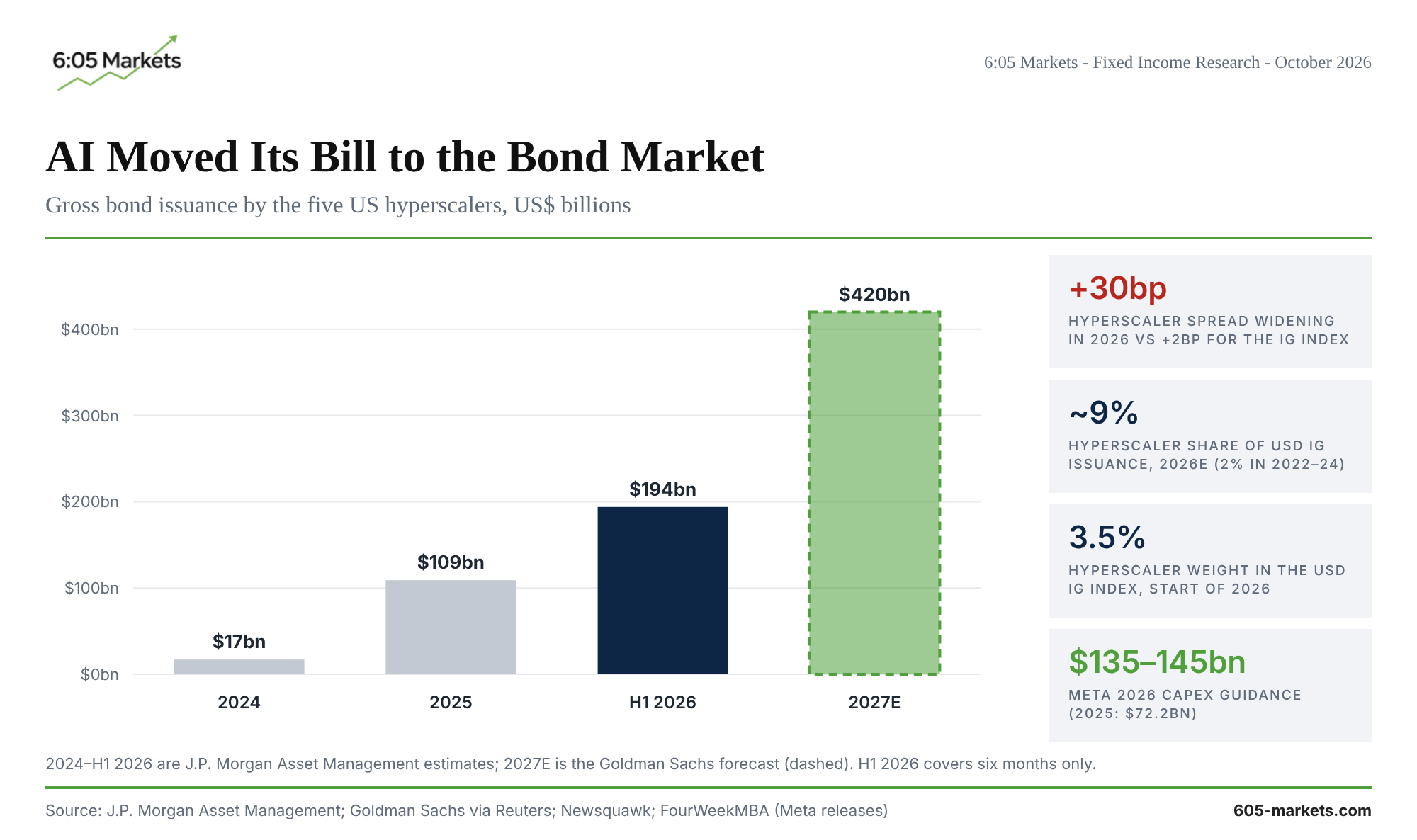
For now, this suggests the damage will remain concentrated rather than systemic. Hyperscalers made up only about 3.5% of the U.S. investment-grade index at the start of the year, so their widening has added only a few basis points to the index as a whole. However, the exposure keeps growing. Forbes estimates AI-related debt is now roughly 10% of the largest long-term investment-grade bond ETFs, up from 7% a few years ago, and Gartner warned this week that AI data center owners could face up to $4 trillion in write-down risk by 2032 if revenues fail to cover the spending. The concern is less about its size today and more about where it is heading.
A Fragile Rally
None of the factors that pushed the 10-year above 5% have disappeared. Brent crude reached $111.99 a barrel on October 20, its highest in about five months, following continued attacks on shipping and energy facilities in the Gulf. On September 16, the Fed unanimously raised its target range by 25 bps to 3.75–4.00%, its first increase since 2023, and a Reuters poll conducted between October 16 and 20 found that 94 of 100 economists expect a hold on October 28 and all 100 expect a hike in December. Supply also continues to build. The Treasury’s $13 billion 20-year auction on October 21 tailed by 0.9 bps, meaning it had to offer a slightly higher yield than expected to sell it all, and J.P. Morgan Asset Management estimates hyperscalers alone could issue about $300 billion of investment-grade bonds over the next year, all competing with Treasuries for the same buyers.
There is, however, a case for the other side. In Europe, ECB President Christine Lagarde said on October 17 that the bond selloff itself is making borrowing more expensive and will slow growth and inflation by more than the European Central Bank (ECB) projected in September. If U.S. credit spreads keep widening, the same logic could apply, with tighter financial conditions doing part of the Fed’s work and making a December hike unnecessary.
Our Prediction
We expect two main cases for this situation until the end of the year, depending mainly on what the Fed decides on December 9. The probability that we are using for each of these scenarios to truly happen is taken directly from CME FedWatch, which has priced a December hike at about 78% and no hike at about 22% on October 22.
The Hike Case. If the Iran war were to continue, Straits of Hormuz remains closed, and/or tensions remain high between the USA and Iran, Oil prices stays high. This is not surprising and the AI scare remains within the AI sector and the fear of an ever growing debt that results may not be defending. This will therefore lower the fear premium in Treasuries and long-term yields drift back toward their levels before this week, while credit spreads stay wide since financing for leveraged AI borrowers does not get any cheaper. We expect the 10-year at 5.05–5.30%, the U.S. investment-grade OAS at 0.88–1.00%, the high-yield OAS at 3.30–3.70%.
The Hold Case. The AI selloff keeps tightening financial conditions, credit widens further and the Fed decides the market has already done the tightening for it. Treasuries rally further, but because this rally comes from weaker growth and wider credit, corporate spreads widen more, not less. We expect the 10-year at 4.60–4.90%, the investment-grade OAS at 1.00–1.20%, the high-yield OAS at 3.80–4.50% and CoreWeave’s CDS at 1,200–1,800 bps.
What we expect. Weighting both cases by their odds, the expected outcome at year-end is the 10-year around 5.08%, the investment-grade OAS around 0.98%, the high-yield OAS around 3.64% and CoreWeave’s CDS around 1,190 bps. In both cases, credit spreads end the year wider than today’s 0.89% and 3.40%. This produces an asymmetry. The premium on AI credit holds regardless of the Fed, while the Treasury rally depends on it. As such, shorter-dated Treasuries look more attractive than long duration, which after this week is mostly a bet that fear will last, and hyperscaler investment-grade debt more attractive than neocloud high yield.
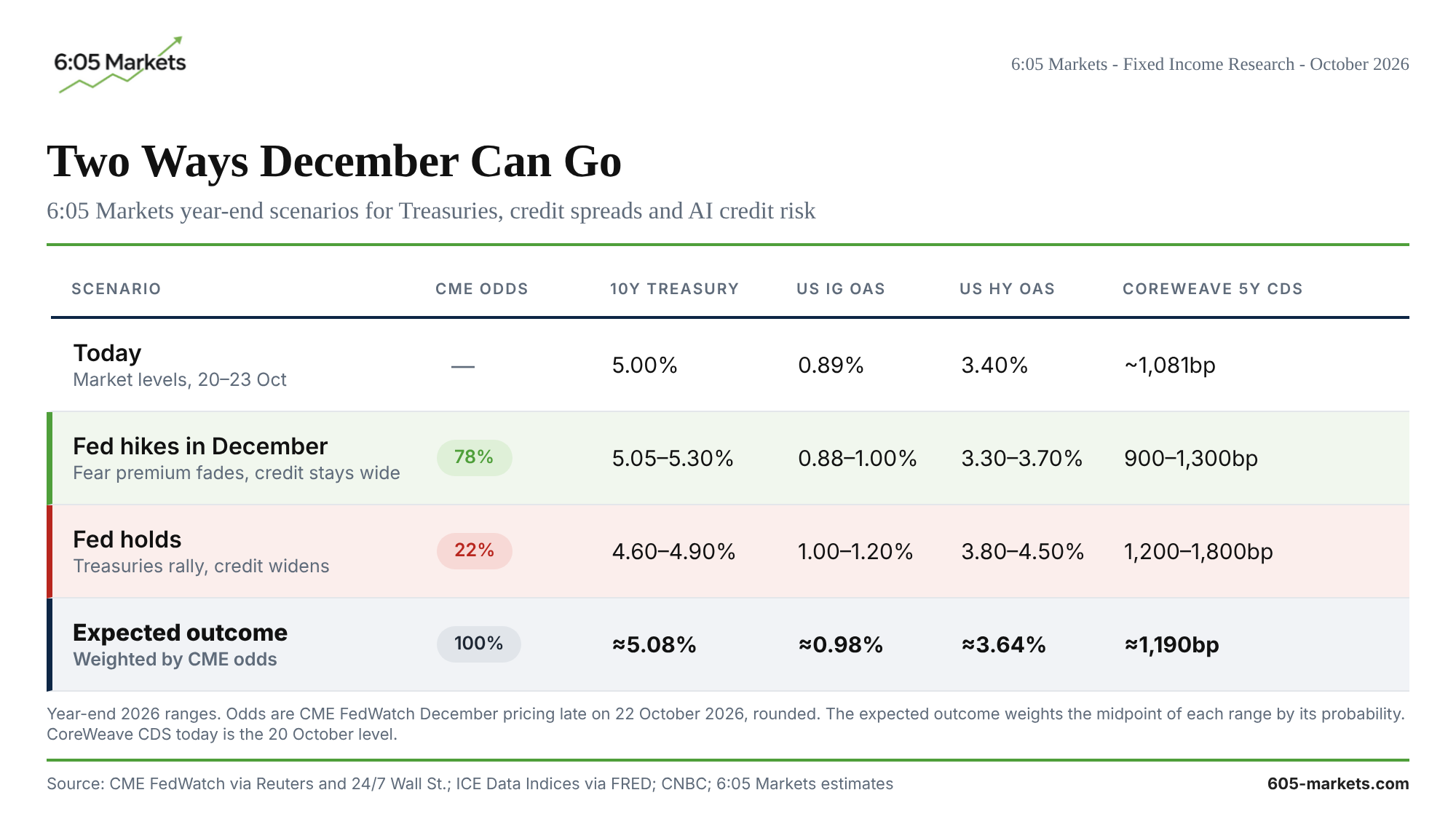
Forecast Method. Our scenario ranges are 6:05 Markets analyst estimates anchored to Treasury closing yields on October 23, ICE BofA option-adjusted spreads published on FRED for October 22, CoreWeave CDS levels reported by CNBC on October 19–20, Brent prices reported by Reuters and observed market behavior around this week’s selloff. Scenario probabilities are taken directly from CME FedWatch December pricing on October 22 as reported by Reuters and 24/7 Wall St. They are not outputs from a term-structure or credit model. The ranges represent the levels we believe are consistent with each outcome rather than point forecasts, and the expected outcome is a simple probability-weighted average of the range midpoints.
What Would Change Our View?
The Treasury rally proves durable if:
- The Fed signals on October 28 that December is not a done deal, PCE cools on October 29, or Brent falls back below $95 a barrel.
The credit case weakens if:
- CoreWeave secures investment-grade financing and its CDS falls back below 600 bps, or the U.S. investment-grade OAS moves decisively above 1.20%, which would mean the stress has turned into a broad credit event rather than an AI one.
Conclusion
The AI selloff is a reminder that risk isn’t created equal in the bond market. For treasury buyers it was a reason to own safety, pushing the 10-year below 5% for the first time in a month, while for credit investors it was a reason to question whether the companies building artificial intelligence could repay what they borrowed, pushing CoreWeave into distressed territory and corporate spreads to their widest since May 2025. Both reactions are understandable, but only one is likely to endure.
Oil close to $110, Fed remaining in the camp for a December hike and the mounting tsunami of government and AI debt all point to the Treasury rally being short lived and the 10-year is likely to be back to about 5.08% by year-end. The repricing in credit, however, looks more lasting, with investment-grade and high-yield spreads moving to around 0.98% and 3.64% without turning into a broad credit crisis. The AI build-out itself is not the fundamental problem for bond investors, the way it is being financed is. For investors, the question is not whether to hold AI exposure in credit, but where in the capital structure to hold it. Hence, investors must remain attentive with these very indebted companies, as the window continues to narrow.
The US 10-year Treasury yield will be at or above 5.00% on 31 December 2026.
Series US 10-year Treasury yield (%) Entry 5.00 Target at or above 5.00 By 31 Dec 2026 Written 23 Oct 2026
Resolves against FRED series DGS10 on the last observation on or before 31 Dec 2026. Not investment advice.