The Future of Venezuelan Crude and What It Means for US Markets
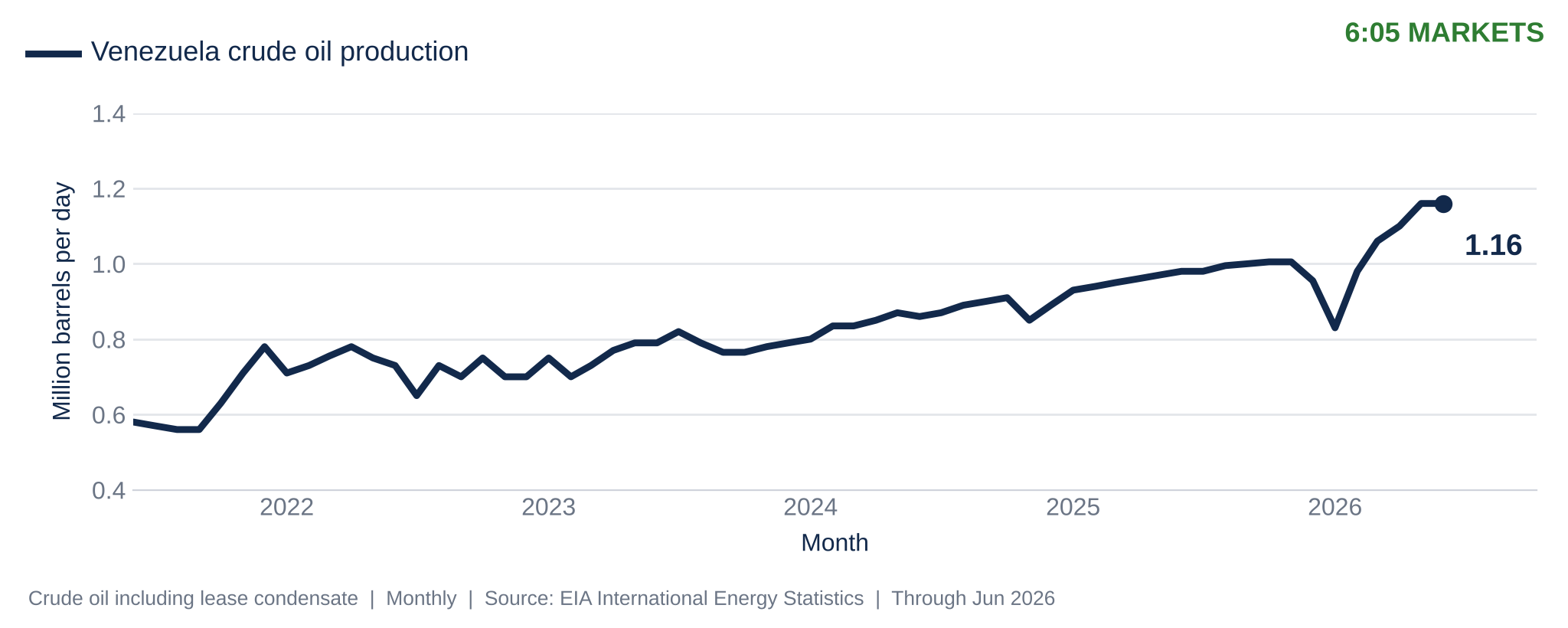
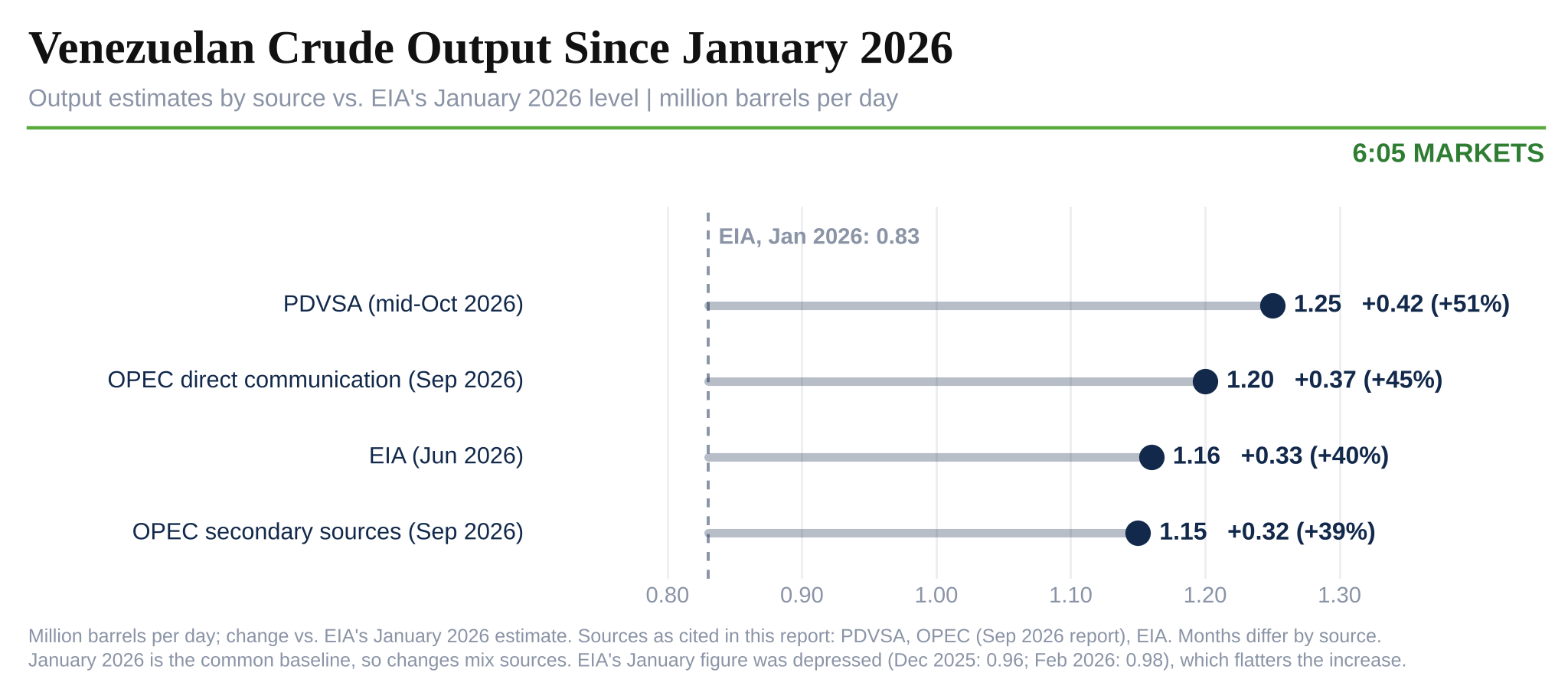
Since January 2026, Venezuela’s crude output has recovered strongly from a 2020 low but remains well below its historical peak. Currently, its short-term effect on US crude and distillate markets is relatively limited. EIA data put 1.16 million barrels per day (mbpd) of crude in June 2026, while state-owned oil and gas company PDVSA reported 1.25 mbpd produced in mid-October. This is more than double the trough in 2020, but far below the 3+ mbpd achieved in the early 2000s.
Executive Summary
Meanwhile, Venezuelan crude exports to the US are rising quickly, with a four-week average of 636,000 bpd imported by the United States. While these volumes need not increase US inventories, we expect in the long run for Venezuela to significantly scale its production while keeping a high export rate to the US.
Currently, three factors set the pace for the short term: physical/financial constraints, US policy, and US refinery fit. Venezuela’s aging crude infrastructure, midstream bottlenecks, and the massive investment necessary create significant constraints for sustainable production growth. Policywise, the newly signed NABEP deal covering 17 fields, established licenses, and foreign companies can support significant long-term growth in Venezuela, but this could be easily reversed. Venezuela’s heavy, sour crude is well suited for Gulf Coast refineries, and excess heavy crude supply flooding the US market will widen the heavy-light differential. Our base case is a marginal Venezuelan production increase by the end of 2027, but it will substantially expand by 2035-2040, assuming friendly policy supports growth. We expect a significant portion to be exported to the US, supporting refinery feedstock economics while strengthening the heavy crude discount. The main risks to our position are export license reversal or slower-than-expected infrastructure modernization.
Figure 1 · Venezuelan Crude Output, Five-Year View
Key Numbers
| Venezuelan crude output | US four-week avg. imports from Venezuela | Gulf Coast heavy crude headroom | Investment needed |
|---|---|---|---|
| 1.16 mbpd | 636,000 bpd | 300,000-400,000 | $126-180 bn |
Where Is Venezuelan Output Today?
Defining Venezuelan Output
OPEC reports crude oil production based on both direct communication from PDVSA and secondary sources. PDVSA (Petróleos de Venezuela, S.A.) is the Venezuelan government-owned oil company. The EIA reports yearly production by product. Kpler tracks tanker movement to estimate export flows, though export volume is not equivalent to production.
Crude oil production measures oil extracted from underground reservoirs, while total petroleum liquids include natural gas liquids or other liquid hydrocarbons.
The Long Decline and Recovery
Venezuelan production peaked at around 3 mbpd in 1999. Former President Nicolás Maduro took office in 2013; at that time, Venezuela had a crude oil production level of 2.7 mbpd. In 2020, due to operational challenges, COVID-related price collapses, and production capacity constraints, production dropped below 0.5 mbpd. It eventually rebounded, with a secondary source September 2026 value of 1.15 mbpd (up 0.018 mbpd from August) (OPEC).
Is the Recent Rise Real?
OPEC reports a September ’26 secondary source value of 1.15 mbpd and a direct communication value of 1.20 mbpd, and Kpler reports an April-September ’26 average of 1.14 mbpd of exported oil. Reuters reports an October export volume of 1.08 mbpd. Following the conclusion of the NABEP deal, production growth has stalled as producers begin to shift focus to repairs of oil infrastructure.
In September, Chevron was granted further development access to the Orinoco Belt with an intent to double current levels of extra-heavy oil production. At the time of the release, Chevron’s three Venezuelan ventures–Petroindependencia, Petropiar, and Petroboscan, S.A.–have increased production by 15% YTD.
In October, Venezuela’s interim president Delcy Rodriguez reported an increase in production in the state of Zulia. Though the period of the increase was not stated, she implied a 429% increase from 70,000 bpd to 370,000 bpd.
The evidence supports a recovery in production. Despite variances in exact outputs, sources collectively conclude that output has improved significantly following the 2020 declines. However, recent stagnation in production growth suggests that future growth is incredibly reliant on upcoming infrastructure investments and venture expansions.
What Was and Is Holding Output Back?
Historical Constraints
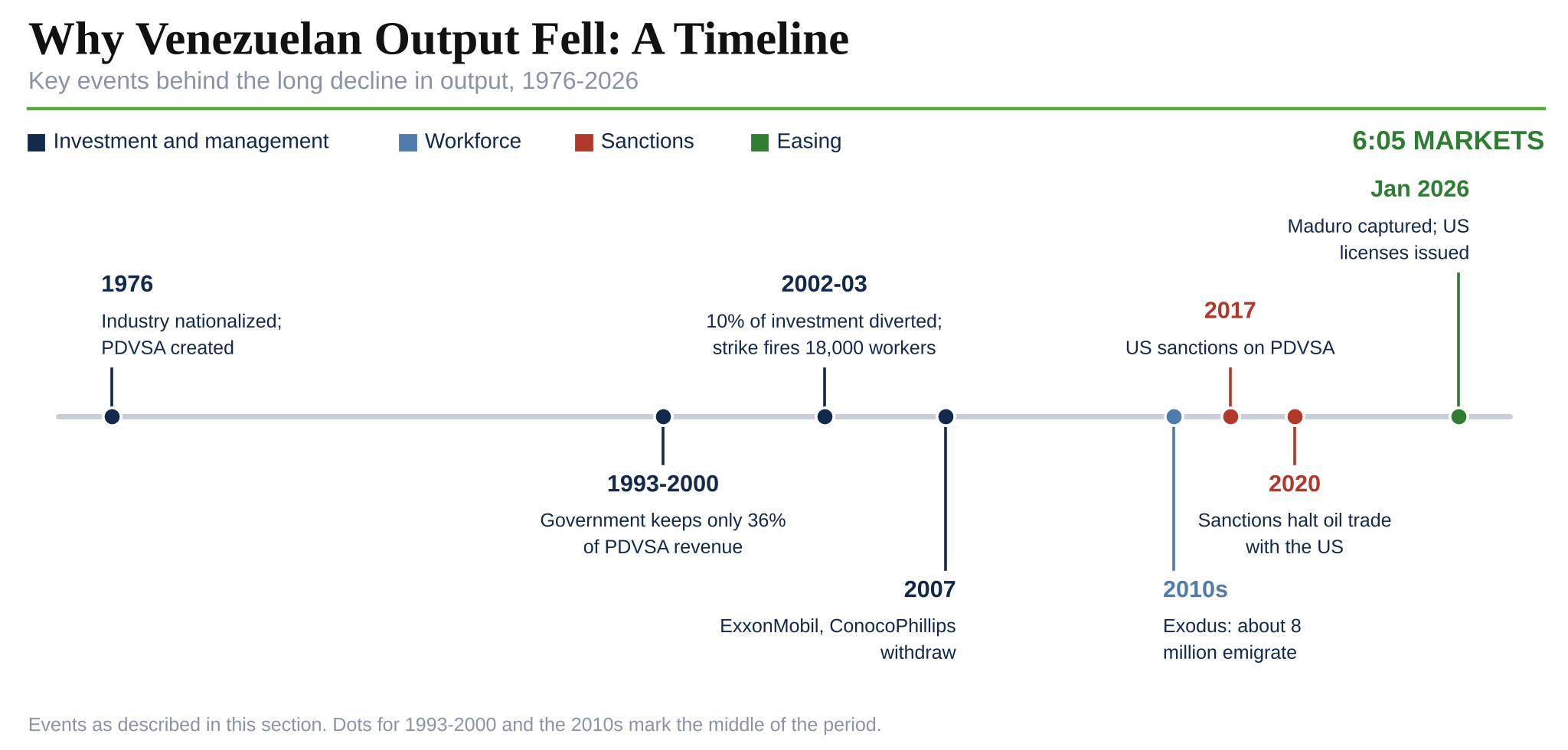
Firstly, the Venezuelan oil industry has suffered years of mismanagement and underinvestment. In 1976, the Venezuelan oil industry was nationalized and Petróleos de Venezuela S.A. (PDVSA) was created. PDVSA’s efficiency has been called into question over the years: from 1993-2000, the government received only 36% of PDVSA’s revenue, the rest being consumed by costs. Furthermore, in the early 2000s President Hugo Chávez used PDVSA resources to fund social programs rather than investment. In 2002, he set a quota of 10% of PDVSA’s annual investment budget to be spent on social programs instead of infrastructure maintenance and development. The government also created an unfriendly environment for foreign investment, forcing companies to renegotiate contracts and accept higher PDVSA stakes. As a result, ExxonMobil and ConocoPhillips both withdrew from Venezuela in 2007.
Secondly, Venezuela’s oil industry has faced, and still is facing, severe personnel shortages. In 2003, PDVSA went on strike in an attempt to force Chávez to resign. The strike resulted in over 18,000 skilled workers being fired and replaced with Chávez loyalists. During the strike, oil production ceased almost entirely, and many of the fired workers would later leave the country in the exodus starting in the 2010s. The FT reports that Venezuela is still facing a severe shortage of skilled workers for the oil industry: this will be covered more in a subsequent section.
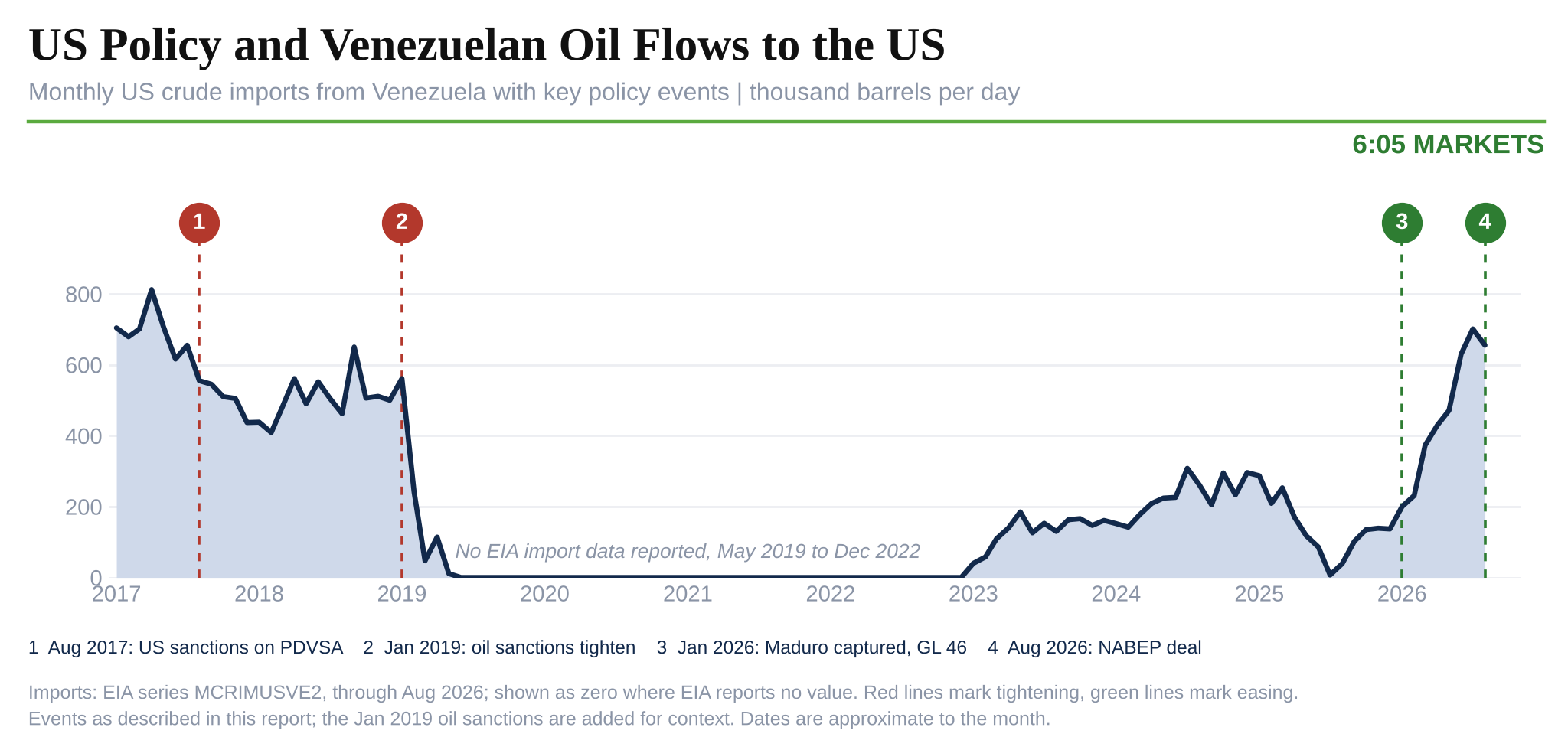
Thirdly, the Trump administration imposed sanctions on PDVSA in 2017. By 2020, sanctions had halted oil trade between Venezuela and the US, further damaging income generated for investment. Following the abduction of Maduro at the start of 2026, the US issued general licenses allowing certain US and international companies to trade, transport and refine Venezuelan crude, but the years of sanctions dealt a hit to PDVSA’s revenue.
Finally, Venezuela’s crude is heavy and sour (high sulphur content). Extraction is expensive, intensive and requires specialized techniques and infrastructure. This is one reason that Venezuelan production is nowhere near that of Saudi Arabia, whose reserves are faster to extract and cheaper to refine.
Can Venezuela Physically Move More Oil?
Venezuela’s heavy oil primarily comes from the Orinoco Oil Belt. In order to be extracted and transported, this crude must be mixed with diluent: usually naphtha, condensate, or light crude. Venezuela does not produce enough diluent and so is heavily reliant on imports – Reuters reports that PDVSA typically imports 100,000bpd of naphtha and light crude. Under US sanctions, this was a serious constraint; Chevron was the only US company permitted to export diluent to Venezuela. Following the issue of General License 47 in February 2026, the export of US diluents to Venezuela is now permitted. Commodity trader Vitol has secured an agreement to supply US naphtha into Venezuela. This has lessened the extent to which diluent is a constraint on production, but it is still a vulnerability in the production process.
Venezuela’s oil production also largely requires steam injections to heat and extract crude. The main fuel sources used for this generation are as follows: domestic natural gas production, small in comparison to its crude reserves; natural gas imported from Colombia via the Trans-Caribbean pipeline; gas produced from Venezuelan light and medium oil fields, largely underutilized due to lack of infrastructure; fuel oil used in heavy fields where natural gas is unavailable. Incorrys reports that scaling up Venezuelan oil production will require significant investment in gas production, gas transportation, and steam generation infrastructure.
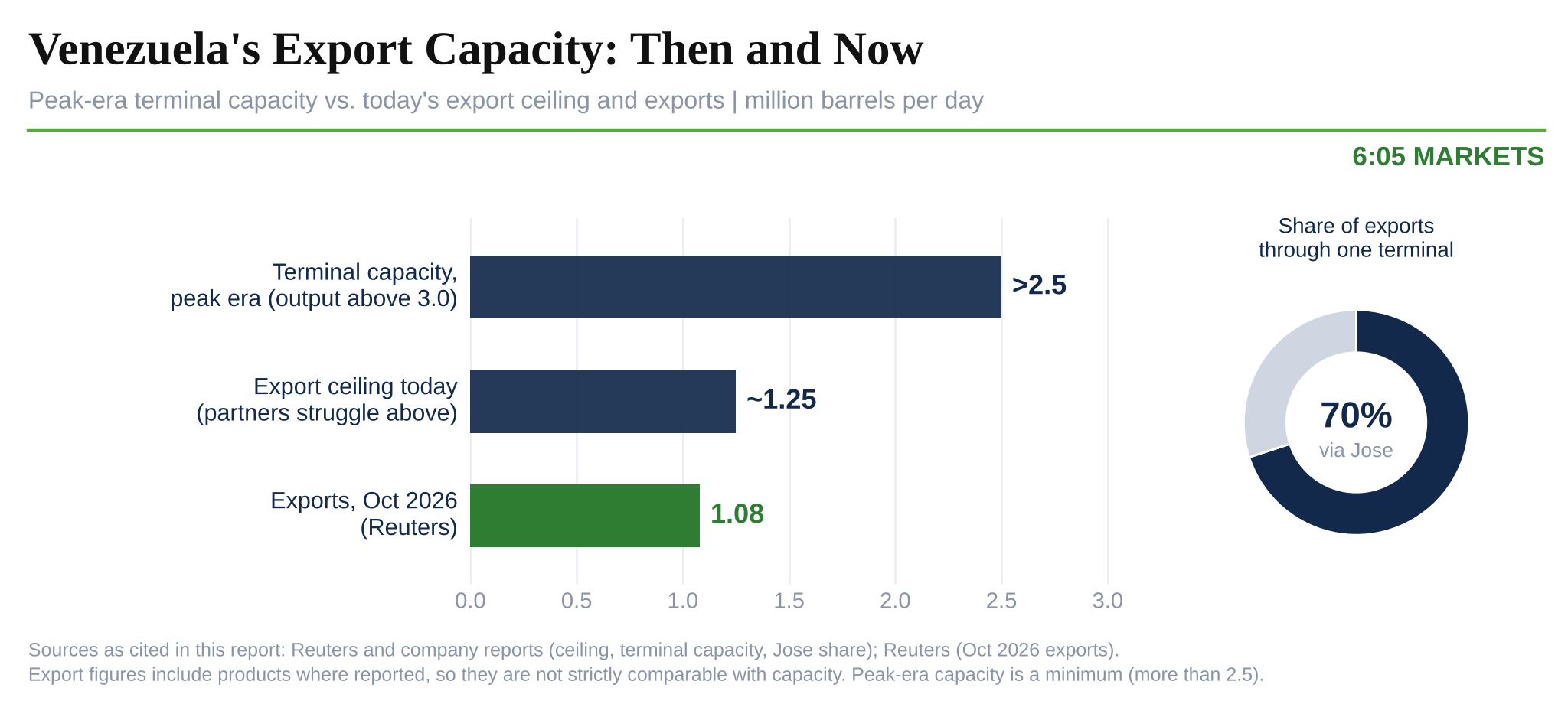
As well as constraints on production, exports are also limited by aging ports. Tankers are reportedly waiting up to 30 days to load, creating a de facto ceiling on the volume of crude being shifted out of the country. PDVSA and its partners have struggled to push exports above roughly 1.25m bpd despite rising production and efforts to drain crude stocks. That is significantly below the more than 2.5m bpd the country’s terminals could handle when Venezuelan oil production was above 3m bpd more than two decades ago. The problem is exacerbated by the fact that around 70% of the country’s total oil exports go through a single terminal, Jose. Shipping data and company reports show repeated interruptions caused by equipment failures, power outages and problems with crude quality.
Money and Labor
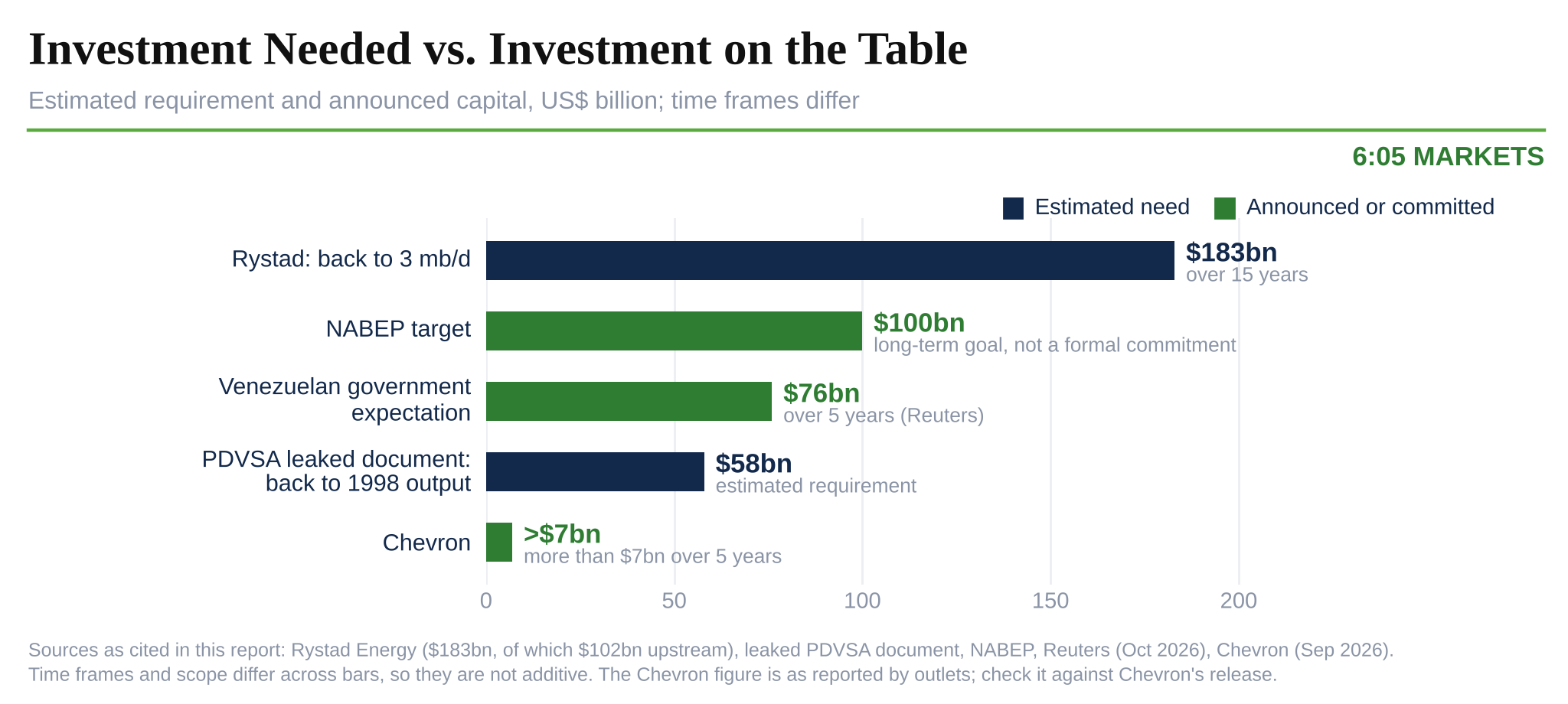
Rystad Energy estimates that $183bn investment over 15 years would be required to boost Venezuelan production back to its peak of c. 3m bpd. Of this $183bn, Rystad says $102 billion would go to upstream costs, with the remainder focused on pipelines, upgrades and other infrastructure. According to a leaked document, PDVSA itself believes it would require $58 billion of investment to restore its oil production to 1998 levels. Trump’s oil deal alone is widely estimated to require $100bn in planned capital investment by NABEP to exploit the oil fields the US has gained access to in Lake Maracaibo and the Orinoco Belt. This is an investment target, not committed funding; these estimates cover different scopes and periods.
Without investment, output falls rapidly. From 1998-2015, Venezuelan crude output fell from 3.4m bpd to 2.4m bpd. This occurred before the implementation of US sanctions, which contributed to the further decline in output to c. 570,000 bpd in 2020. In general, the output of oilfields without proper investment falls c. 8% year on year. The collapse in Venezuelan oil was faster, due to mismanagement of the entire system.
As mentioned already, the 2003 strike of PDVSA resulted in a rapid halt in Venezuela’s oil output and the firing of 18,000 skilled workers. These workers were among the 8 million who emigrated during the Chávez and Maduro regimes. Alejandro Terán, president of the Latin American Association of Oil Entrepreneurs of Texas, estimates that there are 4,800 Venezuelan oil and gas engineers in the US (Financial Times). He says that Venezuela is facing a “major shortage of personnel”, especially at the mid- and lower-technical levels. Monthly salaries at PDVSA are less than 5% of what a Venezuelan oil worker can expect to earn in the US, making return economically unappealing. Furthermore, industry bosses say that Venezuelan universities are not turning out enough petroleum engineers to meet demand.
To conclude, it is likely that north of $100bn investment will be required to bring Venezuelan oil output close to historic peak levels. Whether the appetite of foreign investors is sufficient to fund this effort is still uncertain. Venezuela must also find a way to either attract or train more skilled oil workers.
Sanctions, Policy, and Risk
What is Allowed Today?
Since Maduro’s capture on January 3, 2026, the Office of Foreign Assets Control (OFAC) has eased sanctions on Venezuela and enabled US companies to conduct business in Venezuela. On January 29th, OFAC issued General License No. 46, which allowed established entities to conduct a wide range of oil business in Venezuela. Since then, OFAC has issued subsequent licenses that broaden the range of economic activities that established US entities are permitted to conduct in Venezuela. These cover oil exports, US diluent sales, field services, contingent investment contracts, minerals and gold-related activities. These permissions remain subject to counterparty restrictions and the terms of each licence. Trading authorisation does not itself permit all production, exploration or investment; those activities require the applicable authorisation.
Before Maduro’s capture, Chevron was the only US major still operating in Venezuela. Under certain US authorizations, it was able to deliver crude to the US. Chevron has stakes in three joint ventures with PDVSA. Together, these ventures produce 280,000 bpd, which is roughly a fifth of Venezuela’s output. On September 2nd, Chevron announced major expansion in Venezuela which involved additional acreage in the Orinoco Belt. It also announced the goal of increasing production to 600,000 bpd over the next five years.
A week earlier, on Friday, August 28, President Trump announced an oil deal with Venezuela on his Truth Social account. Describing it as the “BIGGEST OIL DEAL IN WORLD HISTORY,” he established that US oil reserves will more than double at no taxpayer cost. As part of the deal, Venezuela’s interim government gave NABEP (North American Blue Energy Partners) rights to develop and produce from 17 oil fields containing 65 billion barrels. The agreement makes the United States an investor in NABEP with a 35% stake in its parent entity. Furthermore, the US would have the right to buy 20% of NABEP’s future production as well as the right to first refusal to purchase the remainder of NABEP’s production.
How Easily Could It Be Reversed?
The main factor influencing the durability of the above permissions is who remains in power, both in the US and in Venezuela. The OFAC licenses are executive actions and can be amended, suspended or revoked as US policy changes, subject to the applicable legal framework. Historically, licenses are frequently changed as presidents change, so the current OFAC licenses could face renewed uncertainty after a partisan shift in the White House in the next presidential election cycle.
Chevron’s permissions are the most likely to remain. Chevron has had an active presence in Venezuela since 1923, and has survived the countless license changes over the years. Furthermore, the special permissions Chevron has in order to maintain the joint ventures with PDVSA make their presence in the Orinoco Belt more durable.
Finally, the NABEP deal has the strongest formal protections but the most novelty. The 100-year concessions seem durable, and the US government’s 35% stake in NABEP gives Washington a direct interest in keeping the agreement alive. However, the deal hinges on the Venezuelan government. There are legal and political concerns about the Venezuelan side of the agreement given its dubious constitutional grounds and that it was made by an interim president who could be replaced. In the bearish case, the agreement could be annulled as soon as 2027 if an election takes place.
Political and Geopolitical Risks
Venezuela’s political stability rests on Interim President Rodriguez’s government. On Sep 13, 2026, Interim President Rodriguez promised elections in Venezuela, but did not give a specific date. The constitution requires a vote in 2030, but the opposition and general consensus among the Venezuelan people is for an election in 2027. Similarly, US Secretary of State Marco Rubio, who plays a leading role in orchestrating the rehabilitation of Venezuela, has stated that elections would “ideally” take place in 2027. However, both Rodriguez and Rubio have stated that more reforms must take place before a vote is held, including economic reforms, a new supreme court, and a new electoral council.
Investors are still weighing the contract risks and a history of expropriation, unpaid awards, and creditor claims against the protections now in place. In 2007, President Hugo Chávez and his government expropriated ConocoPhillips’ projects, and Venezuela was later ordered to pay an award of roughly $8.5 billion. This award is still being collected. That is just a single example of the contract risk investors face today. A deal with Venezuela can be seized, rewritten, or just not honored. Even an investor who wins in arbitration (like ConocoPhillips) may wait years to be paid.
In recent months, the US-Iran conflict has influenced oil prices worldwide, and Venezuela is no exception. The Iran war pushed oil above $100 throughout October, which raised the value of Venezuelan barrels. Prices have since fallen to around $96 for Brent as of Thursday’s close, as shipments through the Strait of Hormuz slowly return to pre-war levels. OPEC+ is a smaller factor for now. Venezuela is exempt from its quotas and is considering leaving OPEC according to Bloomberg, but no decision has been reported.
Can US Refineries Use This Crude?
Heavy and Sour Crude vs. Light and Sweet
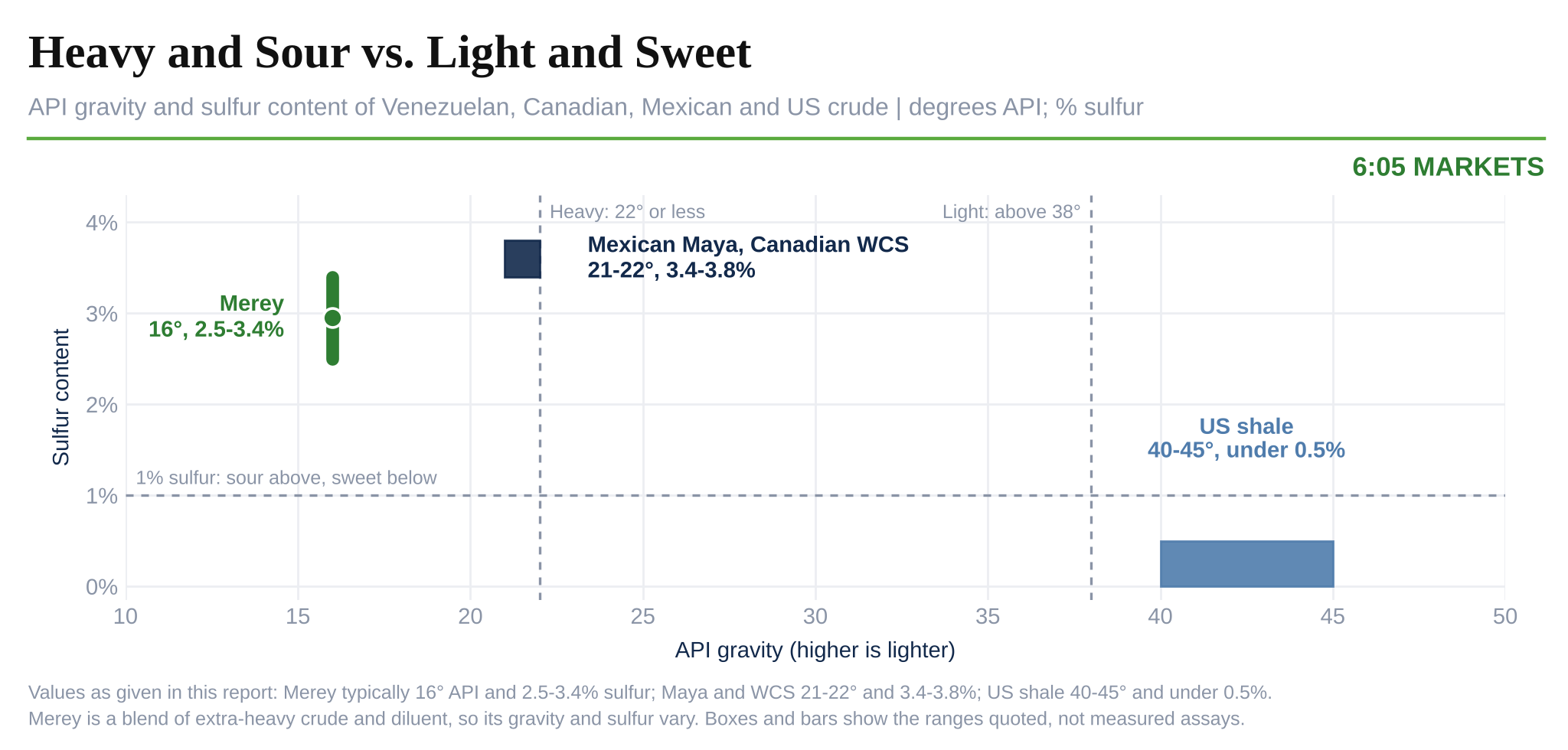
Oil density is measured using an arbitrary scale known as API gravity, API standing for the American Petroleum Institute. This scale is calibrated in terms of degrees API, which is in turn calculated through this formula: (141.5 / (sp. gr. 60ºF / 60ºF)) - 131.5. The denominator below 141.5 refers to the oil’s specific gravity at 60 degrees Fahrenheit which is calculated by dividing the density of the oil by the density of water. Through this scale, water is 10° API; oils above 10° float on water and oils below 10° will sink. Light crude oil generally exceeds 38° API while heavy crudes typically have an API gravity of 22° or less. Another important factor in comparing the qualities of different crude oils is sulfur content. The EIA defines crude oil with less than 1% sulfur as sweet and oil with greater than 1% sulfur as sour.
Merey, the dominant Venezuelan export grade as of mid-2026, typically has 16° API and 2.5 - 3.4% sulfur content, making it heavy and sour. However, it is important to acknowledge that Merey is a blend of extra-heavy Orinoco crude and a lighter diluent, making its API gravity slightly inconsistent and sulfur content fairly variable. These attributes are contrasted by US shale which is generally classified as light and sweet crude with an API gravity of 40 - 45° and a sulfur content of less than 0.5%. Other alternatives to Merey such as Mexican Maya and Canadian WCS are lighter than Merey at around 21 - 22° API and have similar sulfur contents at 3.4 - 3.8%. It is important to note that Merey, Maya and WCS are all heavier and more sour than US Shale. As a result, refining them requires additional units such as cokers and crackers. Only complex refineries, which are concentrated on the Gulf Coast, have this equipment to break down the residue that heavy crudes like Merey leave behind.
Gulf Coast Refining Capacity
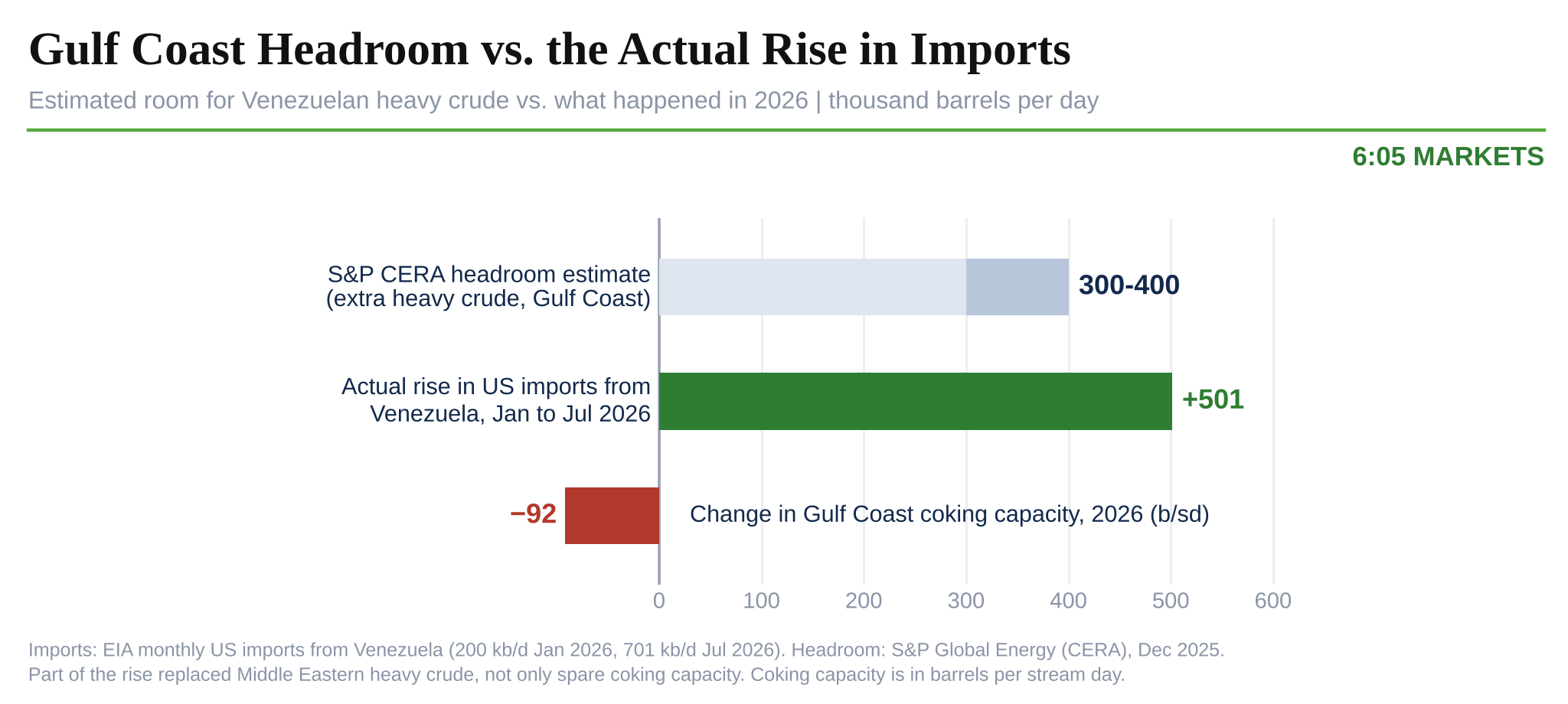
Refineries on the Gulf Coast, predominantly located in Louisiana and Texas, have almost 58% of the entire US’s coking capacity. The Gulf Coast has 1,617,855 barrels per stream day in total coking capacity out of the US total of 2,793,645 b/sd. This area is suited to refining the heavy Venezuelan crude due to the vast coastline, allowing tankers to deliver the crude from Venezuela directly. Interestingly, the Gulf Coast’s total coking capacity fell by around 92,000 b/sd in 2026, which can likely be attributed to the closing of LyondellBasell’s Houston refinery.
S&P Global Energy (CERA) projected in a December 2025 report that the refineries on the Gulf Coast would be able to absorb an additional 300,000-400,000 b/d of heavy Venezuelan crude to raise coking utilization to 2024 levels. Although this absorption was not immediate, by July 2026, US imports of Venezuelan crude rose to around 700,000 b/d, an increase of roughly 500,000 b/d over January levels that exceeded the estimated spare headroom even while total coking capacity decreased. However, this increase was also a result of the disruption to the supply of Middle Eastern oil which led to Venezuelan crude simply replacing other heavy feedstocks rather than solely filling spare coking capacity.
Why Shale Doesn’t Fit the Gap
The production of oil in the United States is forecast to average around 13.8 million b/d in 2026. The majority of it is shale and almost none of it is heavy crude, which accounted for less than 2% of Lower 48 production over the 12 months ending February 2024. The light crude the US produces costs more and leaves little heavy residue, meaning coking units sit partly idle, in turn making Gulf Coast refineries run less efficiently. As a result, the US exports much of the light crude it has in surplus and imports the heavy crude that these refineries need, filling the gap between their coking capacity and the domestic supply of heavy crude oil. Venezuelan Merey therefore complements shale, allowing refineries to blend heavy and light crude oil to use their cokers more efficiently.
Ultimately, US refineries can use Venezuelan crude, thanks predominantly to the Gulf Coast’s coking capacity. Whether Venezuelan supply can continue to fill this role will depend on its production recovery and sustained US licensing.
Implications for US Inventories and Prices
Effect on Crude and Distillate Stocks
We expect most of these increased Venezuelan imports to replace the imported heavy crude currently used in refineries, with stock builds possible if total supply exceeds refinery demand. Currently, the US demands about 20.6 mbpd, with US refineries processing around 17 mbpd (~95% capacity). The 450,000-650,000 bpd imported could marginally assist with commercial stock build-ups over the next year if other crude flows do not adjust. It may also simply displace the heavy Canadian crude currently being imported into the United States. SPR replenishment requires government purchases or other authorised transfers. However, even increased crude stocks do not necessarily imply an increase in distillate stocks. As mentioned in our previous report, US refineries are operating at historic high levels. Feeding more crude into US stocks does not itself increase the amount of distillate refined; refinery runs, crude slate and product yields also matter.
Oil Prices: A Limited Signal
Increased Venezuelan crude is unlikely to significantly affect the price of WTI in the short term, given the limited scale of additional production. WTI serves as a benchmark for the light, sweet crude extracted from the Permian and other basins in the US. WTI and Brent are more sensitive to global macro forces, and because we believe Venezuela’s short-term production growth will be constrained, it’ll lack the scale to alter global supply-demand fundamentals. Rather than moving headline prices, increased imports of Venezuelan crude will primarily widen the heavy crude-light crude price differential existing alongside heavy grades such as Canadian WCS and Mexican Maya.
Differentials and Diesel Margins
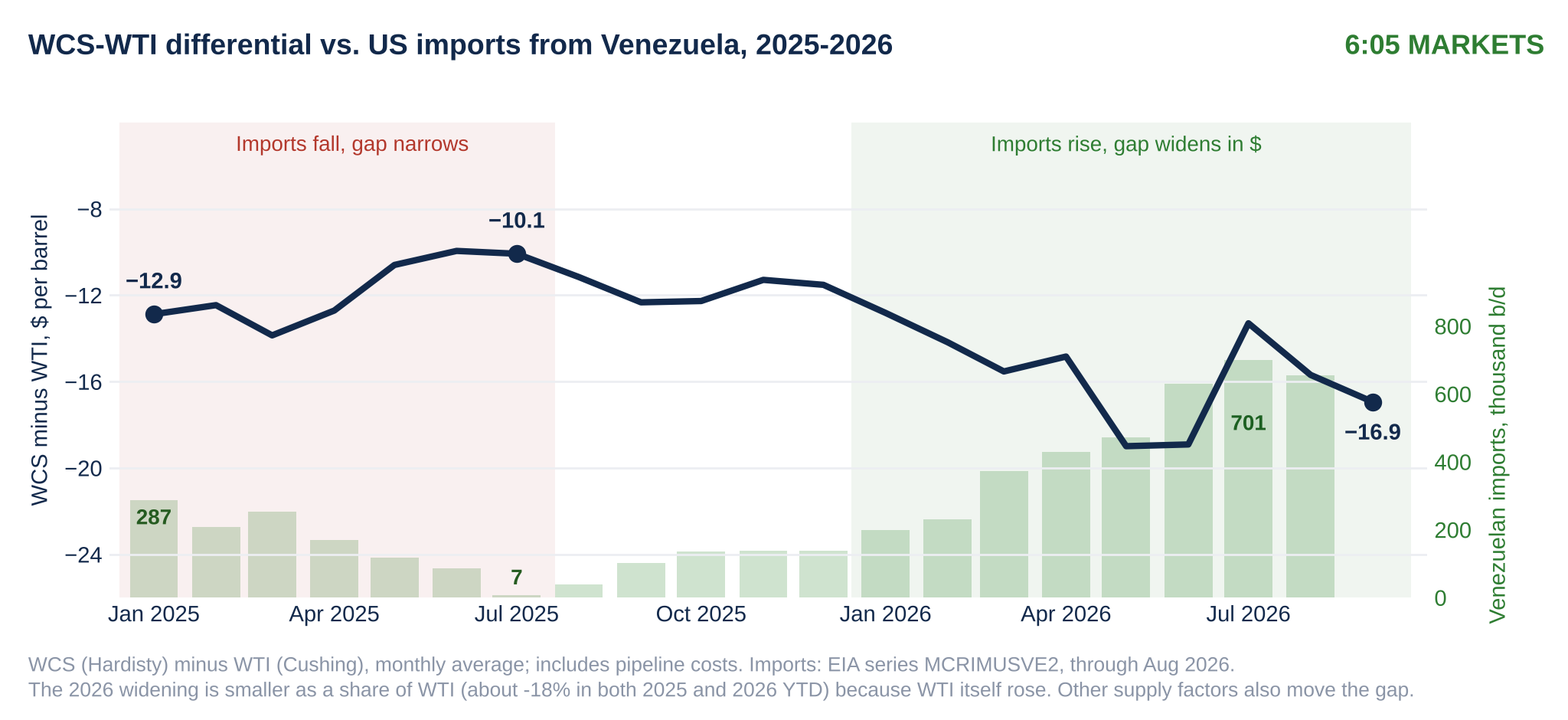
The largest impact that Venezuelan crude has on the US is its ability to undercut the current heavy crude import environment. Canada exports around 3 mbpd of heavy crude while Mexico exports around 300,000 bpd. Adding 400,000-600,000 bpd of Venezuelan imports could put downward pressure on heavy-crude prices, specifically WCS. Already, based on current 2026 data, the resurgence of Venezuelan imports has coincided with the WCS-WTI differential widening from -$12.1 in January to -$16.9 in August. While 2026 was quite an unpredictable year, some of this widening may reflect Venezuelan imports. Similarly, in 2025, we see that after Venezuelan imports dropped to nearly 0, the WCS-WTI differential narrowed from -$12.9 to -$10.1. Refinery maintenance and pipeline constraints also matter, so this comparison alone does not establish causation.
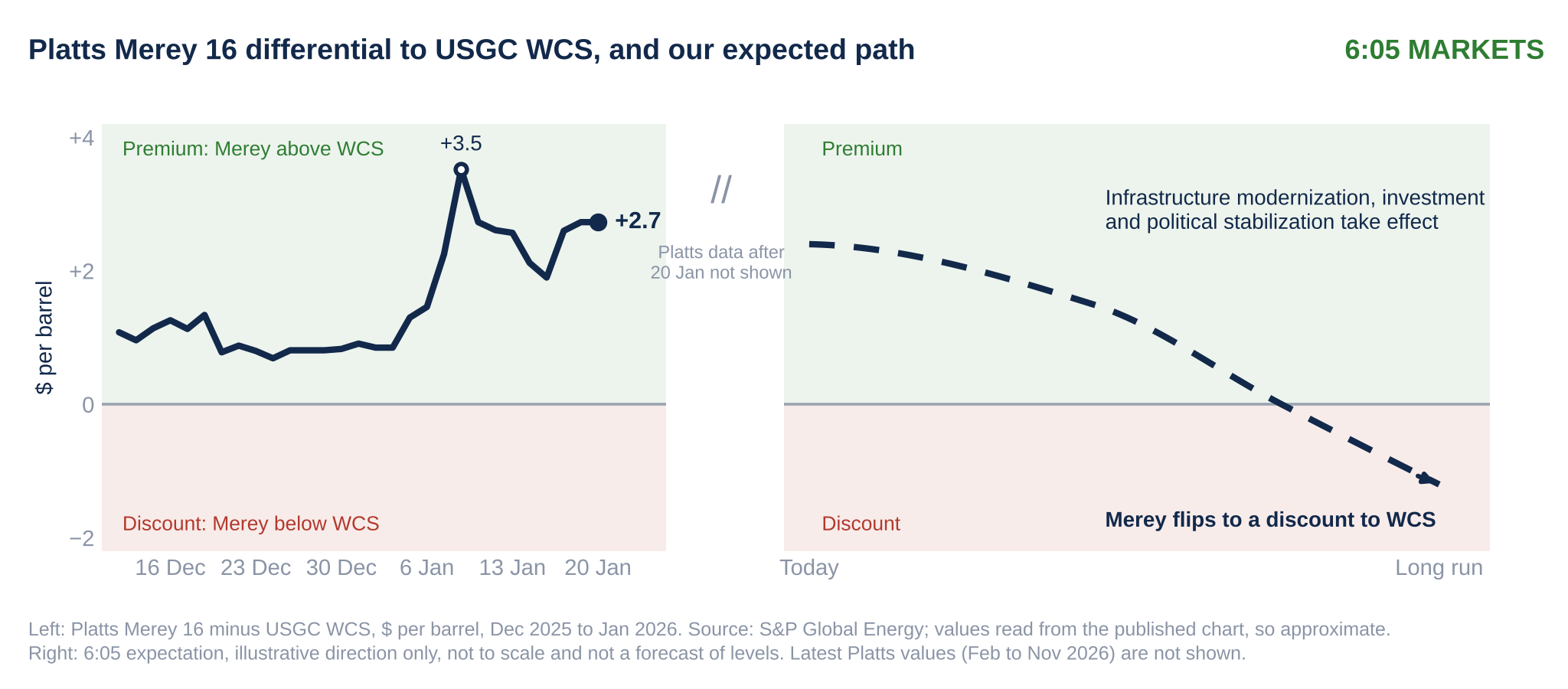
Its impact will also appear in Gulf Coast refining margins. Currently, however, Venezuelan Merey is likely priced at a slight premium to Canadian WCS. This may be due to a multitude of factors, including the concentration of exports at its main terminal Jose. Another reason is the insecurity of the licenses, which could be revoked given a change in the political environment. However, these can be changed. As infrastructure modernisation and investment take effect, and politics stabilize in Venezuela, we expect this Merey premium to WCS to come under pressure and potentially reverse to a discount.
Figure 11 · The Reversal of Merey’s Premium to WCS
As increasing Venezuelan supply competes for refinery demand in PADD 3, it could also force other grades to become cheaper. The widening of the heavy-light differential incentivizes refiners to switch to processing greater amounts of now relatively cheaper heavy crude, improving feedstock economics and boosting US refining margins. This does not necessarily widen benchmark diesel crack spreads.
Our Position
We estimate that vast amounts of reserves, approximately 303 billion barrels, present attractive investment opportunities for foreign petroleum companies and will act as a significant tailwind for Venezuelan output. However, given decaying infrastructure and proposed investment timetables, we believe sizable production and exports will not materialize for a long time. Given that Venezuela continues to maintain or increase its export percentage to the US, the quantity exported will experience a modest increase through 2027. Over the longer term, Venezuela has a much higher ceiling given the required investments.
We will consider the effect of increased shipments of Venezuelan heavy crude to the US refining industry and markets. We expect Venezuelan heavy crude to have a limited short-term impact on the price of WTI, but a greater effect on the heavy-light margin. Therefore, increased Venezuelan output will extend to exports to the US, widening that margin. The main impact of Venezuelan crude will be the economics of these Gulf Coast refineries, which will be more incentivized to run the cheaper heavy crude suited to their configurations.
Short-Run (1-year)
In the past couple of months, production has flatlined, while exports to the United States have fluctuated. US-bound exports fell 29% from September to October, possibly due to refinery maintenance, but still show no signs of improvement. We believe that Venezuelan production is likely at operational capacity. Restarting existing wells and equipment modernization takes months to years. Demand-wise, US refinery utilization has recently run at record highs, and we don’t expect this to extend into 2027. Therefore, we expect a small amount of production recovery in 2027.
| Scenario | Assumptions | Forecast for Averaged Production/Exported to US | Effect on US |
|---|---|---|---|
| Base | Wells partly come back online and bottlenecks gradually ease. Licenses hold, export restrictions ease further, foreign investment rises, and freight rates hold or fall. | 1H2027: 1.20 mbpd output 555,000 bpd exported 2H2027: 1.25 mbpd output 575,000 bpd exported | Doesn’t change crude stocks, slightly widens heavy-light differential, slight increase in refiner margins. |
| Bull | Wells restart quickly, bottlenecks clear faster than expected, equipment and infrastructure modernize, US refinery demand stays high, and Venezuelan crude stays relatively cheap. | 1H 2027: 1.30-1.35 mbpd output 650,000 bpd exported 2H 2027: 1.40-1.45 mbpd output 700,000 bpd exported | US crude stocks build slightly, significantly widens heavy-light differential, keeps refinery margins at record highs. |
| Bear | Policy changes, limited foreign activity, and continued infrastructural bottlenecks contribute to a drop in output. This and decreased US refinery demand lead to fall in exports. | 1H 2027: 1.05-1.10 mbpd output 475,000 bpd exported 2H 2027: 1.00-1.05 mbpd output 420,000 bpd exported | Does not affect crude stocks, narrows heavy-light differential, decreases refinery margins. |
In our base case, we assume a story of slow recovery for crude output: wells are slowly restarted while equipment becomes slowly modernized from new bouts of investment. We also assume a pragmatic view of policy where export licenses remain in place while restrictions on exports ease further. We also assume foreign investment and activity will increase, while freight rates will hold or gradually decline. Under these circumstances, we expect US-bound exports to average 555,000 bpd in 1H 2027 while rising to around 575,000 bpd in the second half of 2027. Gradual growth is logical: as infrastructure and equipment slowly modernize and more wells are utilized, production will slightly increase while an export-friendly policy environment incentivizes more shipments to the US. The effect on the US is quite modest; crude stocks will be largely unaffected due to such a marginal increase in supply, while the heavy-light differential widens slightly, incentivizing refiners to run heavy crude, improving refiner margins slightly.
In our bull case, existing wells restart quickly, US refinery demand stays high, equipment and infrastructure modernize quicker, and Venezuelan crude remains relatively cheap compared to other heavy crudes (Maya/Canadian). We expect US-bound exports to average 650,000 bpd in 1H2027 and further rise to 700,000 bpd in 2H2027. This larger supply slightly builds US crude stocks and significantly widens the heavy-light differential, keeping refiner margins at record highs.
In our bear case, policy changes, limited foreign activity, and continued infrastructure bottlenecks are restraining output, while US refinery demand for Venezuelan crude drops. We expect US-bound exports to average 475,000 bpd in 1H 2027, falling to around 420,000 bpd in 2H 2027, significantly below the recent average. Crude stocks will remain unaffected, but the heavy-light differential narrows, and refiner margins decline.
Figure 12 · US-Bound Venezuelan Export Projections (1-year)
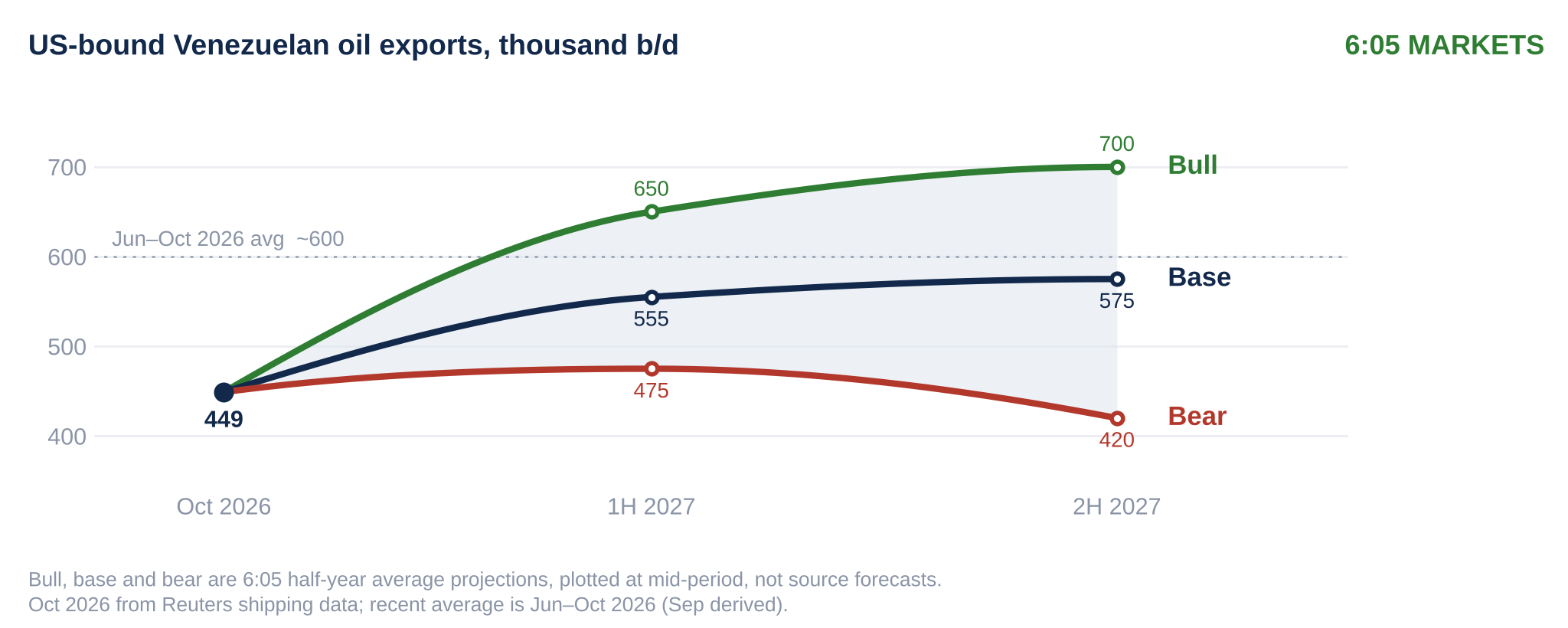
While our base case is lower than the 5-month average of roughly 600,000 bpd, this 5-month average and our half-year projections cover different seasonal periods. The chart starts from October’s approximately 449,000 bpd, not the five-month average. For our scenario analysis, not all the assumptions need to be satisfied, but these would be the most likely factors given our results. Ultimately, analyzing the short run shows there is not likely to be much growth in crude exports to the US since output simply cannot be currently scaled.
Long-Run (2030-2040)
While output is near operating capacity today, we assume that it is due to a limit on current infrastructure and development, not on Venezuela’s long-run potential. Over a 10+ year horizon, our question shifts to how much investment capital is put in, how quickly it delivers returns, and how the market ultimately absorbs these new, extra barrels.
| Scenario | Assumptions | Averaged Forecast 2030/2035/2040 | Effect on US |
|---|---|---|---|
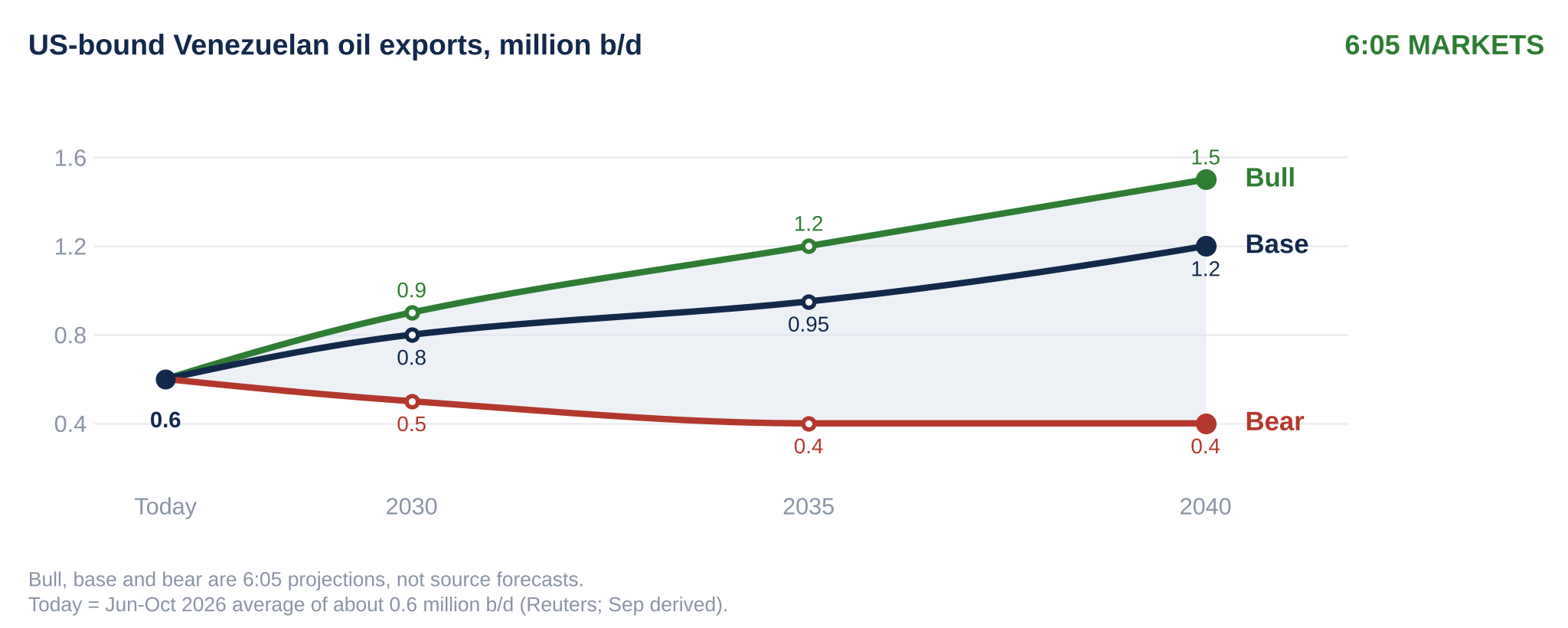
| Base | Around $70-80 billion invested in Venezuela, mostly from Chevron, other joint ventures, and partial satisfaction from NABEP. US policy will remain broadly friendly towards Venezuelan imports, and Venezuelan policy exhibits a similarity to the current environment. | Output (mbpd): 1.6/ 1.9 / 2.4 US-bound exports (mbpd) 0.8/ 0.95 / 1.2 | Venezuelan crude effectively replaces imported Mexican heavy while competing with Canadian heavy. The extra surge will widen the heavy-light differential modestly. Slightly better refinery margins in the long run. |
| Bull | Significantly more invested, around $120-130 bn, with NABEP fulfilling most of its $100 bn while many foreign companies start to ramp up activity in the country. US policy becomes much more lenient, with formal sanctions relief possible. | Output (mbpd): 1.7/ 2.25 /2.8 US-bound exports (mbpd) 0.9/ 1.2 / 1.5 | Venezuelan crude mostly shipped into PADD-3 region, replacing any Canadian flows into the Gulf Coast given more favorable margins. Heavy-light differential widens significantly. |
| Bear | Little investment materializes ($20-35 bn), with the NABEP deal basically failing and little foreign investment activity. US stricter around export licenses, and Venezuelan politics once again sees instability or breakdown. | Output (mbpd): 1.2 / 1.3 / 1.4 US-bound exports (mbpd) 0.5 / 0.4/ 0.4 | Very little change in effect on the US, status quo maintained, considering a marginal increase in Venezuelan exports. |
When considering long-term dynamics, we must first analyze the demand profile for the next 10 years. Many sources expect Venezuela’s output to double or triple; the question is whether this supply will be needed in the US.
The largest supply of crude oil in the US is domestic production, largely crude extracted from the Permian Basin. However, by 2036, extraction prices are expected to increase. This could put upward pressure on the price of WTI, depending on global supply-demand balances, and shift refinery demand towards heavier sources. However, offsetting this increased demand is a potentially greater percentage of electric vehicle usage in the US, effectively reducing the end-market demand offered.
On the supply side, Canadian WCS crude, also heavy and sour in nature, is the main competitor to Venezuelan heavy in the US. However, oftentimes increases in Venezuelan supply force a significant discount on WCS to export to the US, especially in the Gulf Coast PADD-3 region. While Canada will export significantly higher quantities of crude (3 mbpd) to the US, it will be tougher to compete with ever-surging, increasingly cheaper Venezuelan supply flooding into US markets. Therefore, Venezuela, given its current situation, could eventually strengthen its competitive position relative to WCS in the US. So, while demand for heavy crude may become stagnant in 10 years, Venezuelan crude positions itself to be the main competitor for the demand-heavy, refinery-dense US PADD-3 region.
Ultimately, the most consequential factors determining export flows to the US are the investment and political environments. The estimated $180 billion needed is a gargantuan amount that is more ambition than reality. While $100 billion has been planned by NABEP, this is not a formal commitment but a goal over the span of 25 years. Chevron is currently the most open out of all the major foreign oil companies to investment in Venezuela, though other giants such as ExxonMobil have considered reentering the country through joint ventures with PDVSA; the amount invested is unknown. Politically, Venezuela has been quite volatile, and so it will be extremely difficult to foresee whether the environment will support further crude production and growth in exports to the US. As a result, our scenario analysis will involve assumptions that compare these likely erratic variables.
In our base case, we assume roughly $70-80 billion is invested in Venezuela over the next decade, mostly from Chevron and other joint ventures, with NABEP only partially fulfilling its target. We also assume US policy remains friendly towards Venezuelan imports, while Venezuelan policy remains similar to the current environment. Under our given circumstances, we expect output to rise to 1.6 mbpd in 2030, 1.9 mbpd in 2035, and 2.4 mbpd in 2040, with US-bound exports growing to 0.8, 0.95, and 1.2 mbpd over the same years. These are scenario estimates, rather than outputs from a field-level production model. This steady growth is logical: as investment slowly materializes and more wells and infrastructure come online, production should rise while a friendly policy environment keeps Venezuelan barrels flowing to the US. The effect on the US is rather modest. Venezuelan crude replaces imported Mexican heavy while competing with Canadian heavy. This is assuming that the price remains competitive. The extra surge only widens the heavy-light differential slightly, incentivizing refiners to run more heavy crude and slightly improving refiner margins in the long run.
Figure 13 · US-Bound Venezuelan Exports: Three Paths to 2040
Conclusion
Venezuelan crude has recovered strongly since 2020, but its effect on US markets in the short run will be marginal, as output has plateaued. Our base case for the next year also expects little growth for output and exports.
Over the long run, however, the investment and political environments will decide the future of Venezuelan crude. Current investment plans, specifically NABEP’s $100 billion target, are not fully committed funding. Also, the OFAC licenses are executive actions that can be amended or revoked as US policy changes, so US policy will also be a main swing that determines the amount of Venezuelan crude that is exported to the US. Despite this variability, our base case assumes that these environments will remain stable, and if infrastructure, investment, and political stability improve, we expect Merey’s premium to WCS in the Gulf Coast to face pressure and potentially reverse into a discount, increasing its competitiveness.
We are confident about this. Currently, output is flat, and the Gulf Coast holds about 58% of US coking capacity. Venezuelan imports and WCS discounts have also moved in our expected direction in 2025 and 2026, although other market factors also influence differentials. What we are not certain about is the pace of investment. Therefore, to see how our scenarios unfold, we need to watch the state of OFAC licenses, Venezuelan policy, Chevron and NABEP’s progress, port throughput at Jose, freight rates, delivered Merey-WCS differentials, and the entrance of other major oil conglomerates.
US crude imports from Venezuela will average between 515,000 and 600,000 barrels per day from January to June 2027.
Series US crude imports from Venezuela (thousand b/d) Entry 655.00 Range between 515.00 and 600.00 Across 1 Jan - 30 Jun 2027 Written 1 Aug 2026
Resolves against EIA series PET.MCRIMUSVE2.M on the average of its readings from 1 Jan - 30 Jun 2027. Not investment advice.