The French Premium: The Rise of the Yield
The fall in the OAT-Bund spread to 153.9 bps is a pause rather than a recovery, and we expect it to end the year around 154 bps with the French 10-year near 4.83%, as France still has no 2027 budget while its debt and interest costs keep rising.

Executive Summary
On October 22, 2026, the French Obligations, Assimilables du Trésor (OAT), 10-year government bond rose to a yield of 5.13%, compared to the German bund, which holds at 3.38%. Comparing the two bonds, the OAT-Bund spread peaked at 174.6 basis points (bps) on October 22nd. This was the widest the spread has been since the euro debt crisis, and it happened only one day before one of the big three credit rating agencies, Moody’s, had to decide on the rating of France, especially at a time when many sources were expecting a downfall. Previously, in early June, this spread was only around 60 bps, which means that in less than five months investors went from treating France almost like Germany to asking for much more to lend to it. Moody’s ended up keeping France at Aa3, considered a high investment-grade bond with near-zero chances of default but with a negative outlook. This is under the assumption that a 2027 budget reducing the deficit gets adopted, and on November 4, the National Assembly rejected the first part of that budget with 458 votes against none in favor.
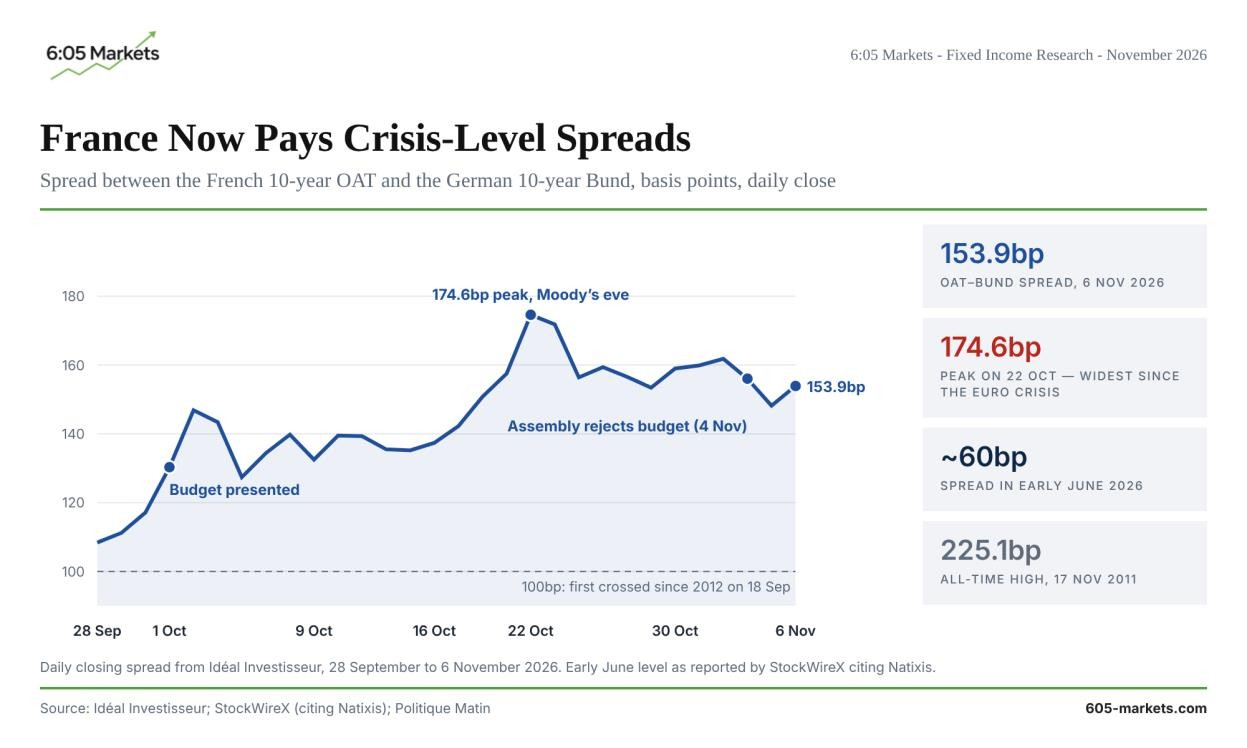
The spread has since come down to 153.9 bps on November 6, and many could see this as the worst being over. Our thesis is that this relief is premature as none of the reasons that pushed the spread to this level have actually been solved. France still does not have a budget for 2027, its debt is at about 119% of GDP, the deficit for this year is expected at 5.4% when the target was 5% and the interest it pays on its debt keeps going up every year. At the same time, inflation in the euro area rose to 4.0% in October and the European Central Bank (ECB) is expected to raise rates again in December, which would therefore make borrowing even more expensive for a country that plans to borrow a record €340 billion in 2027.
To drive our thesis, we will be using three scenarios for the end of the year depending mainly on what happens with the budget, with the probabilities being our own estimates as there is no specific market estimating this. We expect the OAT-Bund spread to end the year around 154 bps, basically where it is today and far from the 60 bps of June, with the French 10-year around 4.83%. In other words, we don’t think France goes back to being priced close to Germany anytime soon.
Key Numbers
| OAT–Bund spread, 6 Nov | Peak spread, 22 Oct | French public debt to GDP | Odds of an ECB hike on 17 Dec |
|---|---|---|---|
| 153.9bp | 174.6bp | 119% | 72% |
Idéal Investisseur, OAT/Bund spread, 6 November 2026; L’Esprit Français, 24 October 2026; Le Private Banker, 5 November 2026.
How France Got Here
A Budget Nobody Votes For
To understand why investors are so worried about France, we must focus on the last budget. It took France four months of political deadlock to finally adopt the 2026 budget on February 2, 2026, and even then, it was not voted by the deputies since the government had to use Article 49.3 of the French Constitution, a rule that lets the government pass a law without a vote but allows deputies to try and remove it if they don’t believe in the action. The government survived two of them, and the budget passed with the goal of bringing the deficit down to 5% of GDP. However, the deficit for 2026 is now expected at 5.4%, showing that France is leaning to miss the target that had been initially set at the start of the year.
This year it looks like the same story is repeating itself. Prime Minister Sébastien Lecornu presented the 2027 budget on October 1, again aiming for a 5% deficit with €54 billion in savings, which is already more relaxed than the 4.1% France had promised to Brussels before. Since the government does not have a majority, even one of its own ministers admitted it would be very hard to get the budget passed through a vote. On November 4, the first part of the budget was rejected 458 to 0. Even the deputies from the president’s own camp voted against it, because the text had been changed so much during the debates that the deficit would end up at 5.9% of GDP instead of 5%, according to the Minister of Public Accounts, David Amiel. Furthermore, the repercussions came one day after, a national strike took around 600,000 people to the streets according to the authorities and more than 1.5 million according to the unions, which shows that it would be very hard for any government to cut spending right now.
Why the Market Reacted
This 174.6 spread in October didn’t happen overnight; instead, it was a series of increases. It went from about 60 bps in early June, to above 100 bps on September 18 for the first time since 2012, and then to around 147 bps on October 2 right after the budget was presented. The biggest jump however came before the Moody’s decision, with the French 10-year going above 5.1% on October 22, as the market was preparing itself for France to lose another rating after Fitch and S&P had already brought it down to A+. When Moody’s kept the rating, the spread fell 15.4 bps in one session, but it has not gone back below 145 bps since.
Furthermore, it is not only politics. The economist Robin Rivaton points to the ECB reducing the amount of bonds it holds, Japan raising rates which is bringing Japanese investors back home, and the financing of artificial intelligence (AI) competing for the same savings, all of which are removing buyers at the same time that France needs more of them. This matters a lot since about 56% of French negotiable state debt was held by foreign investors at the end of 2025, so France depends heavily on investors that can easily choose to lend somewhere else.
Worse Than Italy
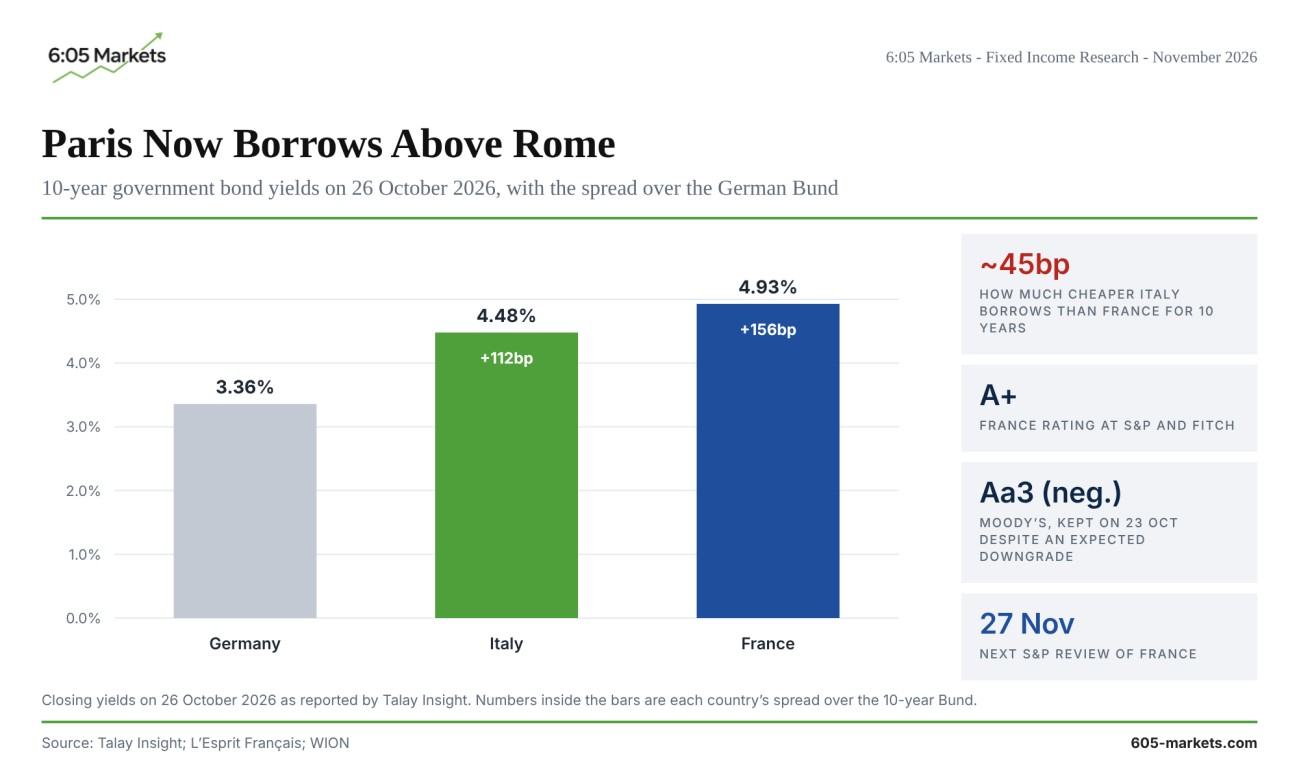
The most surprising part of this situation is how France now compares to Italy, a country that for years was seen as the risky one in the euro area. On October 26, the Italian 10-year yield was at 4.48% against 4.93% for France, meaning Italy was borrowing roughly 45 bps cheaper than France for ten years, with a spread over Germany of 112 bps against 156 bps for France. The market is therefore no longer only looking at how much debt a country has, but at whether its government can pass a plan to deal with it, and right now this is working in favor of Italy.
The Cost of Waiting
A Growing Interest Bill
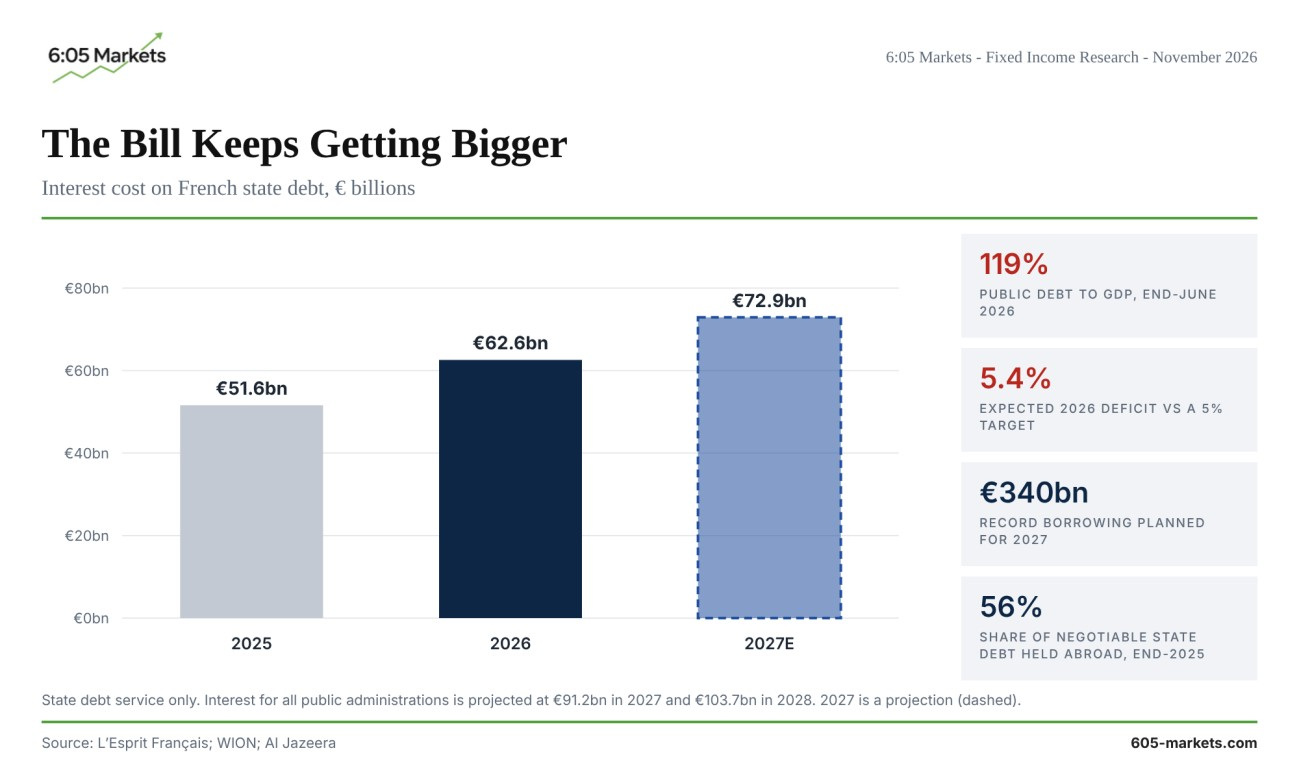
The longer this lasts the more expensive it gets. The interest France pays on its state debt went from €51.6 billion in 2025 to €62.6 billion in 2026 and is expected to reach €72.9 billion in 2027, and when counting all public administrations, it is expected at €91.2 billion in 2027 and €103.7 billion in 2028. With public debt at about €3,595 billion at the end of June, every increase in yields adds to this bill as old debt gets refinanced at higher rates, which would therefore mean even less room to reduce the deficit, a cycle that is very hard to break once it starts.
Our Prediction
We expect three main cases for France until the end of the year, depending mainly on what happens with the budget in the Senate and then back in the National Assembly, as well as the S&P review on November 27. Unlike our previous reports, there is no liquid market pricing the French budget, so the probabilities we are using for each scenario are our own estimates. They are based on what happened last year, when France went into the new year without a budget and only adopted it on February 2 using Article 49.3, which is why we see the budget not passing by the end of the year as the most likely case.
Budget Passes (30%). The Senate and the National Assembly find a compromise, or the government uses Article 49.3 and survives the censure motions that would follow, giving France a 2027 budget before the end of the year. This would remove a big part of the political premium, and S&P would have less reason to cut the rating. We expect the OAT-Bund spread at 110–135 bps and the French 10-year at 4.40–4.65%.
Muddle Through (50%). No budget is adopted by December 31, and France starts 2027 the same way it started 2026, with a temporary solution while negotiations continue, but the government survives. The spread stays close to where it is today as investors keep waiting, while the ECB hike in December keeps yields high across the euro area. We expect the spread at 145–170 bps and the French 10-year at 4.70–5.00%.
Crisis Deepens (20%). The government uses 49.3 and loses a censure motion, and/or S&P downgrades France again on November 27, adding a rating problem on top of the political one. In this case the spread breaks above the 174.6 bps of October 22 and the French 10-year goes back above 5%. We expect the spread at 175–210 bps and the French 10-year at 5.05–5.40%.
What we expect. Weighting the three cases by our probabilities, the expected outcome at the end of the year is the OAT-Bund spread around 154 bps and the French 10-year around 4.83%, similar to where France is today. This is the main point of our thesis: even with relief since October 22, the most likely outcome is not France going back to where it was in June, but staying priced as a risk, still above Italy. As such, we see the recent fall in the spread as a pause rather than the start of a recovery, and we prefer shorter-dated OATs over long ones until a budget is actually adopted.
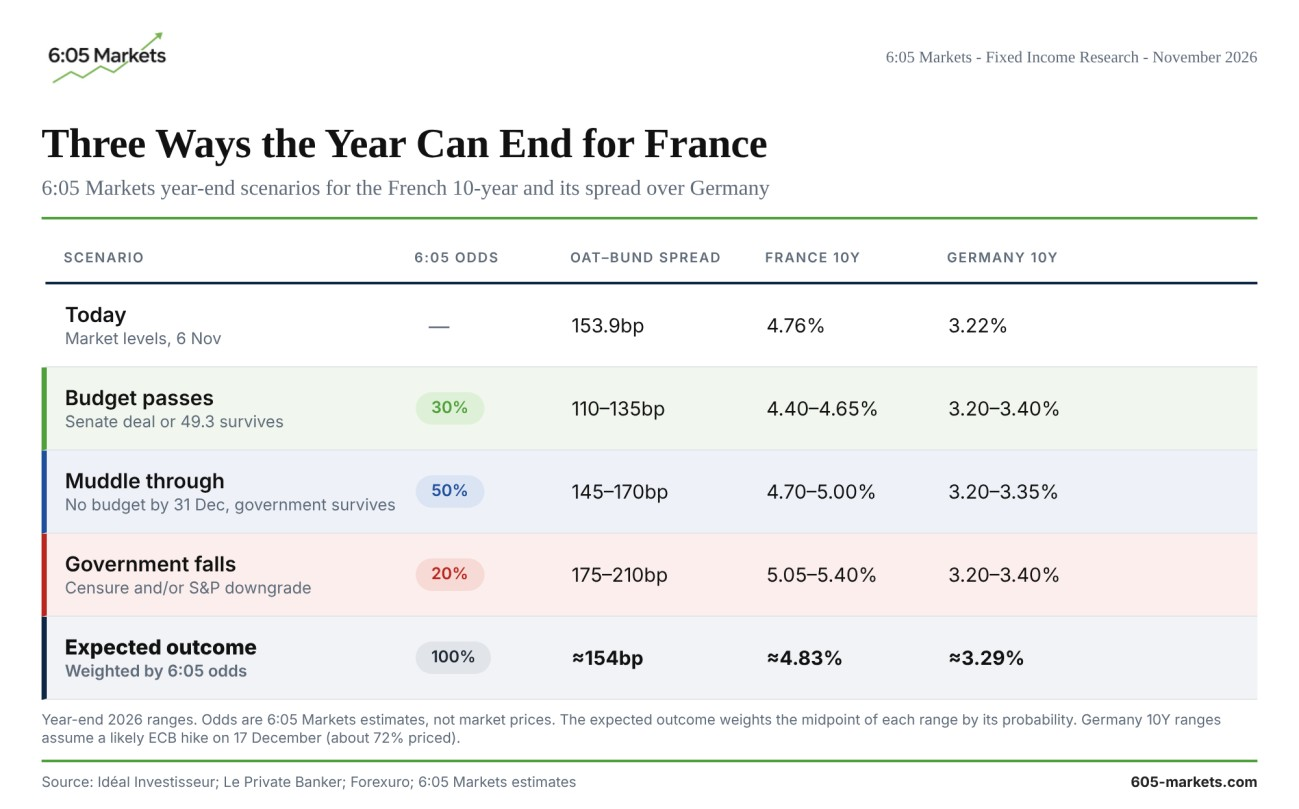
Forecast Method. Our scenario ranges are 6:05 Markets analyst estimates anchored to the OAT and Bund closing yields on November 6, the daily OAT-Bund spread history since September 28, the spread levels reached around the Moody’s decision and the ECB pricing for December 17. The scenario probabilities are 6:05 Markets estimates based on the outcome of the 2026 budget process and the November 4 vote in the National Assembly, as we could not find a liquid prediction market for the 2027 budget. They are not outputs from a model.
What Would Change Our View?
The spread falls faster if:
- The Senate vote on December 9 leads to a compromise that brings the deficit back close to 5% and the National Assembly accepts it, or S&P keeps France at A+ on November 27.
The spread blows out if:
- The government falls after using Article 49.3, S&P cuts France below A+, or the spread closes above the 174.6 bps peak of October 22, which would mean investors are no longer waiting for a solution.
Conclusion
France is a reminder that in the bond market the size of the debt is not the only thing that matters, but whether a government can show it has a plan to deal with it. In less than five months the spread with Germany went from about 60 bps to 174.6 bps, with France now borrowing more expensively than Italy, and even after Moody’s gave France more time the budget that this decision depended on was rejected 458 to 0 less than two weeks later.
Our thesis is therefore that the recent drop in the spread to 153.9 bps is a pause and not a recovery, with the spread around 154 bps and the French 10-year around 4.83% by the end of the year. A divided National Assembly, a deficit that keeps missing its target, interest costs that keep growing and an ECB that is in the camp for another hike all point to France staying priced as a risk until it actually adopts a budget. For investors, the question is not whether France will be able to pay its debt, but how much more they should be paid to hold it while the politics stays this unstable. Hence, investors must remain attentive to the S&P decision on November 27 and the Senate vote on December 9, as these will decide whether France starts to look more like Germany again or keeps being priced above Italy.
The France–Germany 10-year spread (OAT–Bund) will be between 145 and 170 bps on 31 December 2026.
Series OAT–Bund 10-year spread (bps) Entry 153.90 Range between 145.00 and 170.00 By 31 Dec 2026 Written 6 Nov 2026
Resolves against the readings entered for OAT-BUND-10Y on the last observation on or before 31 Dec 2026. Not investment advice.
Data Sources
- Idéal Investisseur – “OAT / Bund Spread Today” (daily OAT, Bund and spread history, 28 September – 6 November 2026), 6 November 2026. ideal-investisseur.fr/en/markets/oat-bund-spread.html
- StockWireX – “Why the French Bond Spread Hit a 2011 High, and What Happens Next” (citing Natixis, Deutsche Bank, ING, Rabobank), October 2026. stockwirex.com/analysis/french-bond-spread-2011-high-october-2026/
- Global Macro Expert – “OAT–Bund Spread: France–Germany 10-Year Bond Spread History” (ECB monthly data), 2026. globalmacro.expert/bonds/spreads/france-germany/
- Cryptoast – “Les OAT explosent : les obligations françaises dépassent 5,1 % quand celles de l’Allemagne restent à 3,4 %,” 22 October 2026. cryptoast.fr/oat-france-taux-obligations-explosent-spread-bund-170-points-dette/
- L’Esprit Français – “Moody’s maintient la note de la France : un répit conditionné à un budget non voté,” 24 October 2026. lespritfr.com/2026/10/24/moodys-note-france-aa3-repit-budget-2027/
- WION – “Why France Looks the Most Fragile in the G7 Amid Protests and Budget Deadlock,” 19 October 2026. wionews.com/world/france-record-borrowing-budget-deadlock-protests-debt-crisis-1792347325485
- Politique Matin – “Budget 2027 : pourquoi même les macronistes ont lâché Lecornu,” 5 November 2026. politiquematin.fr/budget-2027-macronistes-vote-contre-majorite-effondree
- Euronews – “France Braces for Nationwide Strike as Government Backs Austerity Budget,” 5 November 2026. euronews.com/2026/11/05/france-braces-for-nationwide-strike-as-government-backs-austerity-budget-to-rein-in-soarin
- Al Jazeera – “France Adopts 2026 Budget After Two No-Confidence Votes Fail,” 2 February 2026. aljazeera.com/news/2026/2/2/france-adopts-2026-budget-after-two-no-confidence-votes-fail
- Talay Insight – “Italy’s Risk Premium Drops to 112 Basis Points, Undercutting France,” 27 October 2026. talayinsight.com/en/olay/italyanin-risk-primi-112-baz-puana-inip-fransanin-altina-yerlesti/
- ING Think – “Eurozone October Inflation Brings ECB Closer to December Hike,” November 2026. think.ing.com/snaps/eurozone-inflation-brings-ecb-closer-to-december-rate-hike
- Le Private Banker – “Euro Zone Inflation Hits 4% as Energy Costs Surge 20.8%, and ECB’s Zigman Sees Rather Big Chance of December Hike,” 5 November 2026. leprivatebanker.com/2026/11/05/euro-zone-inflation-hits-4-as-energy-costs-surge-20-8-and-ecbs-zigman-sees-rather-big-chance-of-december-hike/
- Forexuro – “ECB Rate Hike Odds: 4% Inflation and EUR/USD,” 6 November 2026. forexuro.com/articles/ecb-rate-hike-odds-eurusd-december-2026