The Copper Stockpile Washington Doesn’t Own: How Do We Keep It Here?
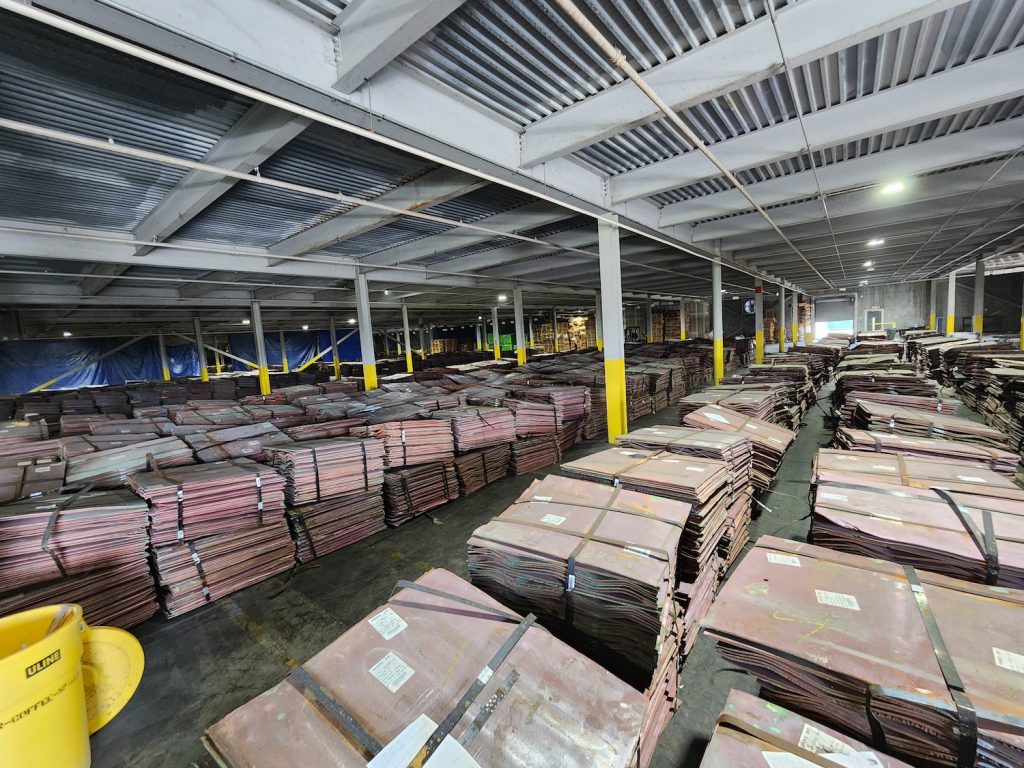
The United States holds about 1.1 million tons of copper in warehouses, more than it did even during the Cold War. Remarkably, the government did not pay for any of it.
Introduction
The United States holds about 1.1 million tons of copper in warehouses, more than it did even during the Cold War. Remarkably, the government did not pay for any of it.
How did it get there? In February 2025, the White House opened an investigation into copper imports, and the market assumed tariffs would follow. US buyers began paying more for copper than London buyers, so traders responded by shipping as much copper to the US as they could.
In his October 12 Reuters column, Andy Home argues that the smartest move is to keep the market guessing. As long as traders believe a tariff could arrive, they will keep their copper here. Because a tariff would apply only to copper entering the country, any copper already in a US warehouse would be worth more if one were imposed. Holding copper here is almost a bet on that possibility, and the bet only makes sense as long as the decision drags on. He calls this strategic ambiguity, and he believes it is working.
However, there is a catch, and Home acknowledges that the government doesn't own this copper. Traders own it and will keep it here if it benefits them. A closer look at his numbers suggests that is already changing.
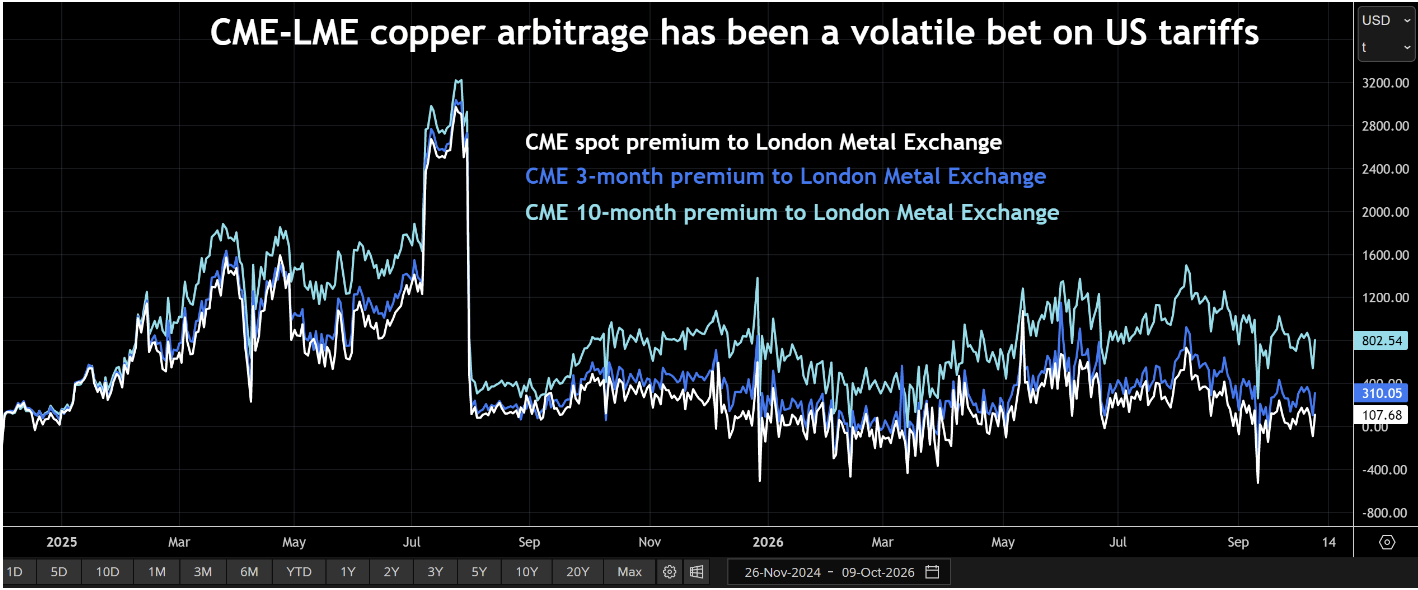
Home's column includes a chart showing how much more US buyers pay than buyers in London. In July 2025, just before tariffs were announced, that gap reached about $3,000 a ton. Today, for copper delivered immediately, it has fallen to about $108. In September it briefly dipped below zero, meaning copper was worth more in London than in the US.
Why Is the Copper Still Here?
The price of copper delivered ten months from now still has a gap of around $800 a ton. Traders are holding it as a bet that tariffs will arrive next year.
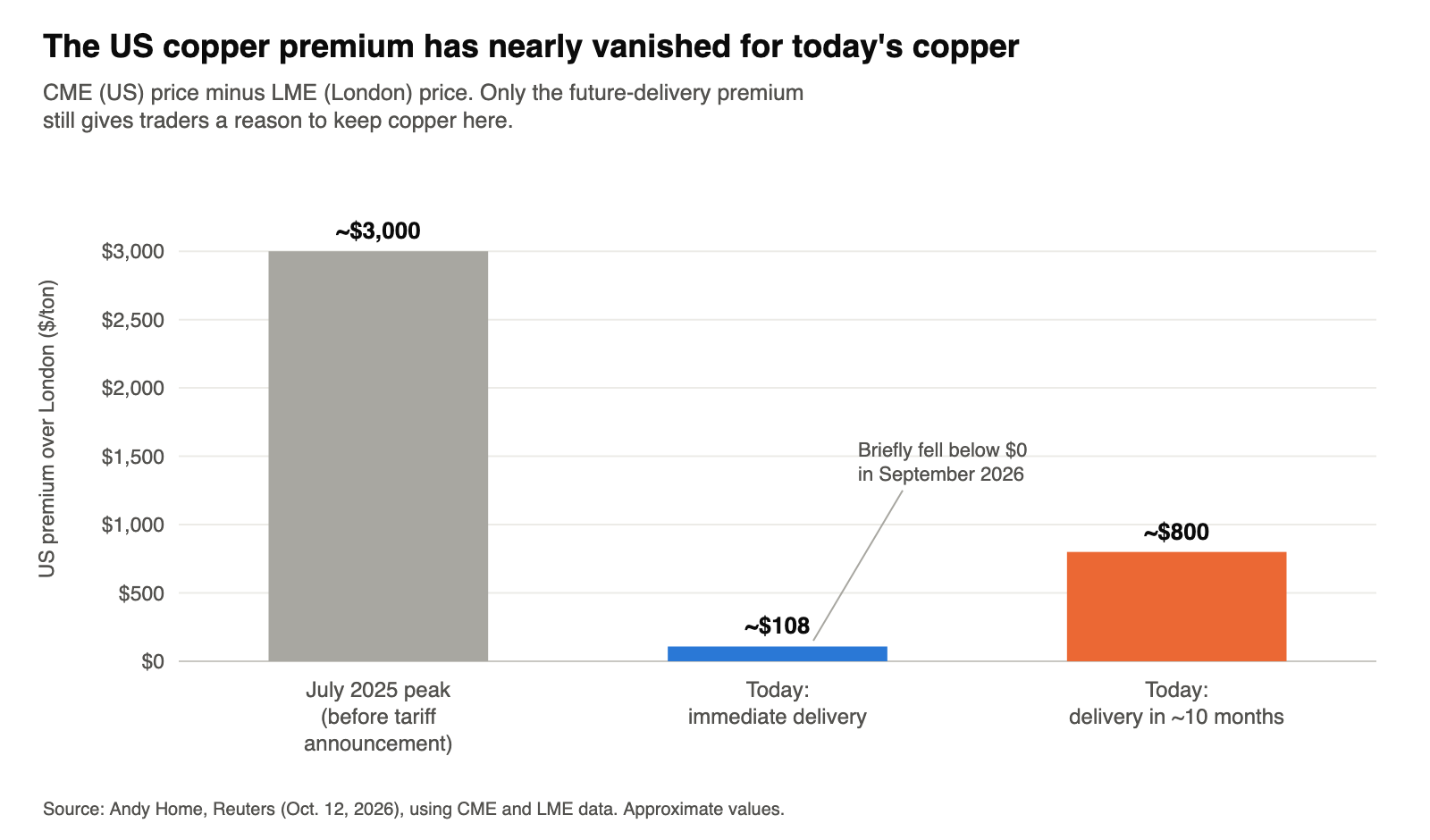
How confident is that bet? One option the White House hasn't ruled out is a 15% tariff on refined copper starting in 2027. With copper at $14,690 a ton in London, that tariff would add about $2,200 per ton. An $800 premium suggests traders see roughly a one-in-three chance that it actually happens.
Meanwhile, Home notes that prices in London and Shanghai are rising as supply tightens. If tariffs are ruled out, or keep being delayed, traders lose a reason to hold copper here.
Every ton of copper sold in the US carries that extra premium, so American wire makers, cable companies, and electrical manufacturers pay more than their competitors overseas.
The result is a strange arrangement: US manufacturers effectively fund a stockpile the government does not own, cannot control, and could lose overnight.
How Do We Keep the Copper Here?
Option one: a tariff.
Phasing in tariffs of 15% in 2027 and 30% in 2028 would make it expensive to move copper out. As Home acknowledges, the problem is that world prices can outrun any fixed tariff. If a global shortage pushes London prices high enough, copper will stay regardless. US manufacturers, meanwhile, would be stuck paying higher prices.
Option two: buy it.
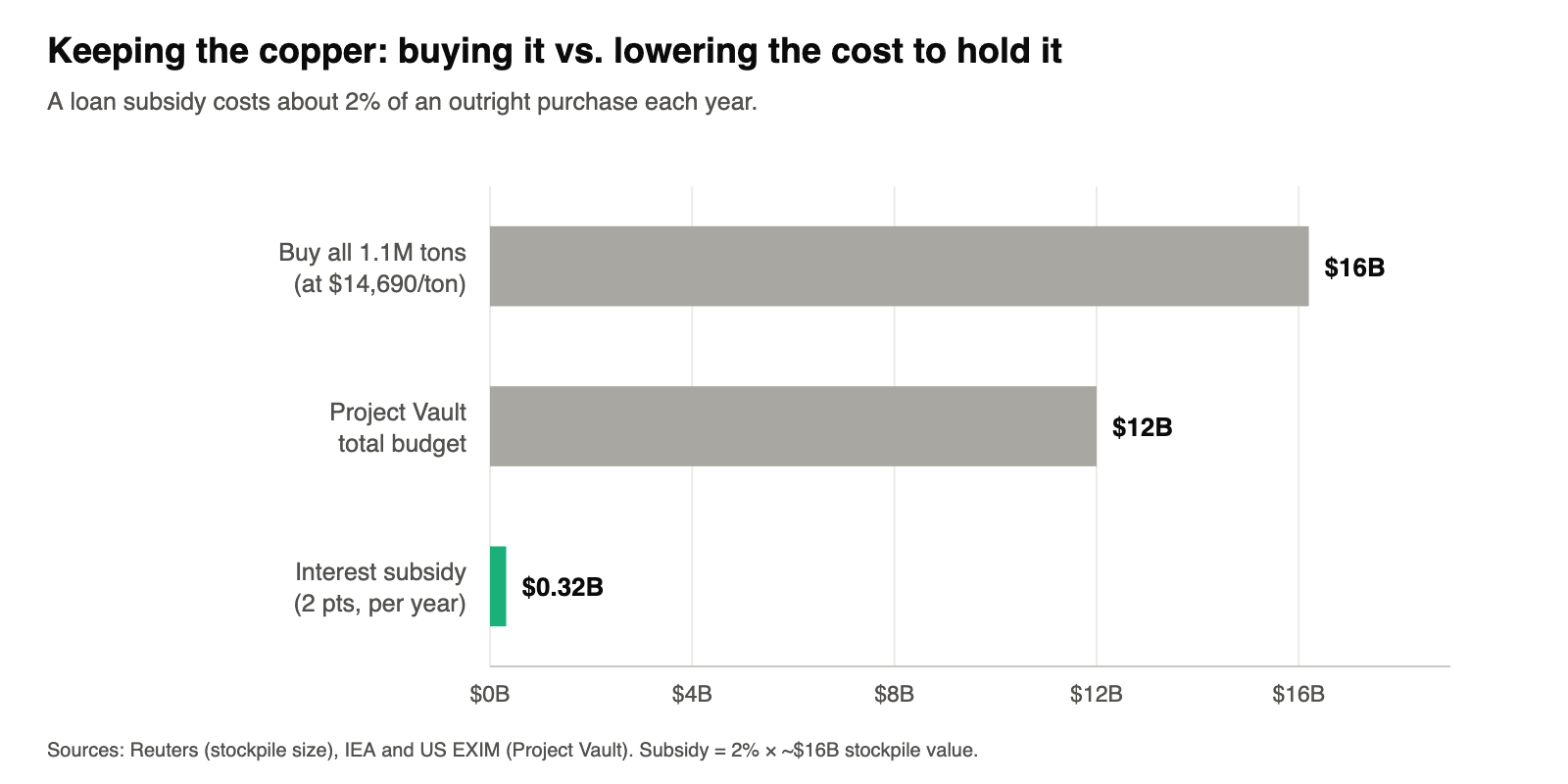
The government could move the copper into Project Vault, the public-private mineral reserve launched in February. At $14,690 a ton, however, all 1.1 million tons would cost about $16 billion. Project Vault's total budget is up to $12 billion, most of it an Export-Import Bank loan, and it prioritizes rare earths. Copper alone would take up the whole program.
Option three: 6:05’s idea.
There is a third option that Home does not consider. Instead of taxing copper or buying it, Washington could make it cheaper to keep it here. Holding copper is costly. Traders pay for warehouse space and insurance, but their largest expense is interest. Most borrow to buy the copper, so they pay interest for as long as it sits in storage. With US interest rates around 3.9%, and traders typically borrowing at somewhat higher rates, holding one ton of $14,690 copper costs roughly $600 to $750 a year. That is close to the $800 premium traders currently earn.
The Export-Import Bank is lending up to $10 billion to Project Vault. It could establish a similar facility for copper, offering low-interest loans to anyone who keeps copper in a US warehouse. Two conditions would apply: the copper must remain in the country for a set period, and in an emergency, Project Vault would have the first right to buy it at market price.
The cost would be modest. Reducing traders' borrowing costs by two percentage points across the entire stockpile would cost about $320 million a year, roughly 2% of the price of buying the copper outright. This approach also fits how Project Vault already operates. The reserve was built around private partners, with trading firms such as Mercuria, Hartree, and Traxys handling supply. A loan program would draw on those same relationships without costing $16 billion.
This is not a perfect solution, and we outline some potential questions below:
"Wouldn't this just pay traders for something they are already doing?" At the moment, partially. While the $800 premium holds, traders have a reason to stay. The program would prove its worth if tariffs are ruled out and the premium collapses. That is exactly when the copper would otherwise leave, so the program could be designed to take effect only then.
"What if there is a global shortage?" If London prices rise far above US prices, no loan program will stop traders from shipping copper abroad. A tariff would not stop them either. However, the government would still have the first right to buy.
"Why not offer a tax break instead?" Many of the largest trading houses are foreign and may owe little US tax, so that a tax credit would do little for them. Low-interest loans work for any holder, wherever it is based.
As Home suggests, keeping the market guessing only works for so long. Each month without a decision, the copper's staying power depends more on a tariff that may or may not happen. Covering part of the cost of storage is cheaper than buying the copper and easier on US manufacturers than a tariff. Washington should decide now, while the copper is still here.
Data Sources
- Andy Home, "US has built a strategic copper reserve. Now can it keep it?", Reuters, October 12, 2026 (stockpile figures, CME premium chart, tariff options)
- International Energy Agency, US Strategic Critical Minerals Reserve (Project Vault funding and rare earths focus)
- Export-Import Bank of the United States, Project Vault fact sheet
- Global Trade Review, Critical mineral stockpile project wins 'largest ever' US Exim loan (trading firms supplying Project Vault)
- MarketXLS, SOFR rate (3.9% as of October 6, 2026)