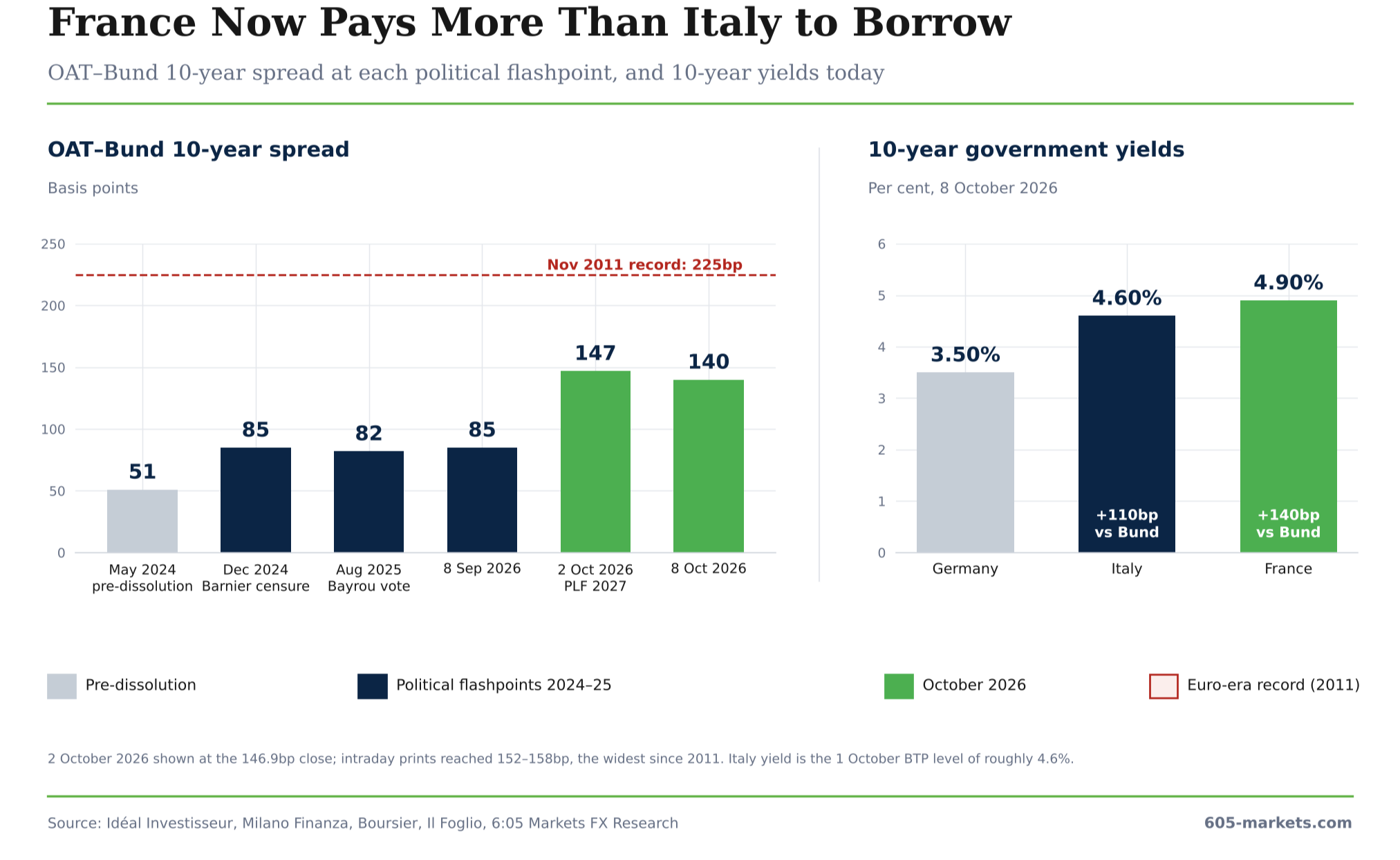
It is our belief that the market is underpricing how long French fiscal risk will weigh on the euro. The currency has fallen to 1.12 against the dollar, a 17-month low. The gap between French and German borrowing costs is the widest since 2011 and France now pays more to borrow than Italy for the first time in the euro era.
It is our belief that the market is underpricing how long French fiscal risk will weigh on the euro. The currency has fallen to 1.12 against the dollar, a 17-month low. The gap between French and German borrowing costs is the widest since 2011 and France now pays more to borrow than Italy for the first time in the euro era.
The clearest transmission runs through the European Central Bank rather than the bond market itself. The French selloff has pushed German yields to a 17-year high. The central bank is treating those higher yields as a substitute for its own tightening, with the market largely giving up on an October rate rise. The Federal Reserve, by contrast, raised rates in September and is expected to do so again in December. That is why the euro is falling.
Banks expect the euro to rise by year-end, but we think they’re underestimating the risk that France’s budget fight brings down the government and puts pressure on the euro.
Our base case places the euro at 1.08 -- 1.11 against the dollar through the end of the year, with the French spread at 150–175 basis points and the European Central bank not raising rates in December. The main counterargument is positioning. Bets against the euro are at a record, so any budget compromise would produce a sharp squeeze. We expect that squeeze to be temporary.
Our central conclusion is that France is a drag on the euro through interest rates rather than a threat to the currency itself. The market is pricing the spread as a sovereign story when it has become a monetary one.
KEY NUMBERS
1.1206
140bp
119%
301,439
EURO VS DOLLAR, 9 OCTOBER
FRANCE–GERMANY 10-YEAR SPREAD
FRENCH DEBT TO GDP, Q2 2026
RECORD GROSS EURO SHORTS
Why the Spread Blew Out
The Scale and Timing of the Widening
The gap between French and German ten-year yields has widened from 85 to 140 basis points in a month. Most of that came in a single week. The spread moved more in the week ending on 2 October than in any week for 17 years, and the French ten-year yield touched 5% for the first time since 2002. The trigger was the presentation of the 2027 budget on 1 October. Within a day, the Socialists had called it unacceptable and kept their threat of censure on the table.
The move is large by the standards of the past three years. The dissolution of June 2024 and the censure of the Barnier government that December each took the spread to between 70 and 85 basis points. The Bayrou confidence vote of last summer did much the same. The current episode has pushed the spread about two-thirds above those highs in a month, and it has done so without a change of government.
A wider spread, a record borrowing programme and a ratings calendar concentrated in the next seven weeks are all pulling in the same direction. The premium investors demand to hold French debt is being converted directly into a weaker currency. As the budget process deepens, we expect this pressure to increase.
Lessons from 2024–25
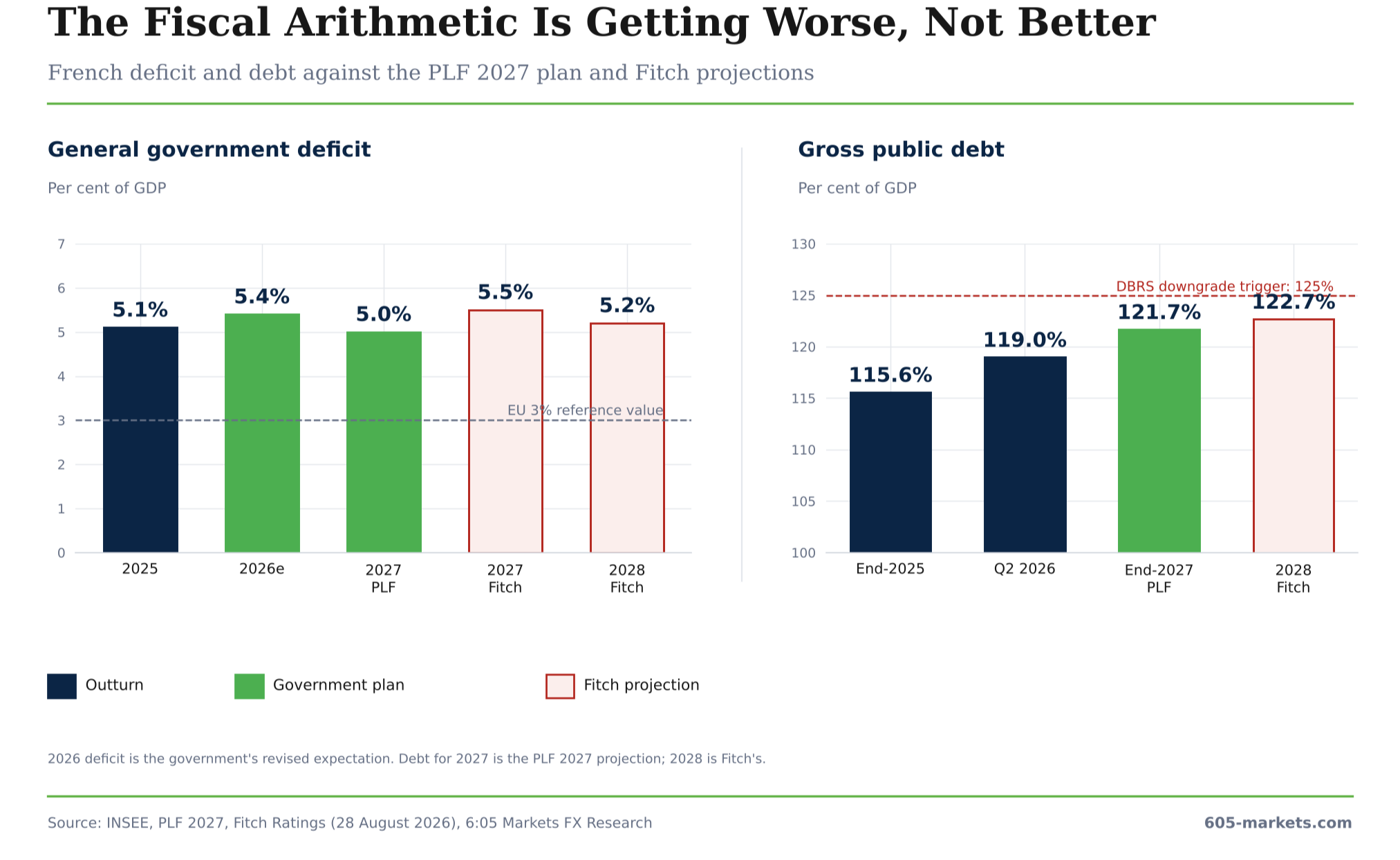
We believe the spread is likely to widen further for two key reasons. First, the fiscal starting point is materially worse than in either 2024 or 2025. The deficit is running above 5% of output for a third year, and debt has reached 119% of output. The 2027 budget promises to bring the deficit down with a large package of savings. The fiscal watchdog has already judged the growth assumptions behind it too optimistic, and Fitch expects the deficit to rise next year rather than fall.
Second, parliamentary arithmetic has not improved. The 2026 budget was adopted in February only after the government used its constitutional override three times and survived eight censure motions. The closest of those failed by 19 votes. The same Prime Minister, Sébastien Lecornu, now faces the same National Assembly with less goodwill. The finance committee had already stripped out more than a billion euros of savings before the text reached the floor.
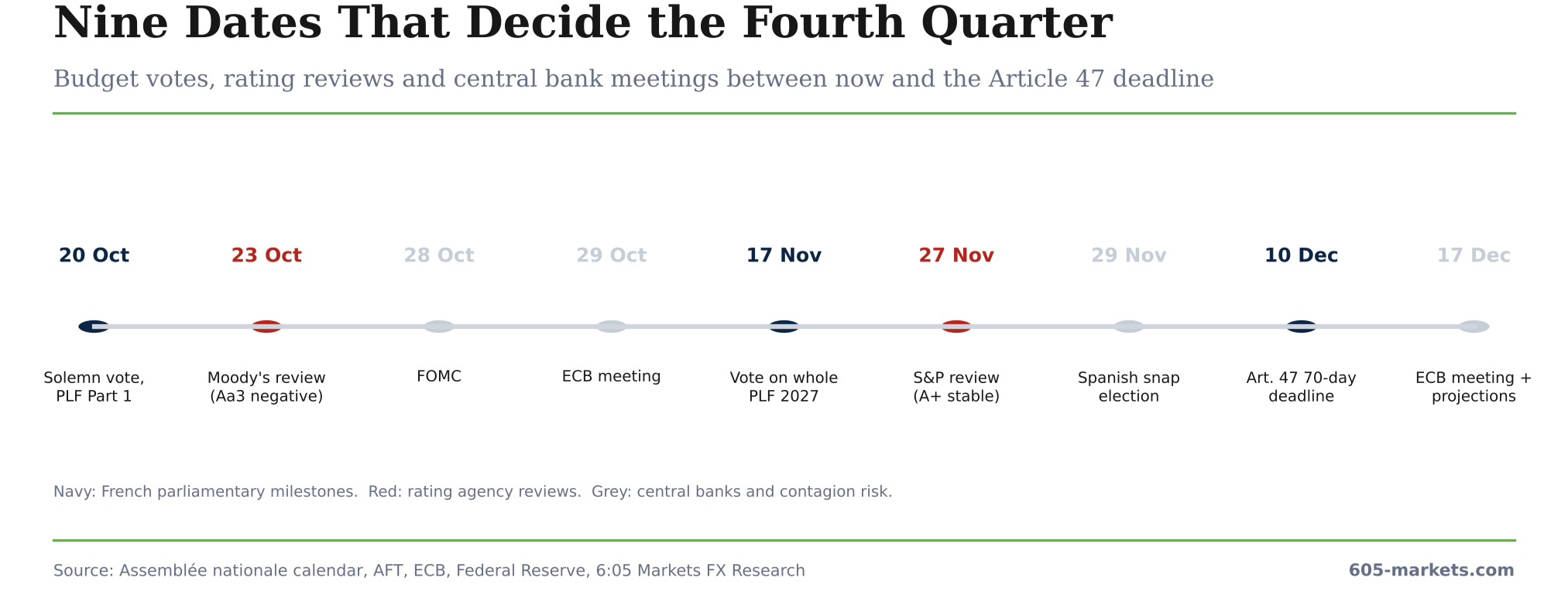
The ratings calendar offers little relief. Moody's holds France on a negative outlook and reviews on 23 October. Standard & Poor's, which downgraded France a year ago, reviews on 27 November. In 2024 and 2025 the spread retraced within weeks of each political peak because the central bank was cutting rates and the deficit was still narrowing. Neither condition holds today.
The scarcity premium is already visible in primary market demand. At the 1 October auction, the ten-year bond drew the thinnest cover of the year. Foreign investors hold more than half of French government debt. The marginal buyer is therefore abroad, often unhedged, and able to sell euros as readily as bonds.
Cost of Funding France
Pass, Negotiate or Govern by Ordinance
A wider spread makes every route through the budget more expensive. The government has no majority. It must either use its constitutional override and absorb the censure motions that follow, negotiate a smaller package with the Socialists, or let the parliamentary clock run out on 10 December and impose the budget by ordinance. None of these options changes the deficit arithmetic. They change only who bears the political cost and when. The three routes should be treated as competing alternatives rather than additive risks.
OPTIONS
WHAT'S CHANGED?
WHAT HAS TO BE PRICED IN?
Use the constitutional override
Used three times on the 2026 budget, with eight censure motions failing by as few as 19 votes
Repeated censure votes between 20 October and 10 December, with the spread repricing on each count.
Negotiate with the Socialists
They demand a revised text, and concessions in committee have already cost over a billion euros
A smaller package, a 2027 deficit closer to 5.5% than 5.0%, and rating pressure.
Ordinance after 10 December
Constitutionally available if parliament fails to vote within 70 days
The weakest signal to rating agencies and the central bank, and a budget without a majority ahead of the April 2027 election.
Why the Spread Still Matters Even at the Margin
The size of the headline debt should not be confused with the immediate cost of a wider spread. France plans to borrow a record €340bn in the bond market next year. Every ten basis points of additional spread on that borrowing alone costs roughly €340 million a year for the life of the bonds. Applied to the whole debt stock, once it has been refinanced over the following eight years, the same ten basis points adds close to €4bn a year. The widening since early September therefore represents an eventual cost of around €20bn a year, before any further slippage in the deficit.
Additional spread
On €340bn 2027 issuance, €bn/yr
On €3.6trn stock fully refinanced, €bn/yr
Share of 2027 interest bill of €91bn
+10bp
0.34
3.6
4%
+50bp
1.70
18.0
20%
+100bp – Severe case
3.40
36.0
40%
The decision to hold the position depends on the value of time. France can avoid part of the cost by borrowing shorter or leaning on the central bank's existing holdings. Both alternatives are not free. Shorter borrowing raises rollover risk precisely when the ratings calendar is heaviest. The proposal from Jean-Luc Mélenchon to cancel the debt held by the Banque de France has been described by its governor as illegal, dangerous and useless. The interest bill is already forecast to rise by about 15% next year. That projection was built before the October widening.
Higher Yields and a Tighter Dollar
The currency cost of the episode has been visible for a month, especially against the dollar. The euro has lost close to 4% in four weeks, with four consecutive weekly declines. Against the Swiss franc it fell 1.5% in two sessions at the start of October. For an American investor holding €100 million of French bonds unhedged, the currency move alone has cost roughly four million dollars since early September, before any loss on the bonds themselves.
The move is even more visible in interest rates. The Federal Reserve raised rates on 16 September, its first increase since 2023, and American ten-year yields have since reached their highest level since 2002. The European Central Bank also raised rates in September. The gap between the two policy rates has nonetheless widened to well over a percentage point, and the gap between two-year yields in the United States and Germany has moved by roughly 40 basis points in three weeks. For a one-year carry position, the cost of holding euros against dollars has risen by close to half a percentage point before any change in the exchange rate.
These Treasury figures provide wider dollar context rather than a direct French exposure. The rise in American yields owes as much to the Federal Reserve as to Paris.
The main issue is the European Central Bank's reaction function and whose reasons differ across markets. The minutes of the September meeting, published on 8 October, show the chief economist arguing that higher market yields may reduce the need for further tightening. Meanwhile, euro-area inflation has risen to nearly 4%, with energy up by a fifth on the year as the Hormuz disruption keeps gas prices elevated. Spain's snap election in late November and an Italian vote due next year are widening the pool of political risk. Gas storage is also running well below last year's level. A fiscal shock in one member state is tightening financial conditions for the whole bloc, without the central bank having to move at all.
Applying this to the euro, a December rate rise now carries a higher bar. In late September the market expected roughly a percentage point of further tightening over the coming year. By 9 October a quarter of that had been priced out. That is less tightening for the same inflation outlook, and it explains most of the widening in the two-year gap against the United States. This is a sensitivity calculation, not a forecast of the central bank's decision. A stronger inflation print or a faster budget resolution would restore part of the pricing, and the spread itself would narrow.
Methodology Note on Positioning and Hedging Flows
A separate yet relevant point is speculative positioning. Futures data for late September showed bets against the euro at their largest since the spring of 2025, and gross short positions at a record. Neither the spread nor the rate gap automatically produces a squeeze. A crowded short does lower the bar for one. Our scenario ranges therefore assume that any budget compromise produces a rebound of two to three per cent before the underlying trend reasserts itself. We do not treat that rebound as a change in direction.
Our Position, Pricing and Risks
Our View Versus Market Pricing
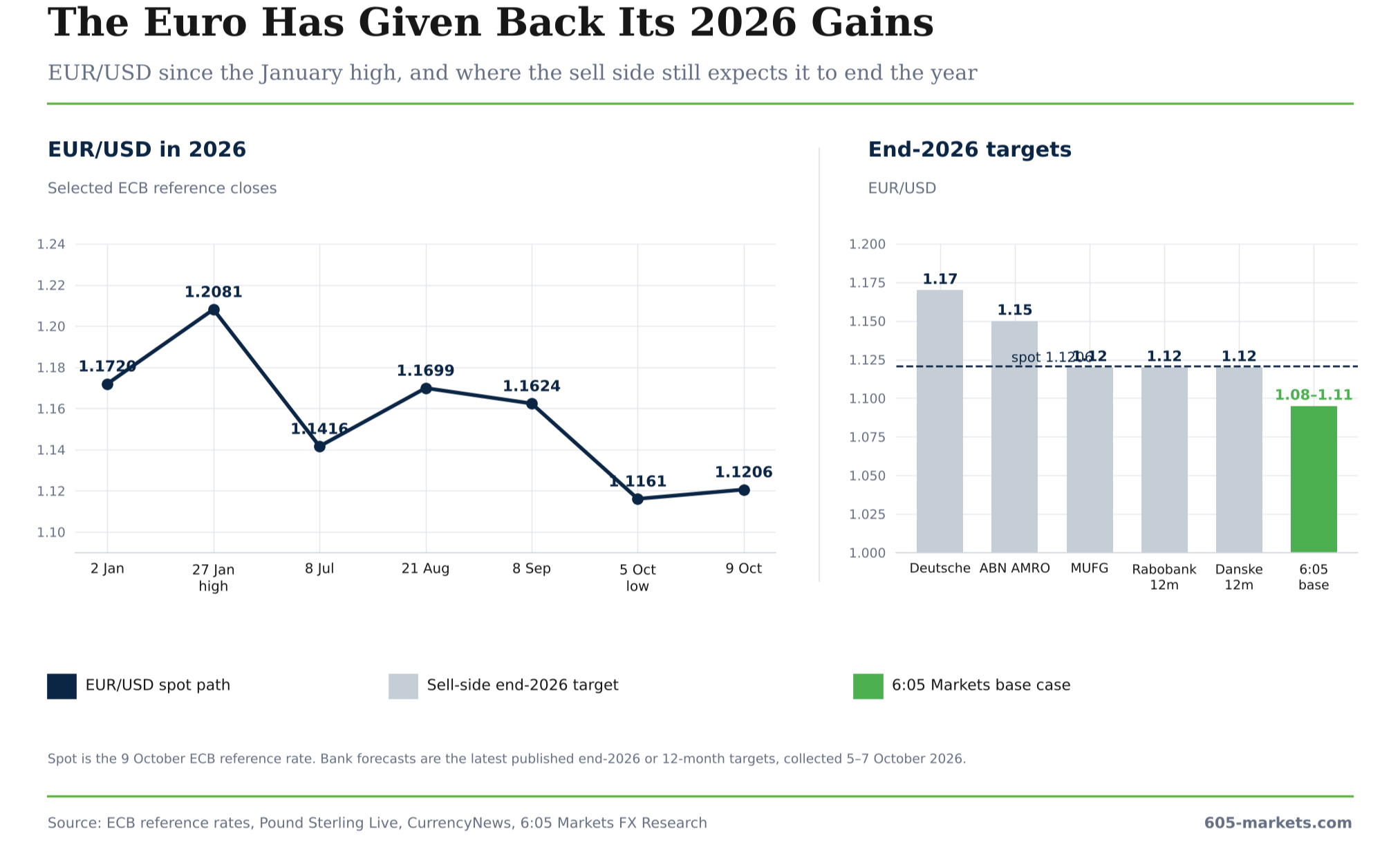
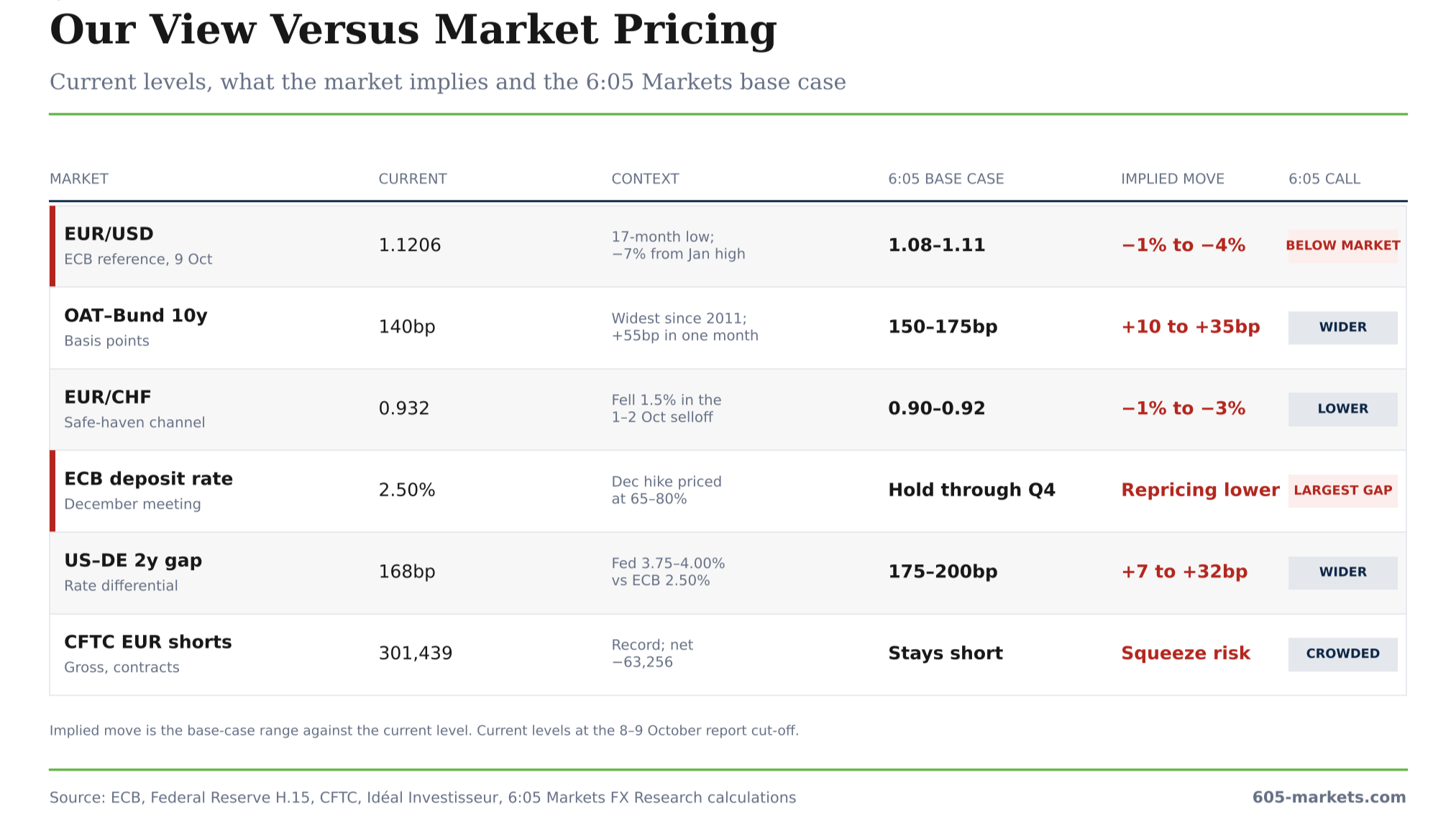
Our central view is that the largest mispricing is the euro's sensitivity to the French spread if the budget process persists into December. The market has already repriced French risk. The spread has widened by more than half in a month and the ten-year yield has touched 5%. Bank forecasts for the euro still assume that much of the move fades. Deutsche Bank sees 1.17 by year-end, more than 4% above spot. ABN AMRO held 1.15 on 7 October on the view that the worst had passed. Several others see 1.12, which is to say roughly where the market already trades.
We disagree with that degree of normalisation if the spread stays wide. The euro was trading at 1.12 at the report cut-off, versus 1.17 at the start of the year. Our working assumption is that the 2027 budget is adopted late, by override or by ordinance, and that the spread settles at 150–175 basis points rather than returning to the levels of early September. The important pricing question is therefore whether the market is pricing enough duration into the central bank's restraint.
The preceding analysis shows that the French shock is already materially affecting interest-rate differentials. Our disagreement with current pricing is that the market is pricing too much recovery into the coming months. We expect the central bank to hold in December, keeping the gap with the Federal Reserve wide and forcing the euro to carry the full cost of the spread. The effect should be strongest against the dollar and the franc. Sterling should be less affected unless the gilt market shares in the move.
The Marginal Buyer Sets the Euro
The marginal buyer sets the price. A wider spread does not mechanically move the euro by the same amount. But if foreign holders of French bonds are reducing exposure, and the central bank is signalling that the market has done its tightening for it, the next buyer may require a materially weaker currency as well as a higher yield to step in. We therefore view the French shock as capable of amplifying an already dollar-positive rate backdrop rather than independently creating the entire decline.
The Euro and the Spread Carry the Clearest Downside
At the report cut-off, the euro was at 1.12 against the dollar. Our base case places it at 1.08–1.11 through the end of the year if the budget passes late and the spread holds at 150–175 basis points. A sustained move below 1.08 is plausible, but it is not our forecast from France alone. It requires both a government collapse and a further Federal Reserve rate rise.
Our strongest conviction is in the central bank. We expect it to leave rates unchanged at its December meeting while the spread is above 150 basis points. The market still prices a December rise as more likely than not. At 150 basis points the spread is roughly double its one-year average. At 175 the central bank would, in our view, be closer to discussing its bond-market backstop than to raising rates.
The Swiss Franc Cross Is Even More Directly Exposed
The euro is even more directly exposed against the Swiss franc. It traded near 0.95 at the end of September and had already fallen to 0.93 by 9 October. We see 0.90–0.92 as a reasonable base-case range under persistent French stress. For a Swiss exporter hedging a hundred million francs, the lower end of that range would add close to four million euros to the cost relative to today.
Sterling Is a Secondary Channel
Sterling is different. The euro fell to a 2026 low against the pound on 7 October, but much of that move reflects relative calm in the gilt market rather than any change in the British outlook. We expect the effect to keep appearing against the dollar and the franc rather than in a one-for-one move against the pound. France is supportive of sterling at the margin. British inflation, Bank of England policy and the November budget remain much larger drivers of the cross.
Forecast Method.
Our scenario ranges are 6:05 Markets analyst estimates. They are anchored to current exchange rates, the 8 October spread close, the market-implied paths for the two central banks, the 2024–25 spread history and the borrowing-cost sensitivities calculated earlier in this report. They are not outputs from a probability-weighted fair-value model. The ranges represent the levels we believe are consistent with each political scenario rather than point forecasts.
Parameter
6:05 Markets View
Direction
Bearish euro against the dollar and the franc, wider French–German spread, neutral against sterling
Primary horizon
Fourth quarter of 2026
Highest-conviction exposure
The central bank on hold in December and the spread, rather than the outright euro level
Base euro–dollar range
1.08–1.11
Base spread range
150–175 basis points
Base euro–franc range
0.90–0.92
France assumption
2027 budget adopted late by override or ordinance, censure motions fail, no change of government before 10 December
Analytical confidence
Medium-high on the central bank and the spread, medium on the euro level
Scenarios and Expected Outcomes
Recovery
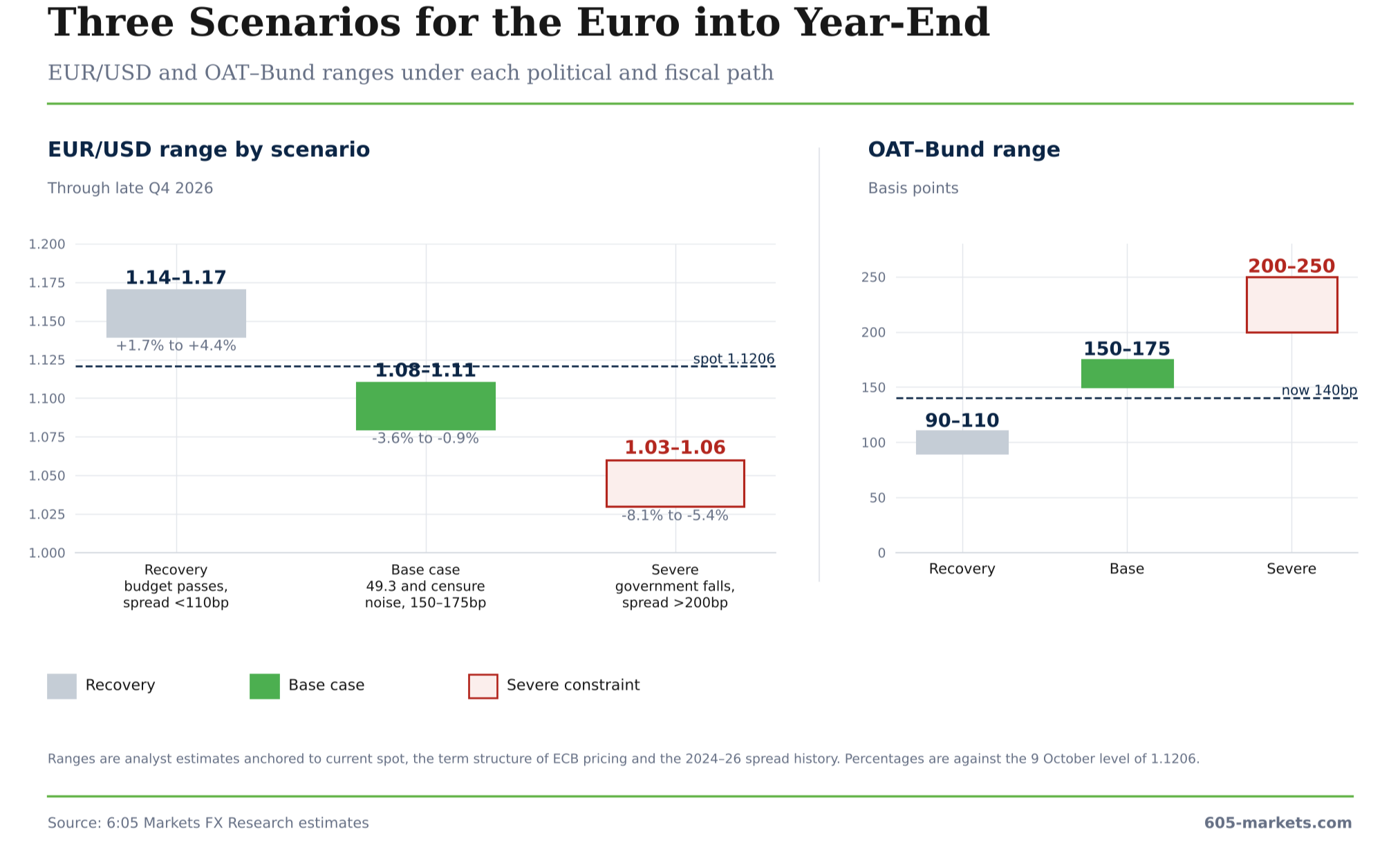
The upside case for the euro requires the government and the Socialists to agree to a revised text that keeps the 2027 deficit near 5%. That would let the first part of the budget pass on 20 October without the override, and Moody's would affirm three days later. Under those conditions the spread should retrace towards 100 basis points and a December rate rise would return to the price. The euro could move back towards 1.14–1.17, helped by a squeeze on the record short. This would not require the deficit to fall. It would only require the political process to look orderly enough that the central bank stops treating French yields as a substitute for policy.
Base Case
Our base case is that the budget is adopted late and without a majority. The spread averages 150–175 basis points, roughly double its one-year average but well below the 2011 record. Censure motions are tabled and fail. Rating outlooks move negative rather than ratings themselves, and the central bank holds in December.
Under this scenario, we expect the euro at 1.08–1.11 against the dollar and 0.90–0.92 against the franc. That implies downside of between one and four per cent from today. The move would come from interest-rate differentials and central bank restraint rather than from the spread alone.
Severe Constraint
The downside case is a successful censure motion before the middle of November. A caretaker government would be unable to pass a budget before the December deadline, and at least one agency would move to a downgrade. The spread would head towards 200–250 basis points, the territory of 2011, and the central bank would be forced to discuss its backstop. At the top of that range France would be borrowing at around 6% for ten years. Under this scenario, we expect the euro at 1.03–1.06 against the dollar and 0.87–0.90 against the franc, or downside of five to eight per cent from today.
For sterling, the effect should be smaller and less direct. We estimate one to two per cent of additional downside for the euro against the pound in an otherwise unchanged British backdrop, mainly through safe-haven flows rather than any improvement in the British position.
Our bearish case weakens materially if
The first part of the 2027 budget passes the vote on 20 October without the constitutional override.
The spread falls back below roughly 110 basis points and stays there for two consecutive weeks.
Moody's and Standard & Poor's both affirm their ratings without a change in outlook.
The market returns to expecting a December rate rise while the spread is still wide, indicating that the central bank is looking through France.
The euro closes above 1.15 against the dollar on a weekly basis.
Bets against the euro halve from their late-September level, indicating that the position has already been covered.
Our thesis position strengthens if
A censure motion comes within ten votes of passing at any count before the middle of November.
The spread breaks 175 basis points on a closing basis or trades well above Italy.
Either Moody's or Standard & Poor's downgrades rather than affirms.
The central bank holds in December with euro-area inflation still above 3%.
Demand at the November bond auctions is thinner than at the 1 October sale.
The euro trades below 1.10 while the Federal Reserve is on hold. That would provide much cleaner evidence that France itself, rather than the dollar, is being transmitted into the currency.
What Could Break the Base Case?
The largest risk is a faster political resolution. France does not need a balanced budget for our thesis to weaken. Even a credible revised text can narrow the spread disproportionately if the market is positioned for a crisis.
The second primary risk is the dollar weakening faster than the euro. September payrolls were far weaker than expected. If the Federal Reserve moves to a hold and the market removes the December rise, the euro can recover even while the spread stays wide, because the rate gap narrows from the American side.
Third, the record short position can solve part of the problem on its own. Current euro weakness reflects positioning as much as the spread itself. If the short is covered on a single headline, the euro can rise two to three per cent in days without any improvement in France.
Finally, the broader energy backdrop can dominate the French effect. A reopening of Hormuz would reduce euro-area inflation and the pressure on the central bank by more than France adds to it. A further energy shock could push the central bank to raise rates regardless of the spread. That would support the euro while making it impossible to attribute the move primarily to France.
Our position is therefore specific. France is an increasingly important drag on an already dollar-positive rate backdrop. We expect the strongest effect to appear first in the central bank's December decision and the spread. A move below 1.08 requires a government collapse as well.
Conclusion
To conclude this report, French fiscal risk is no longer merely a bond-market story. It has become a constraint on a central bank that was tightening into inflation of almost 4%. The spread has widened from 85 to 140 basis points in a month. Based on the parliamentary arithmetic of the past two budgets, we expect it to widen further and to settle at 150–175 basis points in our base case. The market has begun to price this risk, but we believe it is pricing too much normalisation into the coming months. At the same time, the Federal Reserve has resumed raising rates. Every week the European Central Bank stays on hold makes the euro more expensive to own. Our position is therefore concentrated in the December decision and the spread rather than in an outright level for the euro. Under our base case of a late and contested budget, we expect the euro at 1.08–1.11 against the dollar and 0.90–0.92 against the franc through the end of the year.
The central thesis is therefore simple. France is a drag on the euro through interest rates, not a threat to the currency itself. The budget is weakening a currency that has become more vulnerable precisely because the dollar and the energy shock are already pushing in the same direction. If the budget passes on 20 October, the spread retraces or the Federal Reserve moves to a hold, the thesis weakens. If a censure motion passes, the spread breaks 175 basis points or the central bank holds in December with inflation above 3%, the market will have to price a more persistent discount.
That is the core mispricing we identify. The market has recognised that France is expensive to fund today, but it has not fully priced how long the central bank will let the market do its tightening for it.
The prediction
Series updated 21 Oct 2026
By EOQ4, EUR/CHF: 0.9-0.92
Series EUR/CHFEntry 0.93Range between 0.90 and 0.92Across 1 Dec - 31 Dec 2026Written 13 Oct 2026
Resolves against Yahoo Finance ticker EURCHF=X on the last observation on or before 31 Dec 2026. Not investment advice.
Money Times – Interest Rate Futures Rally on “Flávio Trade”, 5 October 2026. EstadãoConteúdo – Long Rates Fall on Election Rally After Strong IPCA, 9 October 2026.InfoMoney – With Selic at 13.75%, Brazil Has the World’s Highest Real Interest Rate, 16 September 2026.Polymarket – Brazil Presidential Election, 9 October 2026.Tesouro Nacional – Federal Public Debt Monthly Report, August 2026.G1 – Musical Chairs: Which Parties Gained and Lost Ground in the National Congress, 10 October 2026.G1 – 2027 Senate Will Have a Male and White Majority; See the Composition in Charts, 8 October 2026.Reuters – Brazil Vote Offers Opposing Politics, Similar Fiscal Outcomes, 26 August 2026.Reuters – Brazil’s Real Jumps After Bolsonaro Leads Election First Round, 5 October 2026.RankiaPro – Brazil Runoff: The Fiscal Test Ahead, October 2026.GMC Online – Interest Rates Fall on Election Trade Despite Higher-Than-Expected IPCA, 9 October 2026.ANBIMA – NTN-B 2035 Indicative Rates, 2–8 October 2026.Banco Central do Brasil – PTAX Exchange Rate, 2 and 9 October 2026.Exame – PL Will Have 28 Senators, Three Times the PT’s Caucus in 2027, 5 October 2026.Independent Fiscal Institution (IFI) – Fiscal Implications of the Court-Ordered Payments Amendment (PEC dos Precatórios), 29 November 2021.Agência Senado – Senate Approves Court-Ordered Payments PEC, Which Returns to the Chamber, 2 December 2021.Mais Retorno – Chamber Approves “Kamikaze PEC” in Second Round by 469 Votes to 17, 14 July 2022.Congresso em Foco – Transition PEC: What Was Approved and the Next Challenges, December 2022.Presidency of Brazil – Constitution of the Federative Republic of Brazil, Articles 57, 60 and 69.Presidency of Brazil – Constitutional Amendment No. 95 (Spending Cap), December 2016.Itatiaia – Central Bank Makes Fifth Consecutive Selic Cut, 16 September 2026.Federal Reserve Board – H.15 Selected Interest Rates, 8 October 2026.O Tempo – Foreign Investors Inject R$12.6 Billion into B3 After First Round, 7 October 2026.Acionista – Public Debt Closes 2023 at R$6.52 Trillion, January 2024.Money Times – Federal Public Debt Rises to R$8.641 Trillion in January, Says Treasury, 25 February 2026.Poder360 – Federal Public Debt Report, May 2020.IstoÉ – Federal Public Debt Grows 2.09% and Closes 2021 at R$5.613 Trillion, January 2022.CNN Brasil – BC: General Government Gross Debt Rises to 82.9% of GDP in August, 30 September 2026.Forbes Brasil – “Tesouraço”: What Flávio Bolsonaro’s Economic Plan Proposes, October 2026.Agência Brasil – Official September Inflation Comes in at 0.82%, Shows IBGE, 9 October 2026.O Especialista (Banco Safra) – Fixed Income Gains Momentum on Fiscal Bet After First Round, 7 October 2026.