Denmark Is Defending a Peg Nobody Is Attacking
Nationalbanken is choosing to let the krone sit on the weak side of its peg rather than defend parity, and we expect euro-krone at 7.47 to 7.49 through year-end because the demand for kroner at home has become structurally weaker.

Executive Summary
We believe the market is reading the krone the wrong way round. The currency has sat on the weak side of its peg to the euro for all this year. In August it touched its weakest level since the euro was born. That used to be the kind of move Nationalbanken crushed within days. This time it sold a little over six billion kroner worth of euros across two quiet operations and then stopped. Nothing in September. Nothing in October. The peg is not under attack. The central bank is choosing where inside the peg the krone should live.
For most of the past decade the problem was the opposite. The krone was too strong and the bank bought euros by the hundreds of billions to hold it down. What has changed is the demand for kroner at home. Danish companies are earning more abroad and keeping more of it abroad. Pension funds have let their dollar hedges run off. The policy rate has sat below the European Central Bank's for almost four years, and the bank matched both hikes this year rather than closing that gap. Each of these removes a buyer of kroner that used to be reliable.
Our case therefore places euro-krone at 7.47 to 7.49 through the end of the year, with Nationalbanken matching a December move in Frankfurt and leaving the spread at forty basis points. The main counterargument is the reserve. At more than a fifth of national output plus a new euro borrowing line from Frankfurt the bank can defend any level it chooses. Our central conclusion is that it has chosen not to. The market is pricing the krone as a currency with a fixed price when the drivers behind it have quietly become structural.
Key Numbers
| Euro-krone, 5 November | Kroner bought to defend the peg, 2026 | Danish policy spread to the ECB | Foreign exchange reserve, end-October |
|---|---|---|---|
| 7.4747 | kr.6.3bn | −40bp | kr.686bn |
European Central Bank reference rate, 5 November 2026. Danmarks Nationalbank, 3 November 2026. Danmarks Nationalbank and European Central Bank, September 2026. Danmarks Nationalbank, 3 November 2026.
What Nationalbanken Did and Did Not Do
The Scale and Timing of the Summer Operations
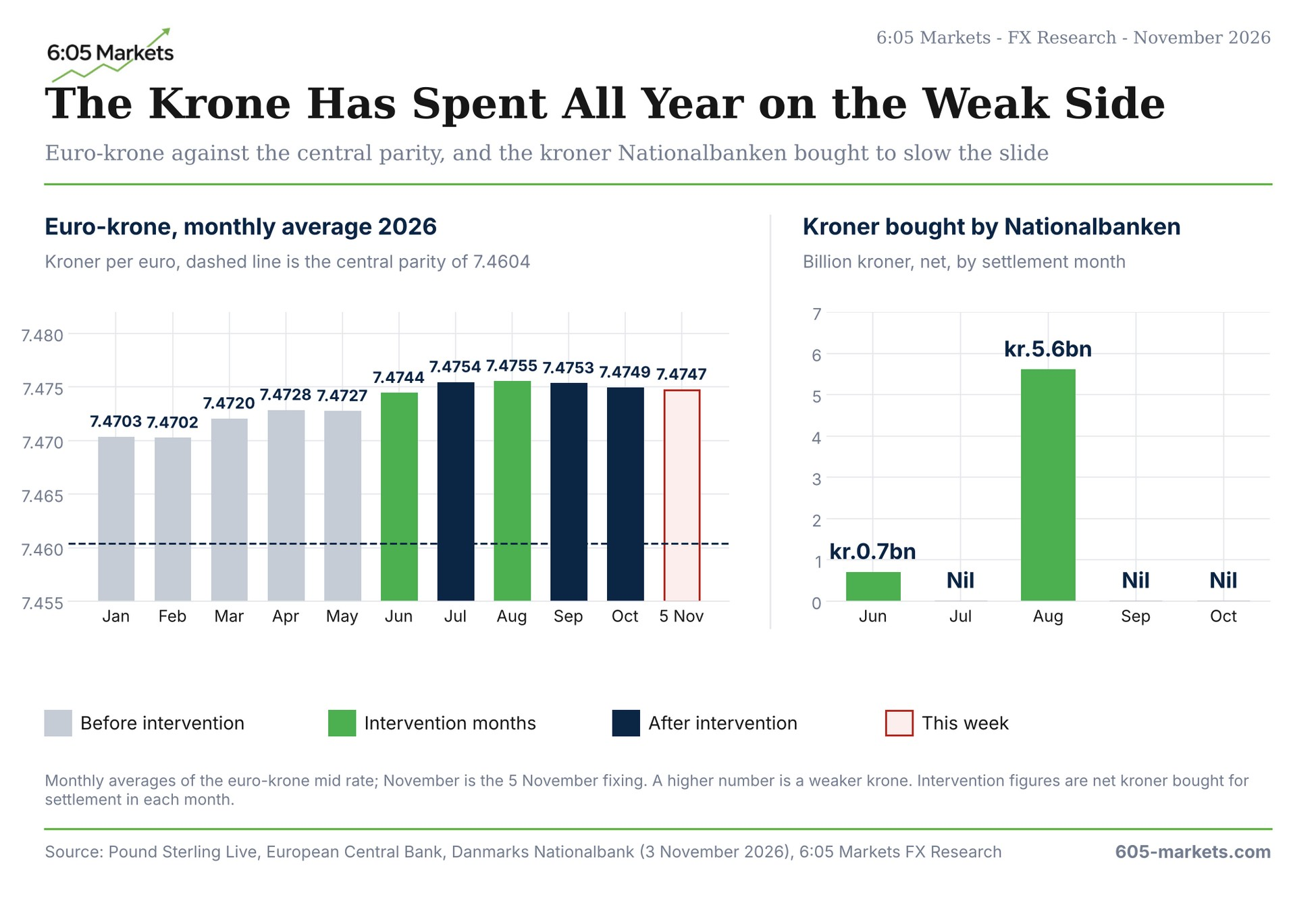
In June the krone slipped past the level it had held since the pandemic. Nationalbanken sold seven hundred million kroner worth of euros to slow it down. It was the first time the bank had defended the weak side of the peg since March 2020 and it was small enough that most of the market missed it. The krone kept sliding. In July it reached its weakest against the euro in more than twenty-five years. Yet, the bank did nothing that month.
August brought the second operation and the larger one. The bank sold a little under six billion kroner worth of euros, roughly eight times the June amount. The krone stopped falling. It has barely moved since. September and October both passed with no intervention at all and the reserve actually fell in October because the government repaid foreign debt. Two operations and a combined six billion kroner is all it has taken.
A small sum, a quiet execution and a currency that is still above parity. The summer proved what Nordea has argued since the spring. The bank is not trying to push the krone back to its central rate. It is trying to stop a slide from becoming a rout. If it wanted the krone back at parity it has the means to put it there in a week. It has chosen instead to let the market find a new resting level a fraction above the old one.
Lessons from 2015 and 2020
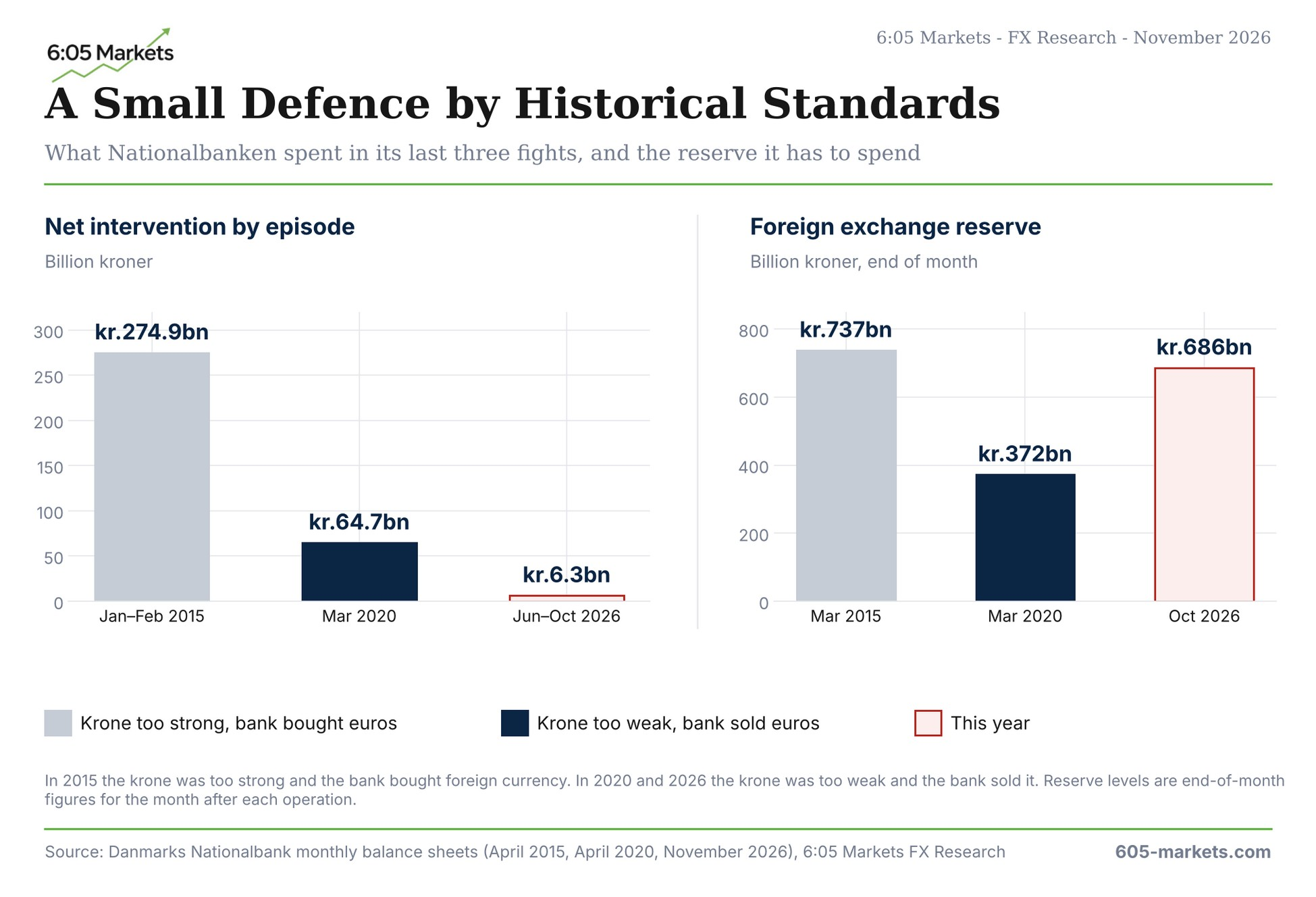
We believe the two previous fights hold two lessons. First the direction of the problem has flipped. In early 2015 the krone was too strong. Money poured into Denmark after Switzerland dropped its franc ceiling, and the bank bought close to 275 billion kroner worth of euros in six weeks to hold the currency down. It cut its deposit rate deep below zero to do it. In March 2020 the krone was too weak. The bank sold around 65 billion in a month and raised its rate on its own for the first time in years. This year's defence is a tenth of that one.
Second, the bank has always treated the two sides differently. It can create kroner without limit so a strong krone costs it nothing but a bigger balance sheet. A weak krone costs it reserves, and there is a finite amount of those. That asymmetry is why the old rule was to hit weakness hard and early. The fact that the bank has not done so this year is the most important fact in this report.
The bank's own figures show how little it has needed to do. The reserve is close to 686 billion kroner, larger than it was in January and more than a fifth of national output. In October the bank also gained access to the European Central Bank's repo facility for central banks, with a ceiling of fifty billion euros. That line was built for exactly the situation a peg defender fears. The bank now holds it and has not touched it. The lesson is not that the peg is weak. It is that the bank has more firepower than at any point in its history and is using less of it than ever.
The scarcity has moved to the other side. Danish companies that used to sell their foreign earnings for kroner every quarter are holding them abroad instead. Foreign direct investment out of Denmark has jumped. Pension funds that bought kroner forward to hedge their dollar assets have let those hedges fall by several points of coverage. Each change removes a buyer and none of them reverses because the bank sells a few billion euros.
The Cost of Holding Kroner
Intervene, Hike or Move the Band
A weaker krone makes every route Copenhagen might take look different. The bank can intervene again, as it did in August. It can raise its rate on its own as it did in March 2020 and close the gap to Frankfurt. Or it can do what it has done since September and let the krone settle where the market puts it. The three routes should be treated as competing alternatives rather than a sequence. Only one of them is free, and it is the one the bank has chosen.
| Options | What's changed? | What has to be priced in? |
|---|---|---|
| Intervene again | Two operations and six billion kroner bought three months of calm | A slow drain on the reserve, a signal that 7.48 is a line, and a krone that returns to the weak side as soon as the buying stops. |
| Raise the rate alone | The spread to Frankfurt has sat at forty points for almost four years | A narrower gap, stronger demand for kroner from carry, and a tightening that Danish inflation of two per cent does not call for. |
| Let the band drift | Nothing in September or October and the krone has stayed above parity | A de facto band that is wider on the weak side, a central rate that stops being a target, and a market that slowly learns the new limit. |
Why the Rate Spread Still Matters at the Margin
The size of the spread should not be confused with the pull it exerts. Holding euros rather than kroner earns the difference between the two deposit rates, about forty basis points a year at current levels. That is thin. But the krone is pinned inside a band so narrow that a tenth of a per cent is a large move. For a Danish investor the choice between kroner and euros is therefore not about the carry. It is about whether the krone moves enough in a year to make the carry matter either way.
| Euro-krone at year-end | Spot move from 7.4747 | One year of euro carry at 0.4% | Net return for a euro-long position |
|---|---|---|---|
| 7.460 – Recovery | −0.2% | +0.4% | +0.2% |
| 7.475 – No change | 0.0% | +0.4% | +0.4% |
| 7.480 – Base case | +0.1% | +0.4% | +0.5% |
| 7.500 – Severe case | +0.3% | +0.4% | +0.7% |
The table makes the point. There is no scenario in which an investor loses money by holding euros against kroner over a year, and in every one of them the carry is bigger than the exchange rate move. That is the quiet cost of a negative spread inside a fixed band. It makes the euro the default. It turns every Danish saver and treasurer into a small patient seller of kroner, and the bank has to lean against all of them with a reserve it has decided to preserve.
A Weaker Krone Beyond the Euro
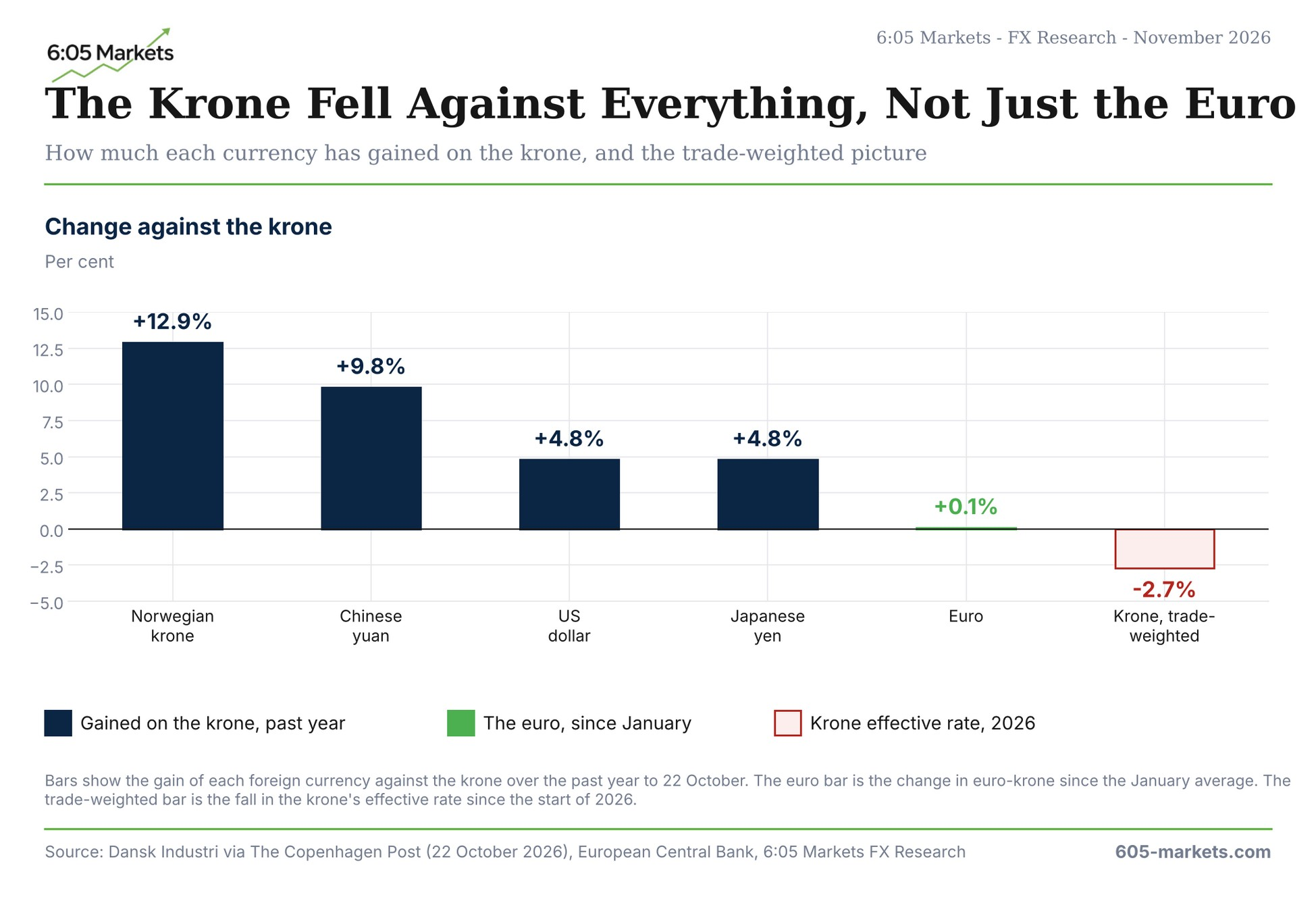
The move looks tiny against the euro and much larger against everyone else. The Norwegian krone has gained close to thirteen per cent on its Danish cousin over the past year. The yuan is up nearly ten. The dollar and the yen are both up around five. Dansk Industri puts the fall in the krone's trade weighted value at close to three per cent since January. For a currency that is supposed to be fixed that is a meaningful devaluation and it has arrived without a single headline.
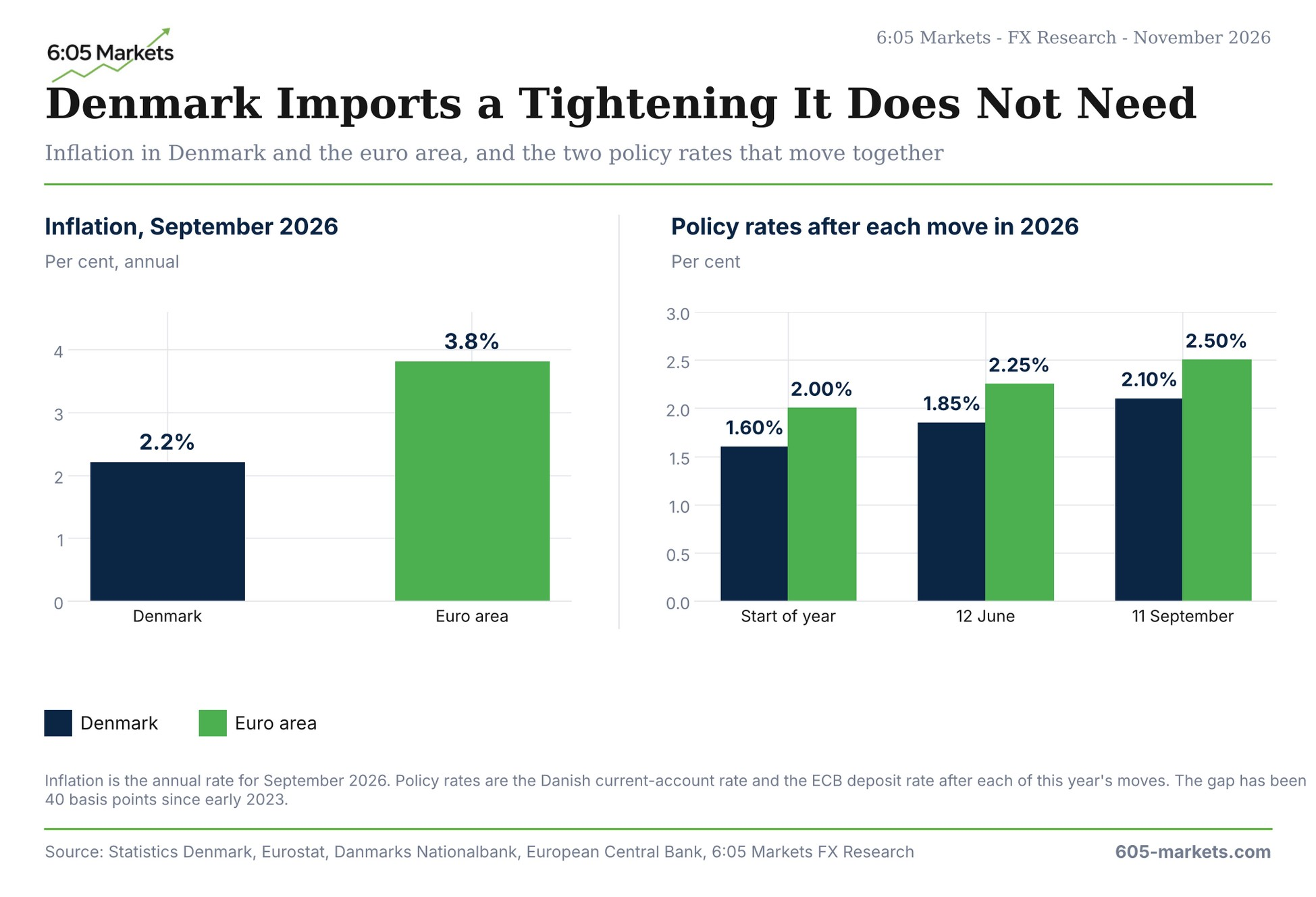
The move is even more visible in the inflation gap. Euro area inflation was near four per cent in September. Danish inflation was a little over two. Denmark has followed Frankfurt through two hikes this year and will follow a third if it comes in December. Its own economy did not ask for any of them. The exchange rate is the only part of Danish monetary conditions that has loosened, and it has loosened by exactly the amount the bank has allowed.
The main issue is why the demand for kroner has gone. The reasons differ by source. At companies the trigger was the surge in foreign investment and the decision to leave earnings abroad in an uncertain year. Nationalbanken itself linked the August weakness to companies keeping more of their money in foreign currency. At pension funds the trigger was the dollar. After a bruising 2025 they hedged more, and hedging means buying kroner forward. In 2026 they let the hedges roll off and that buyer vanished with them. At the bank the trigger was simply inflation. With prices rising slower than in the euro area there is no domestic case to narrow the spread.
Applying this to the exchange rate the consequence is that the krone's natural level has moved. For most of the past decade it sat a touch below parity because too much money wanted in. This year it sits a touch above because less money needs to come home. This is a flow story not a confidence story. If companies start converting again the krone will drift back. But the resting level has changed and that is the more reasonable reading.
Methodology Note on Flows and Positioning
A separate yet relevant point is where the kroner selling has been coming from. The current account surplus is still enormous, close to 240 billion kroner in the first eight months of the year. That money used to be the floor under the krone. It still exists. It is simply not being converted. Our scenarios assume that corporate conversion stays low through the winter. A move back to parity requires either a change of heart at the companies or a change of policy at the bank, and we see neither before the year ends.
Our Position, Pricing and Risks
Our View Versus Market Pricing
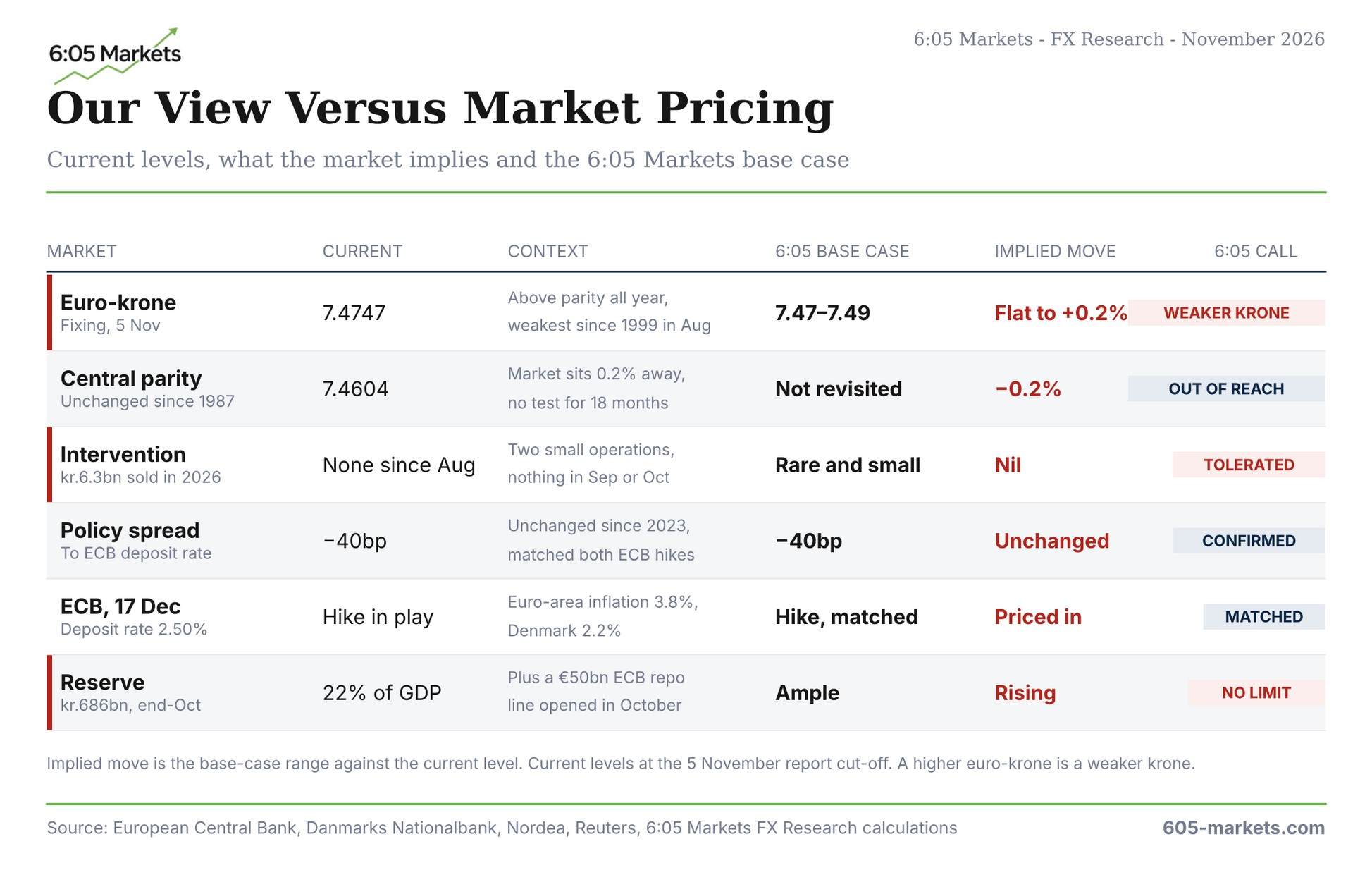
Our central view is that the largest mispricing is not in the level of euro-krone but in what the market thinks limits it. Forecasters have mostly stopped forecasting. Nordea calls the weakness structural and expects a more symmetric band around parity in the years ahead. Most banks publish a flat line. The market in other words expects the krone to sit still because it is pegged.
The krone was at 7.4747 at the report cut-off, versus the central rate of 7.4604. Our working assumption is that the European Central Bank raises rates in December and that Nationalbanken matches the move, leaving the spread exactly where it is. What is not priced is that the bank has already shown where its tolerance ends. It let the krone reach its weakest level in a generation in July and stepped in only when the move accelerated in August. The level it defended was not parity. It was somewhere near 7.48.
The current analysis shows that the drivers of the krone's weakness have not reversed. Our disagreement with current pricing is not that the market expects a stable krone. It is that the market expects stability around the wrong number. We expect euro-krone to spend the fourth quarter between 7.47 and 7.49, with the central rate out of reach and the old ceiling near 7.47 becoming a floor.
The Marginal Seller Sets the Krone
This matters because the marginal flow sets the price even inside a peg. A forty point spread does not mechanically move the krone by any set amount. But companies are leaving earnings abroad at the same time as pension funds are letting hedges expire. Every nervous month in global markets produces a little more of both. The next buyer of kroner may therefore have to be the central bank. We therefore view Nationalbanken as ratifying a level the market has already found rather than choosing one.
Euro-Krone Carries the Clearest Upside
At the report cut-off, euro-krone was 7.4747. Our base case places it at 7.47 to 7.49 through the end of the year if the December hike is matched and the bank stays out of the market. A sustained move above 7.49 is plausible, but it is not our forecast from Denmark alone. It requires a wider risk shock that sends Danish money abroad faster than the bank is willing to replace it.
Our strongest conviction is in what will not happen. The krone will not return to parity this year. Parity would require the companies to convert, the pension funds to hedge again or the bank to raise rates alone. None is in motion. At 7.48 the krone would be about a fifth of a per cent weaker than the central rate and about where the bank intervened in August.
Scenarios and Expected Outcomes
Recovery
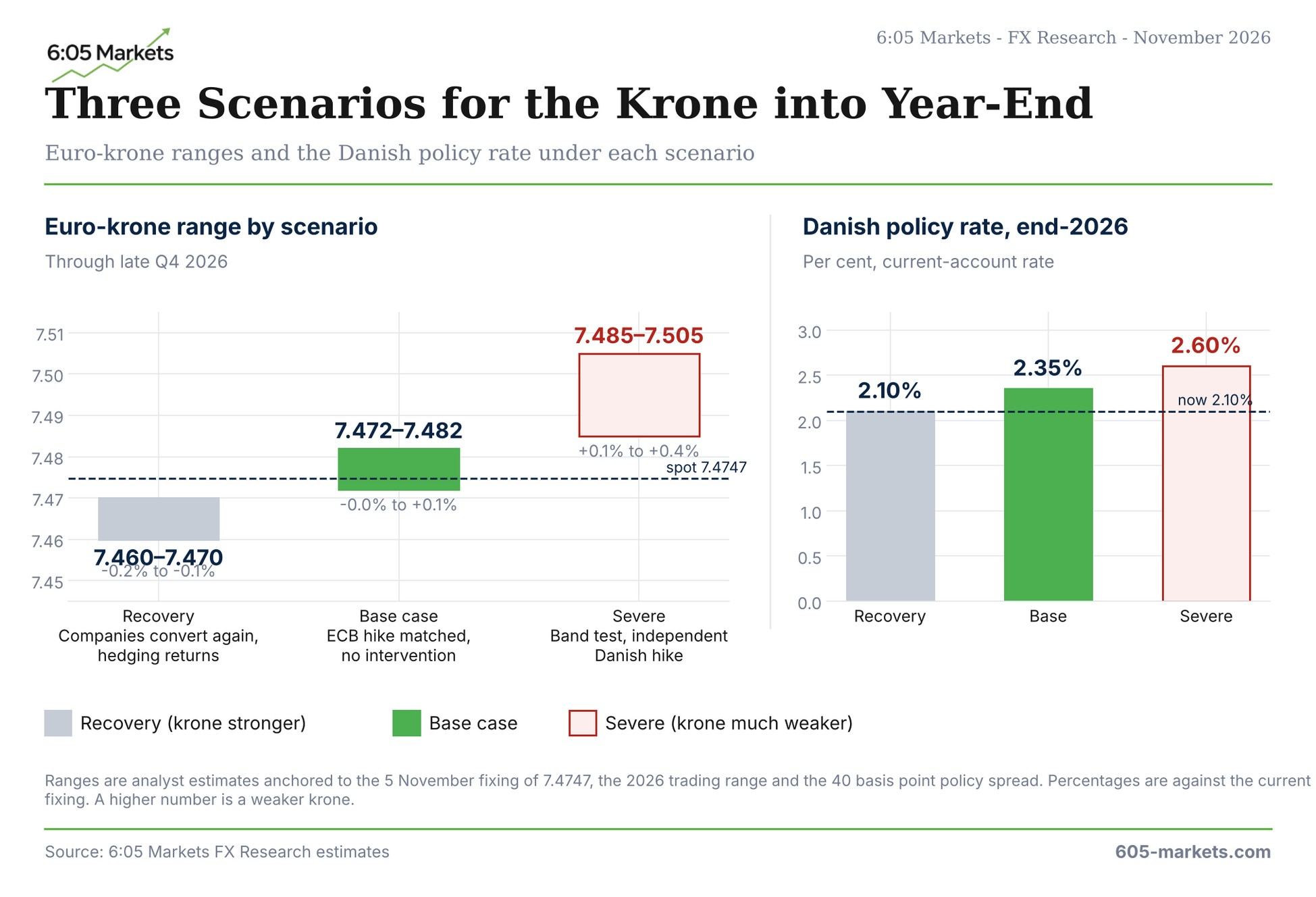
The case for a stronger krone requires companies to begin converting foreign earnings again and pension funds to rebuild their dollar hedges after a weaker dollar. Under those conditions the old pattern returns and the krone drifts back towards 7.46 to 7.47, roughly where it spent 2024. This would not require any intervention. It would only require the money that is already earned to come home.
Base Case
Our base case is that the European Central Bank raises rates in December, Nationalbanken follows the same day and the spread stays at forty basis points. Corporate conversion stays low and the reserve is untouched.
Under this scenario we expect euro-krone at 7.47 to 7.49. That implies a krone that is flat to a fifth of a per cent weaker than today. The move would come from the absence of buyers rather than from any decision in Copenhagen.
Severe Constraint
The case for a much weaker krone is a global shock that pushes Danish investors abroad in size. Euro-krone would test 7.50 and the bank would face the choice it has avoided all year. We expect it to intervene first and hike alone second, as it did in 2020. Under this scenario we expect euro-krone at 7.485 to 7.505, a tenth to four tenths of a per cent weaker than today, and a Danish policy rate that ends the year at 2.60% against 2.10% now.
For the Nordic neighbours the effect should be larger and less direct. We estimate the krone loses a further two to four per cent against the Norwegian krone in a severe scenario, mainly because the oil price would be doing the work rather than the peg.
What Would Change Our View?
Weaker krone case weakens materially if
- Nationalbanken reports kroner purchases above five billion for November when it publishes in early December.
- The bank raises its rate without a matching move in Frankfurt.
- Euro-krone fixes below 7.470 for a full week.
- Corporate conversion returns in the balance of payments data, with foreign earnings flowing home again.
- Pension funds report rising dollar hedge ratios for the fourth quarter.
- The European Central Bank cuts in December, which would reverse the carry logic that favours the euro.
Our thesis position strengthens if
- Euro-krone fixes above 7.480 with no intervention for the month.
- The bank matches a December hike to the basis point on the same day.
- Danish inflation stays below the euro area's when the October data arrive later this month.
- Nordea or Danske Bank publish a wider working band in their forecasts.
- The current account stays in large surplus while the krone stays weak, which would confirm that the money is earned but not converted.
- Euro-krone holds above parity through the European Central Bank decision on 17 December. That would provide much cleaner evidence that the resting level, rather than the peg, has moved.
What Could Break the Base Case?
The largest risk is the bank itself. It has told the market nothing about where it will intervene and it never does. A sudden ten billion kroner operation would push the krone back towards 7.47 in days and make this report look early.
The second primary risk is Frankfurt. If the European Central Bank hikes faster than expected and Nationalbanken does not match it, the spread widens and the krone weakens through our range. If Frankfurt cuts the opposite happens. Denmark imports every one of those decisions.
Third, the dollar can change the pension flow. A sharp fall in the dollar would push Danish funds to hedge again, and hedging means buying kroner. That is the single largest potential buyer in the system and it responds to New York rather than Copenhagen.
Finally, politics can move the band. Denmark has debated the euro before, and a government that wanted to signal closeness to Frankfurt could lean on the bank to narrow its tolerance. A bank that formally announced a symmetric band would do the reverse and make 7.49 a normal level overnight.
Our position is therefore specific. The krone has stopped being too strong and started being allowed to be weak. We expect the clearest effect to appear in the absence of intervention rather than its presence. A move above 7.50 requires a global shock as well.
EUR/DKK will average between 7.47 and 7.49 from 10 November to 31 December 2026.
Series EUR/DKK (euro-krone) Entry 7.47 Range between 7.47 and 7.49 Across 10 Nov - 31 Dec 2026 Written 5 Nov 2026
Resolves against Yahoo Finance ticker EURDKK=X on the average of its readings from 10 Nov - 31 Dec 2026. Not investment advice.
Data Sources
- European Central Bank – “Euro foreign exchange reference rates,” 5 November 2026 and 23 October 2026. Euro-krone fixings.
- Pound Sterling Live – “EUR/DKK 2026 history,” retrieved 6 November 2026. Daily levels and monthly averages.
- Danmarks Nationalbank – “Foreign exchange and liquidity and monthly balance sheet,” October 2026, published 3 November 2026. Intervention, reserve and policy rates.
- Danmarks Nationalbank – “Foreign exchange and liquidity and monthly balance sheet,” June 2026 and August 2026. June and August interventions.
- Danmarks Nationalbank – “Interest rate increase,” 11 June 2026 and 10 September 2026. Policy rate decisions.
- Danmarks Nationalbank – “Danmarks Nationalbank now has access to the Eurosystem repo facility for central banks,” 1 October 2026. Euro borrowing line.
- Danmarks Nationalbank – “Renewed global uncertainty and neutral monetary policy,” 26 March 2026. Policy spread and krone commentary.
- Danmarks Nationalbank – “Foreign exchange and liquidity and monthly balance sheet,” March 2015 and March 2020. Historical interventions and reserves.
- Bloomberg – “Danish central bank intervenes to defend krone peg after slide,” 2 July 2026, and “Danish central bank intervenes again to defend currency peg,” 2 September 2026. Intervention reports.
- Investing.com – “Denmark's central bank intervenes to support krone after currency slide,” 2 July 2026. June operation detail.
- NextFin via Bloomberg – “Danish central bank intervenes again to defend currency peg,” 2 September 2026. August operation and corporate flows.
- Nordea via FXStreet – “Danish krone: Nationalbanken tolerance for weaker krone,” 30 June 2026. Band tolerance argument.
- Nordea via FXStreet – “Danish krone: weakness seen as structural against euro,” 5 August 2026. Structural demand argument.
- Nordea – “A symmetric band around the central parity in Denmark,” 2026. Band and corporate demand analysis.
- The Industry Spread – “EUR/DKK holds 7.4748 while the policy spread holds,” 24 October 2026. Spread and reserve detail.
- The Copenhagen Post citing Dansk Industri – “Danish krone loses value against major currencies in 2026,” 22 October 2026. Trade weighted and cross rate moves.
- Reuters via Kitco – “Global pension funds pull back on FX hedges as dollar woes ease,” 13 July 2026. Danish pension hedge ratios.
- European Pensions – “Danish pension funds increase dollar hedging,” September 2025. Hedging mechanics.
- Trading Economics – “Denmark current account,” August 2026 release. Current account surplus.
- Trading Economics – “Denmark inflation rises to one year high,” 12 October 2026. September inflation.
- Reuters via Yahoo Finance – “ECB holds rates at 2.5% as Lagarde announces early exit,” 29 October 2026. Euro area inflation and December outlook. investingLive – “Danish krone exchange rate: 2026 expert forecast and peg data,” August 2026. Peg mechanics and band limits.