BAAJA: Will the Blue Tsunami Keep the Permitting Bill From Passing This Year?
We expect the Bipartisan American Affordability and Jobs Act (BAAJA) to become law by December 31, 2026. Starting with the 73 yes votes, and considering the four senators who expressed concerns, we estimate about two will flip and 71 senators will vote yes on its passage.
Executive Summary
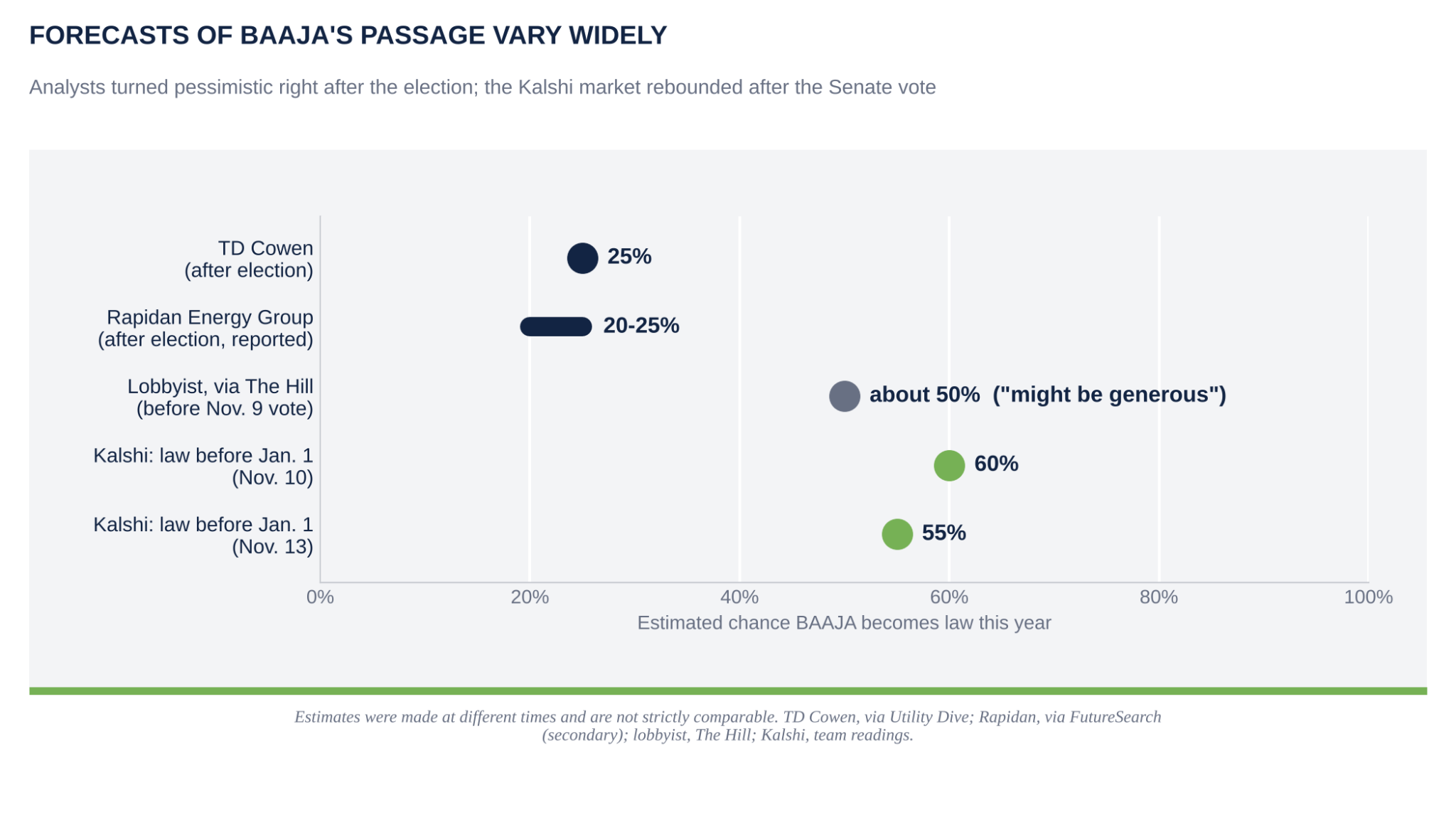
We expect the Bipartisan American Affordability and Jobs Act (BAAJA) to become law by December 31, 2026. Starting with the 73 yes votes, and considering the four senators who expressed concerns, we estimate about two will flip and 71 senators will vote yes on its passage. The Senate advanced the bill on November 9, 2026, but Democrats taking back both chambers in the 2026 United States midterm elections has led some members of that party to advocate waiting on permitting reform until the next Congress. In the 120th Congress, which will convene on January 3, 2027, the Democrats will have strong majorities in both the Senate and House, though they would still need 60 votes in the Senate and President Trump’s signature. This uncertainty has split predictions, with TD Cowen giving bill passage 25% after the election while Kalshi’s odds of it becoming law before 2027 sit at 55%. We do not expect the Democratic wave to block the bill this year, though the House keeps the outcome close.
Key Numbers
| Senate procedural vote (Nov. 9) | Votes needed to end debate in the Senate | Funding deadline | Kalshi (as of Nov. 13) vs. TD Cowen odds |
|---|---|---|---|
| 73-25 | 60 | Dec. 11 | 55% vs. 25% |
Sources: U.S. Senate roll call vote 257 (Nov. 9, 2026); The Hill (Nov. 2026); Utility Dive (Nov. 10, 2026); Kalshi (as of Nov. 13, 2026).
Where the Bill Stands
On November 9, 2026, the Senate voted 73-25, with two senators not voting, to advance the Bipartisan American Affordability and Jobs Act (BAAJA) to floor debate. Republicans voted overwhelmingly in favor, 51-1, to advance the bill. Sen. Mike Rounds of South Dakota was the lone holdout on the basis of protecting private property rights and preserving state-level decision making. Additionally, 21 Democratic senators and independent Sen. Angus King of Maine (who caucuses with the Democrats) voted for advancement. On November 10, the Senate then adopted the motion to proceed 62-21, with 17 senators not voting and no senators changing sides.
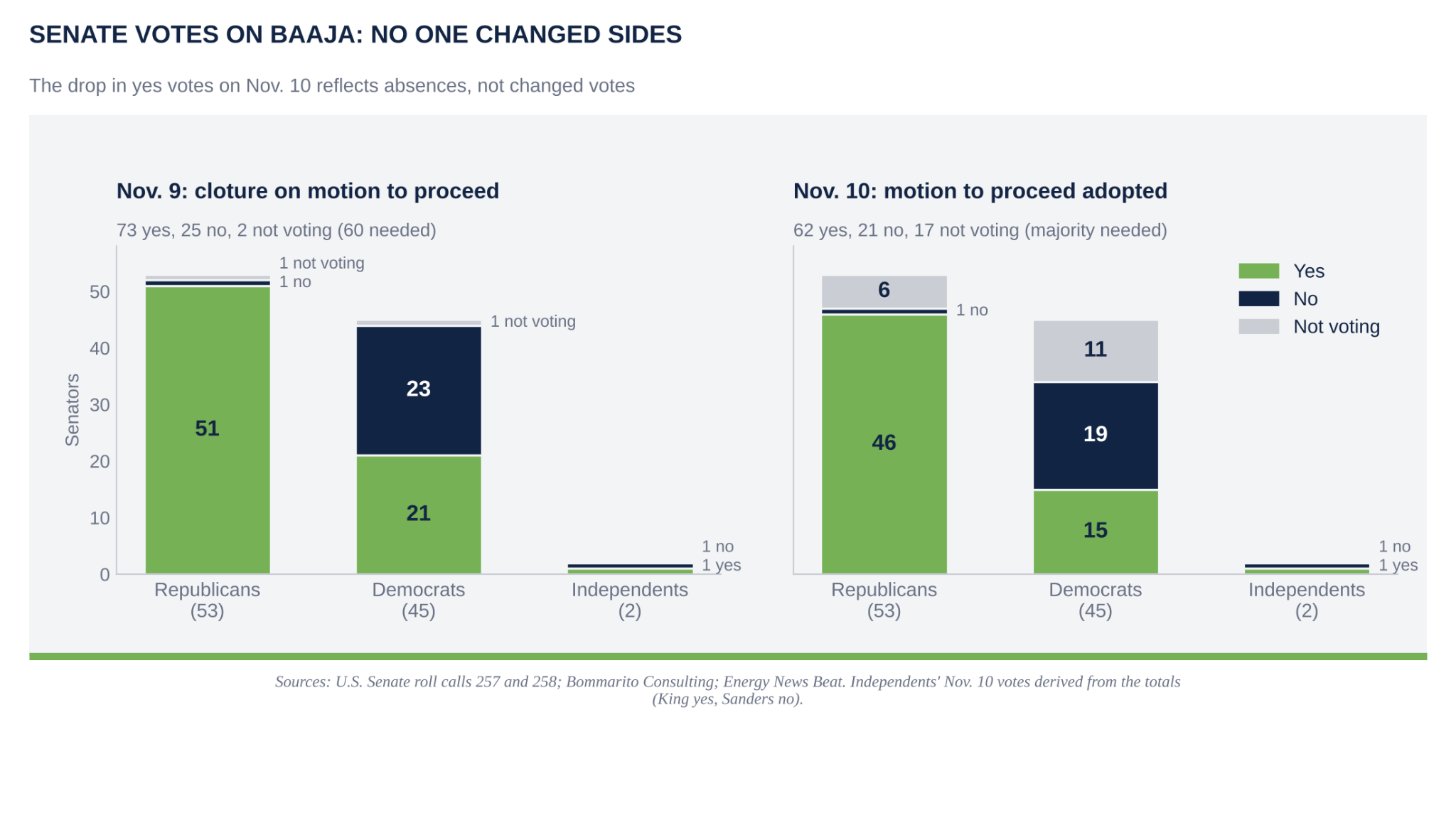
On November 11, Majority Leader John Thune of South Dakota filed cloture, a request to end debate, on the substitute amendment containing BAAJA and on the unrelated tax bill it is attached to, each of which needs 60 votes. A final Senate vote is expected the week of November 16 after the amendment process. For BAAJA to become law, the House must then pass the same text and President Trump must sign it before the 119th Congress ends on January 3.
What’s Driving the Odds
There are four main factors that shape the odds of this bill’s passage: the Democrats’ incentive to wait and their split over the best course of action, the amendment process, the calendar, and the White House.
The first factor is the Democrats’ incentive to wait. After the midterms, House Minority Leader Hakeem Jeffries of New York said the bill falls short on environmental and tribal protections, Rep. Jared Huffman of California wants a hearing and amendments to the bill, and TD Cowen has argued that the election has emboldened those in the party who want to pass a more party-line, renewable-focused bill in 2027. However, others in the party, such as Reps. Sharice Davids of Kansas and Nikki Budzinski of Illinois, have said the cost relief of the bill should not wait.
The amendment process could also prove lengthy, as several Democratic senators have said their votes to advance the bill are not votes to pass it. Senate Minority Leader Chuck Schumer of New York has said he has outstanding concerns he will pursue through amendments, while Sens. Catherine Cortez Masto of Nevada, Brian Schatz of Hawaii, and Republican Lisa Murkowski of Alaska have stated they want additional protections for tribal nations. Additionally, Speaker Mike Johnson of Louisiana expects the House to pass the Senate’s version, but analysts at the investment firm Jefferies say Republican House support for the bill is uncertain, and conservative critics such as former FERC Chairman Mark Christie have objected to the bill’s expansion of FERC’s transmission authority.
Third, the calendar is expected to be packed as there remains a Dec. 11 funding deadline, and Republicans will try to pass the defense authorization bill, the farm bill, and nominations while they still retain a federal trifecta. Finally, President Trump has endorsed the bill but said he will not approve wind turbines, while Sen. Sheldon Whitehouse of Rhode Island, a co-author of the bill, has said progress on wind turbine approval is needed before final passage.
Why Forecasts Disagree
Forecasts have varied widely since the midterms. Right after the election, TD Cowen cut its odds of lame-duck passage from about 40% to around 25%, and Rapidan Energy Group reportedly put it at 20-25%, both pointing to the Democratic sweep. A lobbyist told The Hill they would give passage “50-50, and that might be generous.” After the Senate’s 73-vote procedural win, analysts at the investment firm Jefferies said Senate passage is possible but enactment is unlikely without a clear House strategy. Kalshi’s market on the bill becoming law before 2027 has been volatile, falling to the teens after the election, rebounding to a 2 in 3 chance on Nov. 9, before easing to 55% as of November 13. Most likely, the gaps come from timing and method, as the analyst estimates came right after the election, before the Senate vote and Speaker Johnson’s comments, while Kalshi is a thinly traded market that reacts quickly to news.
Scenarios and Expected Outcomes
We expect enactment by the end of 2026 since the 73-25 cloture vote leaves 13 votes of cushion above the 60 needed. That means the Senate can absorb some Democratic defections on final passage, including Cortez Masto if the National Historic Preservation Act provisions stay in. Removing the four senators who have expressed concerns would still leave 69 votes. Considering this, Trump’s endorsement of the bill, and Speaker Johnson’s statement that Republicans have the votes in the House if the Senate passes it, we expect it to pass. The risks remain the packed calendar, amendments that could cost Republican votes, and Trump’s stance against wind. We remain slightly more confident than the market, but this remains a coin flip due to the House.
| Scenario | Outcome for Call | Senate final vote | House | Driver |
|---|---|---|---|---|
| Base (our call): Signed this year | Passes | Clears 60 after amendments | Johnson brings it up and it passes | Amendments satisfy Senate holdouts and Jeffries accepts it |
| Senate passes, House stalls | Fails | Clears 60 | No vote before Jan. 3, or fails | House Democratic leaders resist and the funding fight drains floor time |
| Dies in the Senate, restarts in 2027 | Fails | Falls short of 60 or expires | Never reached | Democrats bet on a better deal with new majorities following midterms. |
If It Passes: What It Could Mean for Renewables
BAAJA would help renewables chiefly by making projects faster and more certain to build, but not necessarily by making them cheaper. Columbia’s Center on Global Energy Policy described BAAJA as a fundamental “speed-and-certainty” bill, which makes the bill’s benefits contingent on implementation and slow to show up. Sen. Whitehouse, a co-author, claims the bill could raise wind capacity by 25%, solar by 28%, and energy storage by 70%. These are sponsors’ figures and warrant skepticism. Independent estimates are more measured. Rhodium Group’s best case adds 200 gigawatts of new clean energy by 2040, while in its worst case emissions stay flat. In every scenario, the concrete effects would take years to appear.
Regarding transmission, it is the most consequential channel, because renewable projects tend to be sited far from the cities and data centers that consume their power. Foley Hoag calls transmission arguably the backbone of the bill, and the reforms address the main ways new lines have been held up. Additionally, all planning regions must use common input assumptions and models, with regional and interregional plans due within two years of enactment and updated at least every four years. C2ES/Greenline modeling of four regions serving about 54% of U.S. demand, cited by Foley Hoag, projects about $7 billion in net delivery-cost savings by 2035, about $1.1 billion in residential bill savings, and nearly 40 GW of added interregional transmission capacity. Two nuances to mention: ERCOT is excluded, and an expanded authority is only as effective as a FERC willing to use it.
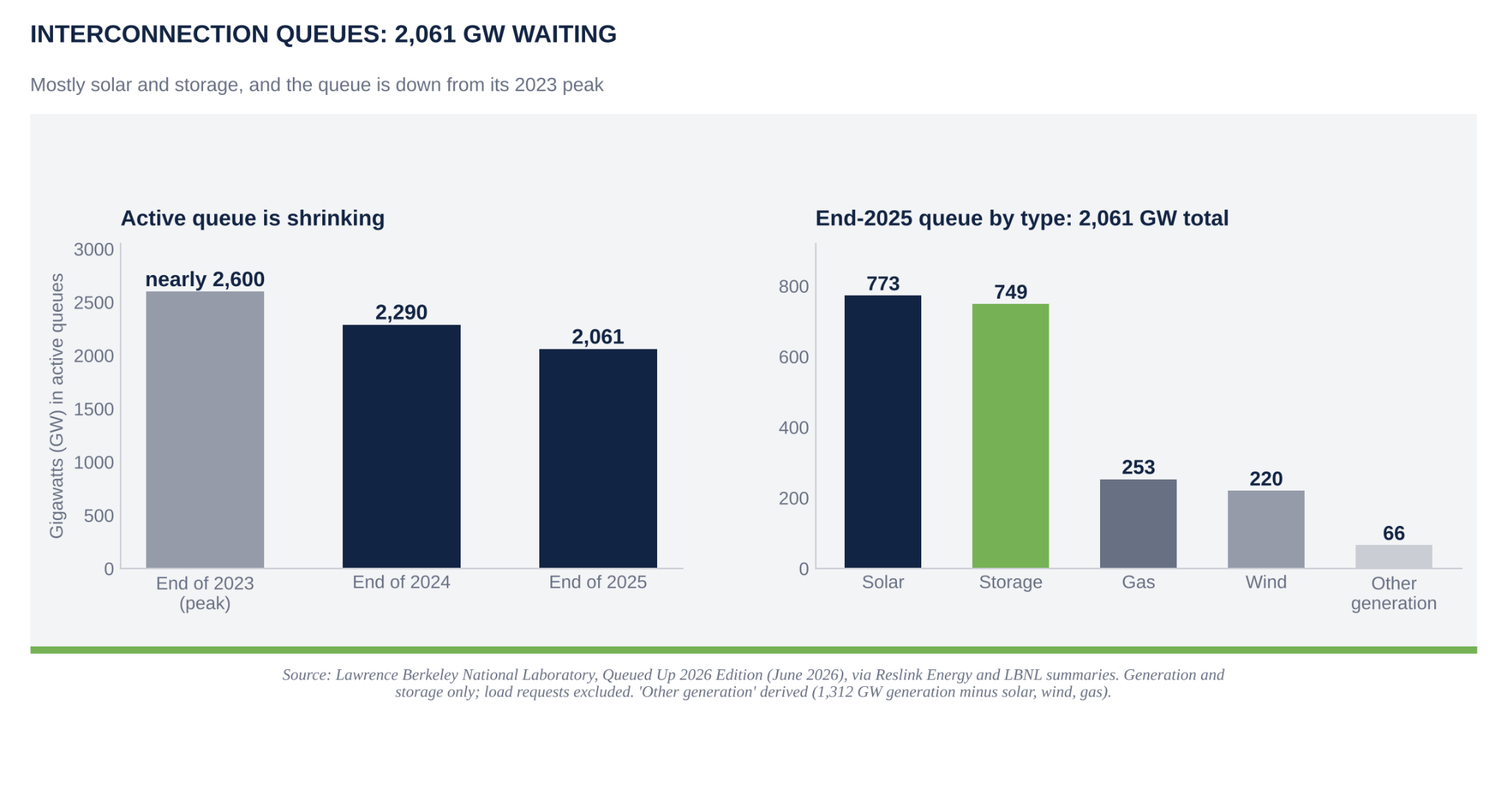
Regarding interconnection, the interconnection queue is where the gap between proposed and built renewables is widest. Some 2,061 GW of generation and storage capacity is actively seeking grid interconnection, down approximately 10% from 2024, and the median project built in 2025 took 61 months from interconnection request to commercial operation, compared with 36 months in 2015 and 22 months in 2008. Moreover, gas capacity in queue rose 86% year over year to 253 GW, while solar, storage and wind all declined. BAAJA therefore directly addresses the queue’s structural flaws. Regions must plan generation and transmission together over a 20-year horizon and publish interconnection locations, each with an upfront, fixed cost. We would treat any improvement in the queue as a positive sign that the bill is working, rather than an expected result from the get-go.
Storage is where the bill’s benefits are most direct. Adding energy storage at or near an existing transmission or distribution facility would be excluded from NEPA review and from Section 106 of the National Historic Preservation Act. Section 2108 would require grid operators to admit qualifying aggregations into their wholesale markets within 18 months.
Wind is the riskiest class. Trump has backed the bill but said he will not approve wind turbines, and Democrats are still waiting for assurances that the White House will lift its blockade on wind permits.
If It Fails
If the bill expires without a resolution, it would have to be reintroduced, but would restart on more favorable grounds for the recently encouraged Democrats. The open question is whether a more ambitious bill ends up a better bill or no bill at all. An important fact to note is that the new majorities following the midterms are still not enough to clear the 60-vote threshold necessary, and would still require President Trump’s signature, pointing towards the idea that the current deal is the best-case scenario for Senate Democrats. For operators within renewable energy, a delay would mean a stall and longer wait for prior benefits instead of an outright loss.
What Would Change Our Call
Given the uncertainty related to the passing of the bill and the unstable political climate, several developments would raise our projected odds of passage. An upcoming event to keep a close eye on is the Senate final vote the week of November 16. A tally close to the current cloture would convey that Democratic support survived even the midterm landslide, increasing odds of passing significantly. A second point to monitor is Representative Jeffries’ behavior when it reaches the House. If Jeffries declines to whip against the bill, that would point toward approval, as would the establishment of a firm voting date ahead of the Dec. 11 funding deadline.
Conversely, our projected passing odds would be lowered if the final Senate vote slips toward 60. Additionally, a statement from Jeffries siding with Huffman would significantly increase the likelihood that the bill would stall in the House. Amendments that further increase the asks of Republicans would increase downward pressure on the current equilibrium of votes on cloture, although these seem unlikely at the moment given the blue tide seen in the midterms.
Conclusion
To conclude, we expect BAAJA to become law by December 31, 2026, with about 71 senators voting yes on final passage. The gains would arrive through transmission, interconnection, and storage over several years, not through any near-term drop in project costs. If the bill fails, Democrats will likely try to write a more renewables-focused version in 2027, but that path carries its own risk. It would need to face a Republican-held White House, and in the meantime, renewable developers would keep facing the same queues and bottlenecks.