Air Cargo Rates Are Set to Fall Below Pre-War Levels
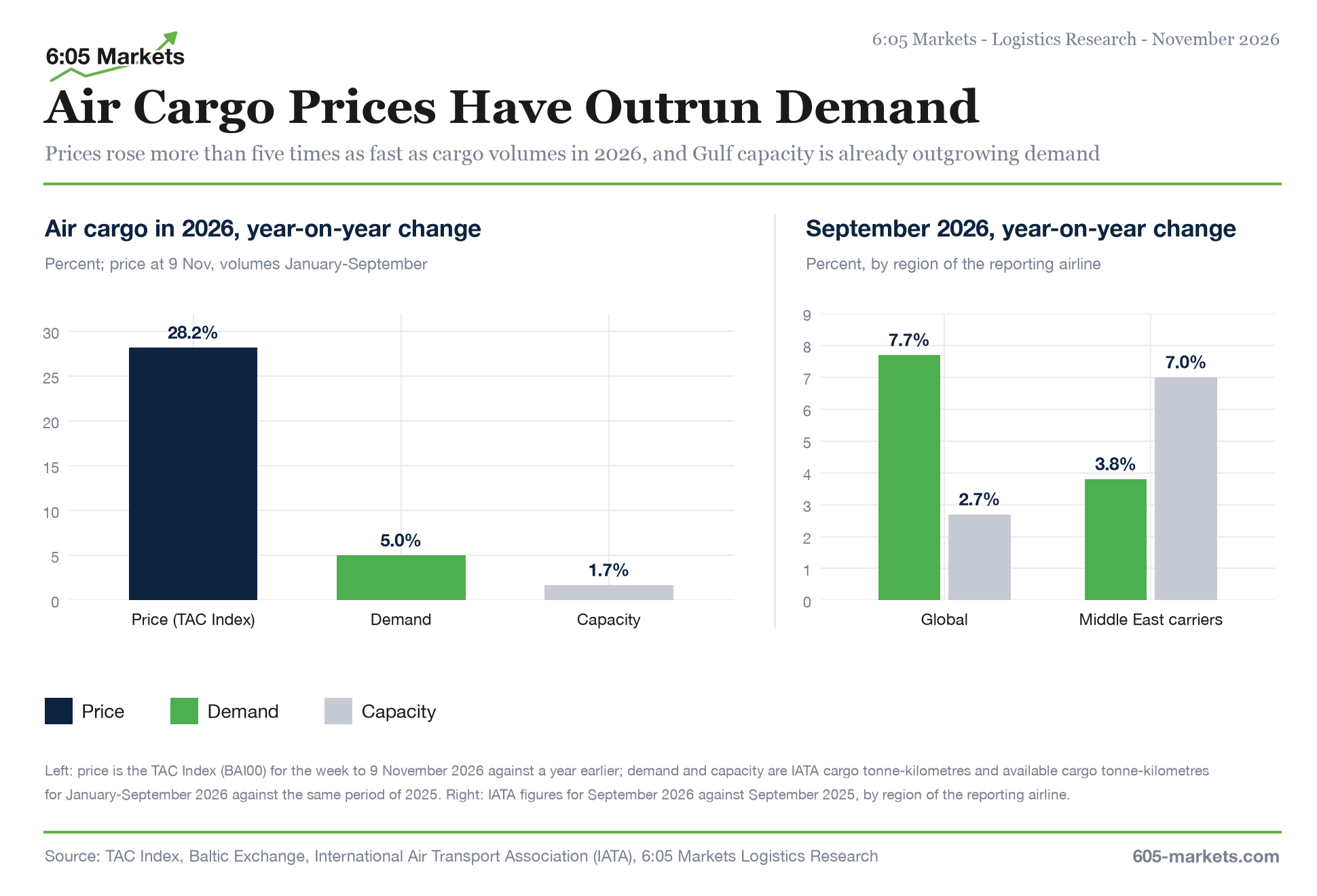
Air cargo’s 2026 rally has been driven by costs and tight capacity, not by stronger underlying demand. Prices rose 28% year on year while demand grew about 5%.
Executive Summary
Air cargo’s 2026 rally has been driven by costs and tight capacity, not by stronger underlying demand. Prices rose 28% year on year while demand grew about 5%. This discrepancy paired with the transitioning of Chinese e-commerce towards localized logistics away from air cargo as well as overextended capacity to satisfy current demand will push rates below what we’ve seen before. Although there is no purchasable index that tracks air cargo rates one-to-one, we recommend a short on Expeditors International (NYSE: EXPD), a freight forwarder that books space on planes and resells it to forwarders. Their earnings have historically been highly correlated with air freight prices. Currently the stock sits at $194.80 on November 15th, 2026. We expect the stock to be at or below $170 by September 30th, 2027.
Risks and Mitigants
Our thesis relies on the assumption that the Strait of Hormuz will clear up and jet fuel prices will revert to pre-war norms. Although there have been talks of ceasefire between the US and Iran, none have manifested itself in any tangible capacity. The total traffic through the Strait still remains at around 10% of pre-war levels, down from 28% in the June rebound. If global oil supply remains in the Strait, our catalysts will only be a secondary factor on the price of air cargo. Instead, the rates will be propped up by the continued elevated jet fuel pricing.
Another key mitigant to our thesis is the continuous demand for AI hardware. Although the AI fever has calmed from the mania we experienced just a few months ago, many of the largest companies in the world still seek to build up their AI infrastructure as fast as possible. If now, that demand skyrockets farther than we’ve already seen, air cargo demand will make a jump and our expectation for air cargo rates will take a hit.
Capacity Growth
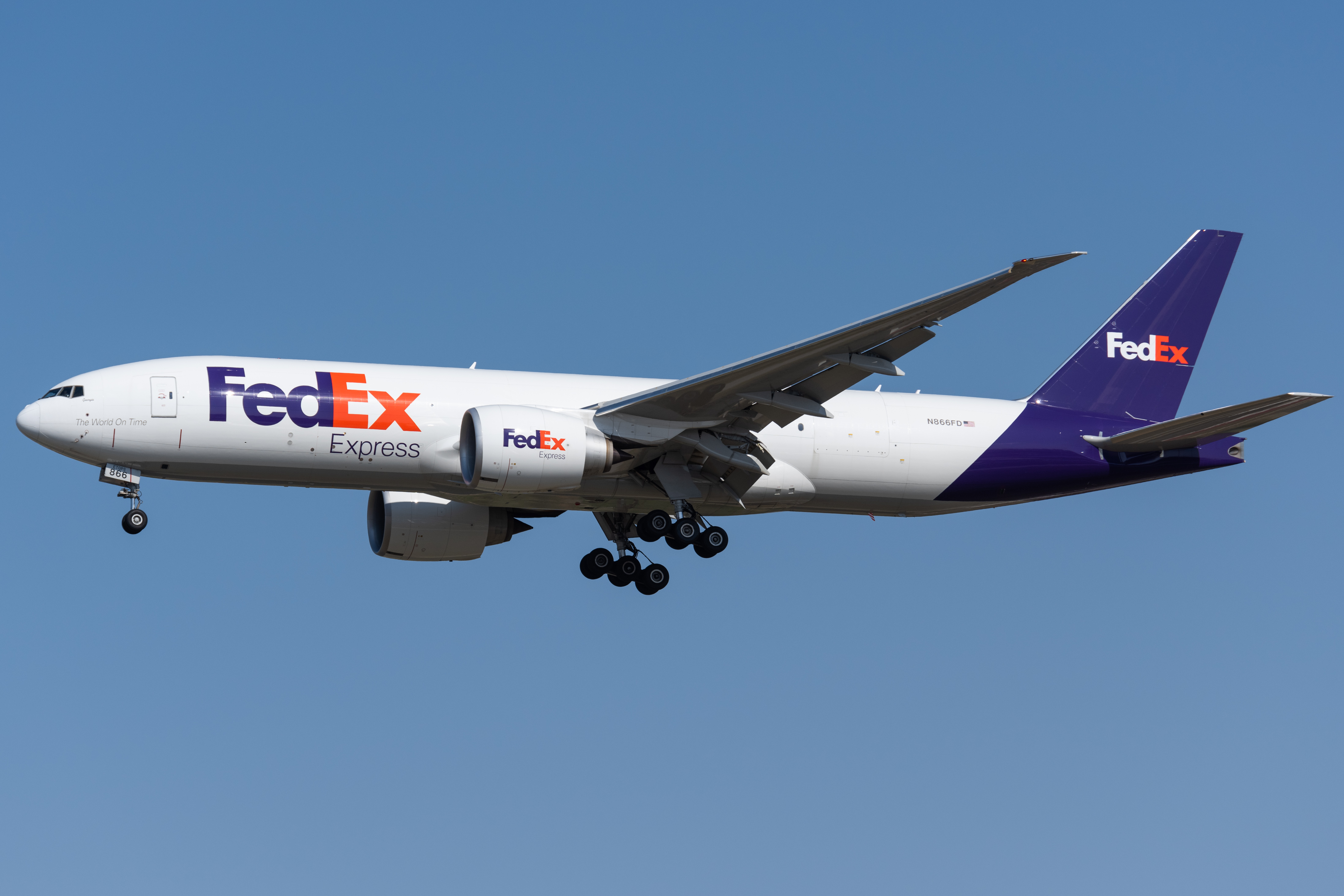
Air freight capacity has grown significantly since before the war. According to the International Air Transport Association (IATA), Middle East carrier capacity has grown 7% from September of last year and global capacity has grown 2.7%. Moreover, STAT Times projects a further 7% capacity growth in 2027. Given the current accelerated demands for air cargo, companies are in a sort of arms race to build up capacity. The Boeing 777F is the most widely used freight dedicated plane, making up 40% of air freight capacity. Of which, Boeing expects to deliver 20 more within 9 months. This marks an additional 8% growth in 777F capacity which returns approximately 3% total freight growth. In addition, AerCap and IAI are also converting regular 777s to freight versions. The companies have delivered over a dozen already, and expect more on the way.
When the Strait reopens and fuel costs begin to recover, total nominal air cargo capacity is set to be far greater than prewar volume. This metric taken alone will inevitably lead air cargo rates lower than those found before the war. Furthermore, the supply shock from freight cargo under new passenger planes can also be considered when judging the global air capacity growth.
Demand Growth
According to the same IATA we referenced earlier, global demand for air cargo has risen about 5% from January to September and projects a further 3.5% jump in 2027. At face value, these figures would push air cargo rates up, and they have thus far. However, these figures appear to be propped up by temporary distortions where shipping providers are left to look for alternatives. Where other land-freight and substitutional maritime-freight routes can be complex and hard to come by, air cargo remains the most reliable method of getting products to customers. Moreover, the confidence lost in traditional maritime shipping routes appears to be coming back to providers. Ships are beginning to return to the Suez, traffic in the route increasing from 8% at its lowest to 36% of total capacity today. As temporary transitioning between maritime shipping to air freight begins to revert, we will see demand drop significantly.
Chinese E-Commerce
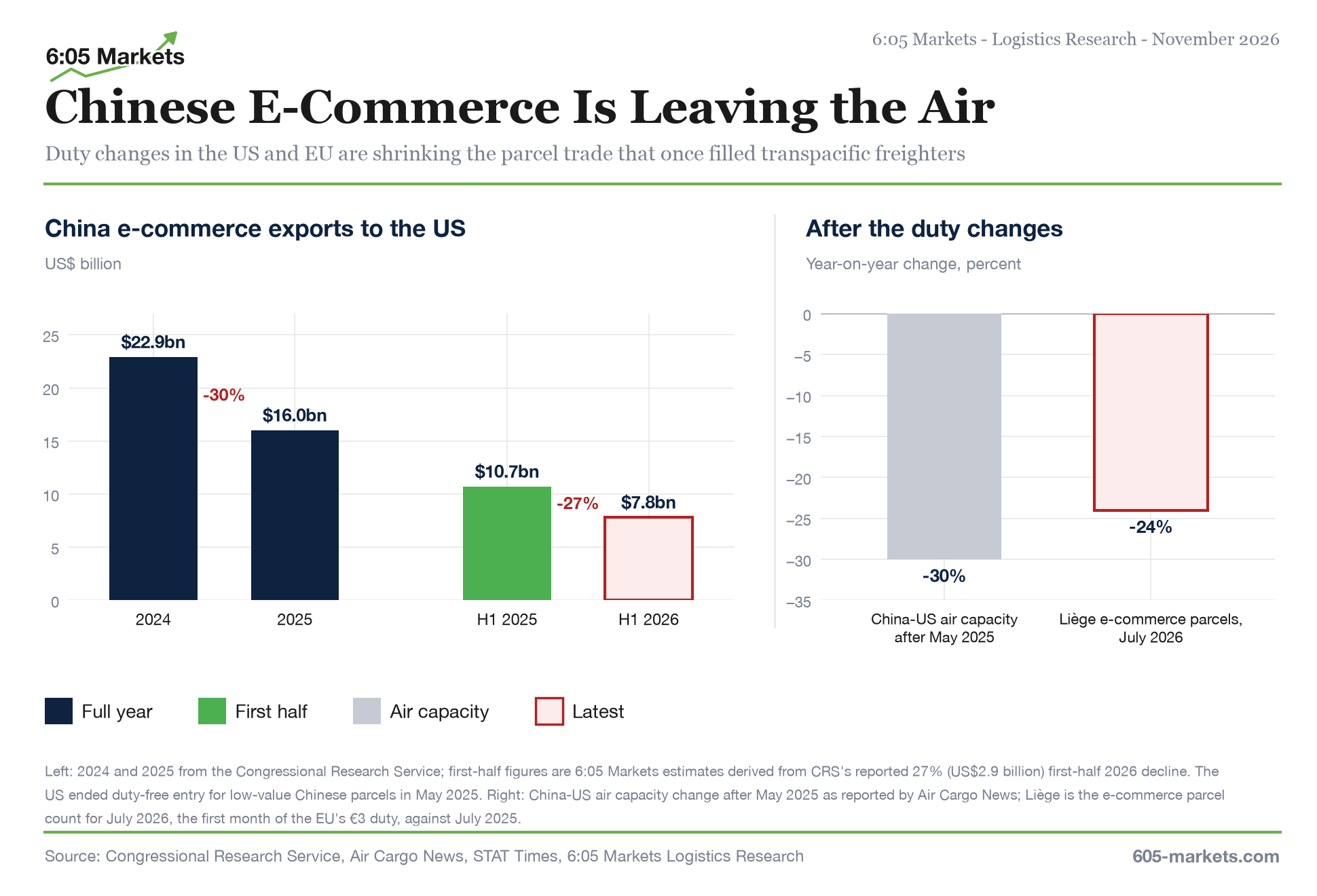
Before the war began, there was a surge of small-package exports from Chinese e-commerce brands like Shein, Temu, and AliExpress. In 2024, experts estimated cargo of this specific class made up to 50% of transpacific air cargo and 18-22% of all long-haul cargo, a key component of air freight traffic. However in May of 2025, Trump’s war on trade ended duty free exemptions on Chinese imports. Whereas before the policy, small-packages like the ones commonly exported by Chinese e-commerce firms entered the country duty free, falling under the low value threshold. From 2024 to 2025, Chinese e-commerce exports fell from $22.9B to $16B in 2025. In the first half of 2026 they fell a further 27%, although we cannot reasonably consider the new tariff policies as the only factor for that drop. This exodus is not particular to the US either. After the EU implemented a €3 duty on low-value parcels, e-commerce parcels at Liège, a major European e-commerce hub, fell 24%.
Although the tariffs may only be temporary, the changes may be leading Chinese e-commerce more permanently away from air cargo. According to Supply Chain Dive, Temu’s owner PDD is investing in local fulfillment and adjusting its supply chain to limit the impact of EU duties, repeating what it did in the US. Investing in local warehouses creates an avenue for greater reliance on ocean freight to get their goods to the customer. Once there exists a mechanism of storage away from the manufacturer and closer to the customer, the more expensive, direct air shipping becomes more or less obsolete.
Conclusion
We expect air cargo rates to fall below pre-war levels as fuel costs normalize, capacity expands, and some shipments return to ocean freight. Chinese e-commerce firms’ investment in local fulfillment could reinforce this shift by reducing reliance on direct air shipments. Our forecast remains conditional on restored flows through the Strait of Hormuz and an easing of wider transport disruptions. Under that scenario, we expect pressure on Expeditors’ airfreight profitability and forecast a share price of $170 or below by September 30, 2027. Prolonged disruption or stronger-than-expected demand for AI hardware would weaken this call.
Expeditors International (EXPD) shares will be at or below $170 on 30 September 2027.
Series Expeditors International (EXPD) share price Entry 194.80 Target at or below 170.00 By 30 Sep 2027 Written 15 Nov 2026
Resolves against Yahoo Finance ticker EXPD on the last observation on or before 30 Sep 2027. Not investment advice.